QUESTION IMAGE
Question
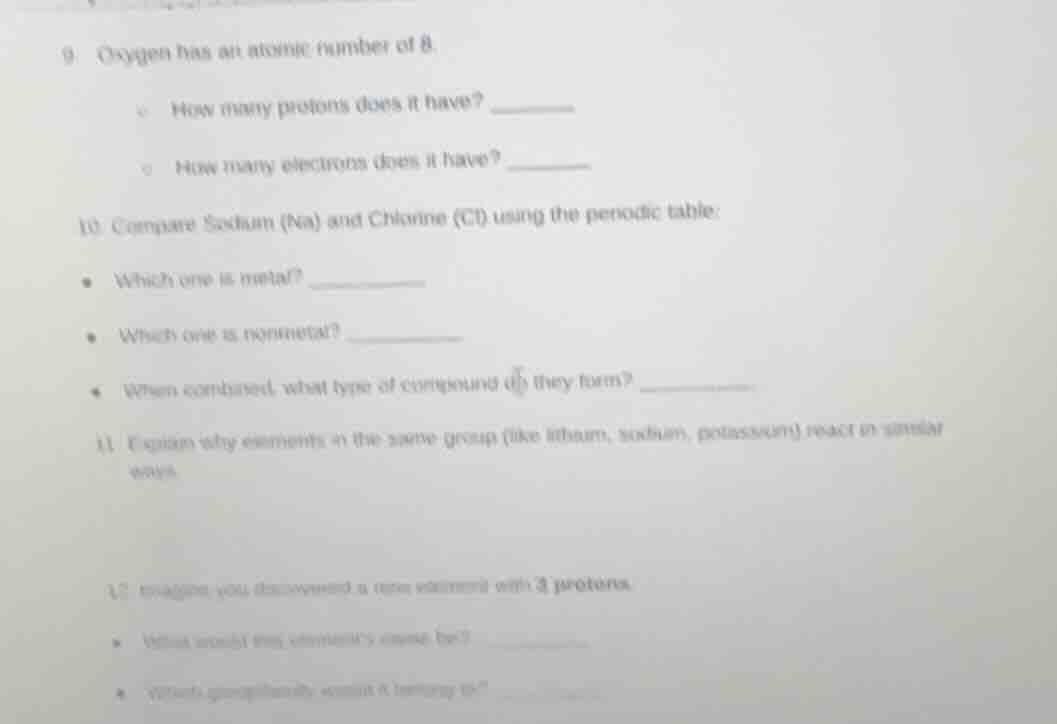
- oxygen has an atomic number of 8.
- how many protons does it have? ______
- how many electrons does it have? ______
- compare sodium (na) and chlorine (cl) using the periodic table:
- which one is metal? ______
- which one is nonmetal? ______
- when combined, what type of compound do they form? ______
- explain why elements in the same group (like lithium, sodium, potassium) react in similar ways.
- imagine you discovered a new element with 3 protons.
- what would the element’s name be? ______
- which group/family would it belong to? ______
Question 9
How many protons does oxygen have?
Step1: Recall the definition of atomic number
The atomic number of an element is equal to the number of protons in its nucleus.
Step2: Apply the atomic number of oxygen
Oxygen has an atomic number of 8, so the number of protons is equal to its atomic number.
Step1: Recall the neutral atom electron - proton relationship
In a neutral atom, the number of electrons is equal to the number of protons.
Step2: Use the number of protons of oxygen
We know from the previous part that oxygen has 8 protons, so a neutral oxygen atom will have 8 electrons.
Metals are elements that are generally good conductors of heat and electricity, are malleable and ductile, and are found on the left - hand side and in the middle of the periodic table. Sodium (Na) is in Group 1 (alkali metals) of the periodic table, and it exhibits metallic properties. Chlorine (Cl) is a non - metal.

Snap & solve any problem in the app
Get step-by-step solutions on Sovi AI
Photo-based solutions with guided steps
Explore more problems and detailed explanations
8