QUESTION IMAGE
Question
this is a 2 - page document!
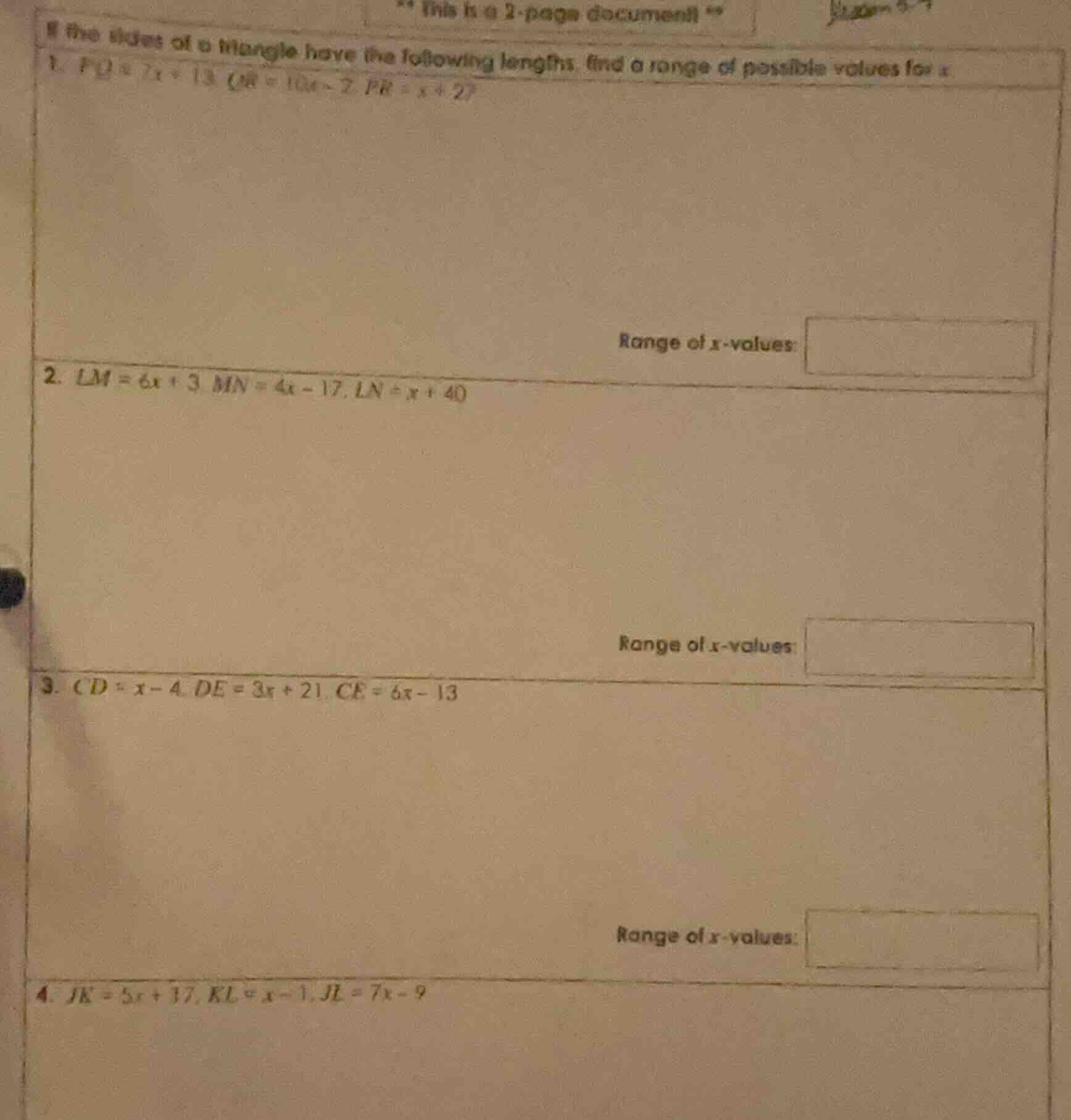
if the sides of a triangle have the following lengths, find a range of possible values for x
- ( pq = 2x + 13 ), ( qr = 10x - 2 ), ( pr = x + 27 )
range of x - values:
- ( lm = 6x + 3 ), ( mn = 4x - 17 ), ( ln = x + 40 )
range of x - values:
- ( cd = x - 4 ), ( de = 3x + 21 ), ( ce = 6x - 13 )
range of x - values:
- ( jk = 5x + 17 ), ( kl = x - 1 ), ( jl = 7x - 9 )
Problem 1: $PQ=2x+13$, $QR=10x-2$, $PR=x+27$
Step1: Apply Triangle Inequality 1
Sum of $PQ+QR>PR$
Step2: Apply Triangle Inequality 2
Sum of $PQ+PR>QR$
Step3: Apply Triangle Inequality 3
Sum of $QR+PR>PQ$
Step4: Take strictest bounds
The tightest constraints are $x>\frac{16}{11}$ and $x<6$.
---
Problem 2: $LM=6x+3$, $MN=4x-17$, $LN=x+40$
Step1: Ensure side lengths are positive
First, $MN=4x-17>0 \implies x>\frac{17}{4}$
Step2: Apply Triangle Inequality 1
Sum of $LM+MN>LN$
Step3: Apply Triangle Inequality 2
Sum of $LM+LN>MN$
Step4: Apply Triangle Inequality 3
Sum of $MN+LN>LM$
Step5: Take strictest bounds
The tightest constraints are $x>6$ and $x<20$.
---
Problem 3: $CD=x-4$, $DE=3x+21$, $CE=6x-13$
Step1: Ensure side lengths are positive
$CD=x-4>0 \implies x>4$; $CE=6x-13>0 \implies x>\frac{13}{6}$
Step2: Apply Triangle Inequality 1
Sum of $CD+DE>CE$
Step3: Apply Triangle Inequality 2
Sum of $CD+CE>DE$
Step4: Apply Triangle Inequality 3
Sum of $DE+CE>CD$
Step5: Take strictest bounds
The tightest constraints are $x>\frac{19}{2}$ and $x<15$.
---
Problem 4: $JK=5x+17$, $KL=x-1$, $JL=7x-9$
Step1: Ensure side lengths are positive
$KL=x-1>0 \implies x>1$; $JL=7x-9>0 \implies x>\frac{9}{7}$
Step2: Apply Triangle Inequality 1
Sum of $JK+KL>JL$
Step3: Apply Triangle Inequality 2
Sum of $JK+JL>KL$
Step4: Apply Triangle Inequality 3
Sum of $KL+JL>JK$
Step5: Take strictest bounds
The tightest constraints are $x>9$ and $x<25$.

Snap & solve any problem in the app
Get step-by-step solutions on Sovi AI
Photo-based solutions with guided steps
Explore more problems and detailed explanations
- $\frac{16}{11} < x < 6$
- $6 < x < 20$
- $\frac{19}{2} < x < 15$
- $9 < x < 25$