QUESTION IMAGE
Question
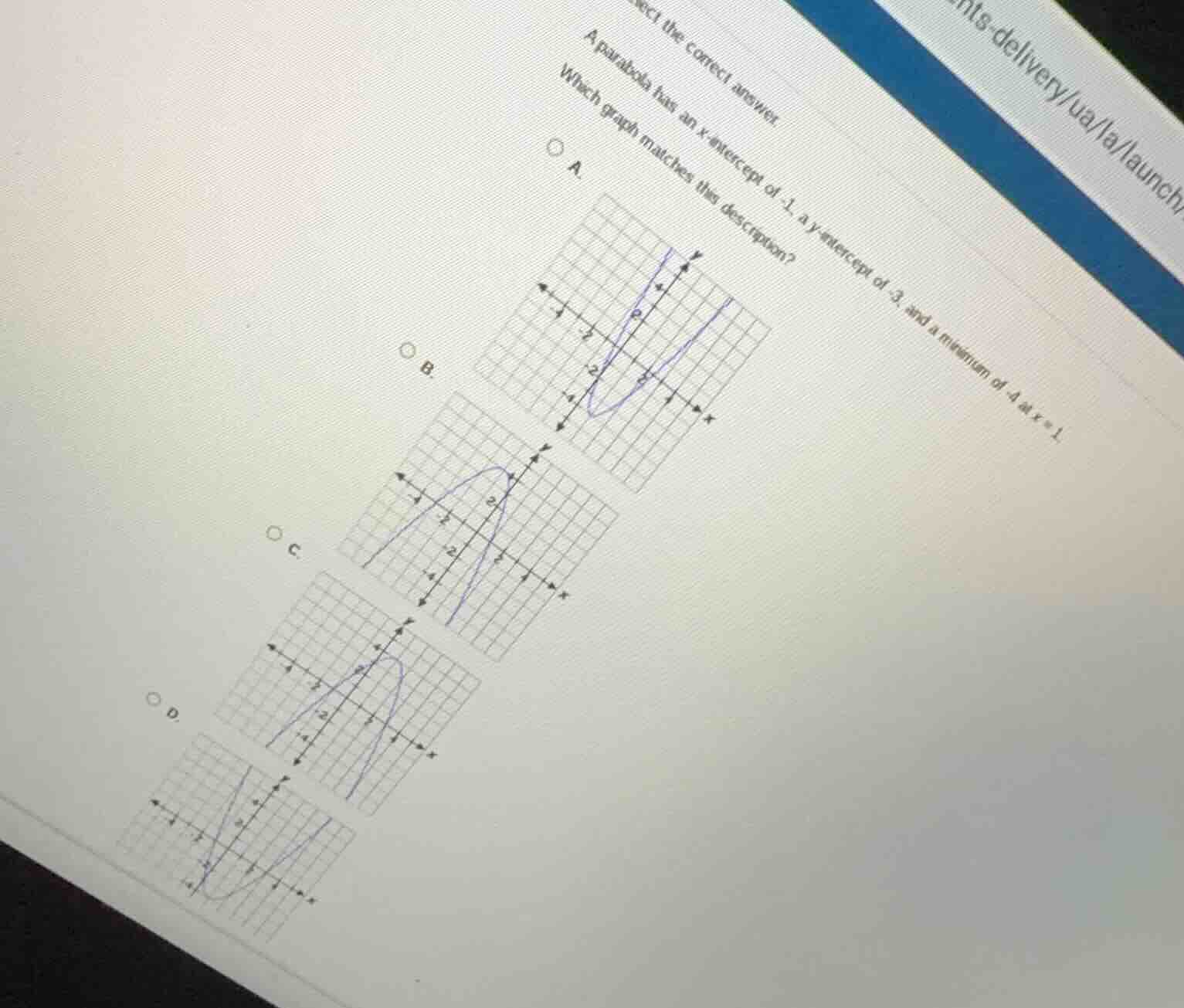
a parabola has an x - intercept of - 1, a y - intercept of - 3, and a minimum of - 4 at x = 1. which graph matches this description?
options:
a. graph of a parabola
b. graph of a parabola
c. graph of a parabola
d. graph of a parabola
Step1: Analyze the parabola's properties
The parabola has a minimum (so it opens upwards, since a minimum implies the coefficient of \(x^2\) is positive), an \(x\)-intercept of \(-1\) (so it crosses the \(x\)-axis at \(x = -1\)), a \(y\)-intercept of \(-3\) (crosses the \(y\)-axis at \(y = -3\)), and a minimum at \(x = 1\) (vertex at \(x = 1\), \(y = -4\) as the minimum value is \(-4\)).
Step2: Eliminate options based on direction
First, check the direction of the parabola. A minimum means it opens upwards (like a "U" shape). Option B and C open downwards (have a maximum), so we can eliminate B and C.
Step3: Check \(y\)-intercept
Now check the \(y\)-intercept. The \(y\)-intercept is \(-3\), meaning the graph crosses the \(y\)-axis at \((0, -3)\). Option A: Let's see the \(y\)-intercept. From the graph, when \(x = 0\), the \(y\)-value seems to be around... Wait, no, wait. Wait, the minimum is at \(x = 1\), \(y = -4\). Let's check the \(x\)-intercept. Option D: Wait, let's re - evaluate. Wait, the parabola has a minimum at \(x = 1\), so the vertex is at \((1, -4)\). Let's recall the vertex form of a parabola: \(y=a(x - h)^2 + k\), where \((h,k)\) is the vertex. Here, \(h = 1\), \(k=-4\), so \(y=a(x - 1)^2-4\). It has an \(x\)-intercept at \(x=-1\), so plug \(x=-1\), \(y = 0\) into the equation: \(0=a(-1 - 1)^2-4\), \(0 = 4a-4\), \(4a=4\), \(a = 1\). So the equation is \(y=(x - 1)^2-4=x^2-2x + 1-4=x^2-2x-3\). The \(y\)-intercept is when \(x = 0\), \(y=-3\). Now check the options:
- Option A: Let's see the \(y\)-intercept. If we look at the graph, when \(x = 0\), the \(y\)-value is not \(-3\) (it seems positive or different).
- Option D: Let's check the \(y\)-intercept. When \(x = 0\), \(y=(0 - 1)^2-4=1 - 4=-3\), which matches the \(y\)-intercept. Also, it opens upwards, has a minimum at \(x = 1\), and let's check the \(x\)-intercept. Set \(y = 0\): \(x^2-2x-3=0\), factoring: \((x - 3)(x+1)=0\), so \(x = 3\) or \(x=-1\), so \(x=-1\) is an \(x\)-intercept. Option A: Let's check its \(x\)-intercept. If we look at the graph, does it have an \(x\)-intercept at \(-1\)? Probably not. So the correct option should be D? Wait, wait, maybe I made a mistake earlier. Wait, the original problem's options: Let me re - check the images. Wait, the user's image: Option D's graph. Let's re - analyze. Wait, the minimum at \(x = 1\), \(y=-4\). Option D: Let's see the vertex. If the vertex is at \(x = 1\), \(y=-4\), and it opens upwards, \(y\)-intercept at \(-3\), \(x\)-intercept at \(-1\). So after eliminating B and C (downward opening), and checking \(y\)-intercept and \(x\)-intercept, the correct option is D? Wait, no, wait the initial analysis: Wait, the equation we derived is \(y=(x - 1)^2-4\), which has \(y\)-intercept \(-3\), \(x\)-intercept at \(x=-1\) and \(x = 3\), minimum at \(x = 1\), \(y=-4\). So the graph that matches is the one with vertex at \((1, -4)\), opening upwards, \(y\)-intercept at \(-3\), and \(x\)-intercept at \(-1\). So among the options, after eliminating B (downward, max), C (downward, max), A (wrong \(y\)-intercept or \(x\)-intercept), the correct one is D? Wait, maybe the correct option is D. Wait, but let's check again.
Wait, maybe I messed up the options. Let's re - check:
- Option A: Opens upwards, but \(y\)-intercept? Let's see, if \(x = 0\), what's \(y\)? If the vertex is at some point, but the \(y\)-intercept of A: looking at the graph, when \(x = 0\), the \(y\)-value is positive? No, maybe not. Wait, the \(y\)-intercept is \(-3\), so at \(x = 0\), \(y=-3\). So the graph should cross the \(y\)-axis at \((0,…

Snap & solve any problem in the app
Get step-by-step solutions on Sovi AI
Photo-based solutions with guided steps
Explore more problems and detailed explanations
D (assuming the option D's graph matches the derived properties: upward opening, vertex at \(x = 1\), \(y=-4\), \(y\)-intercept \(-3\), \(x\)-intercept at \(-1\))