QUESTION IMAGE
Question
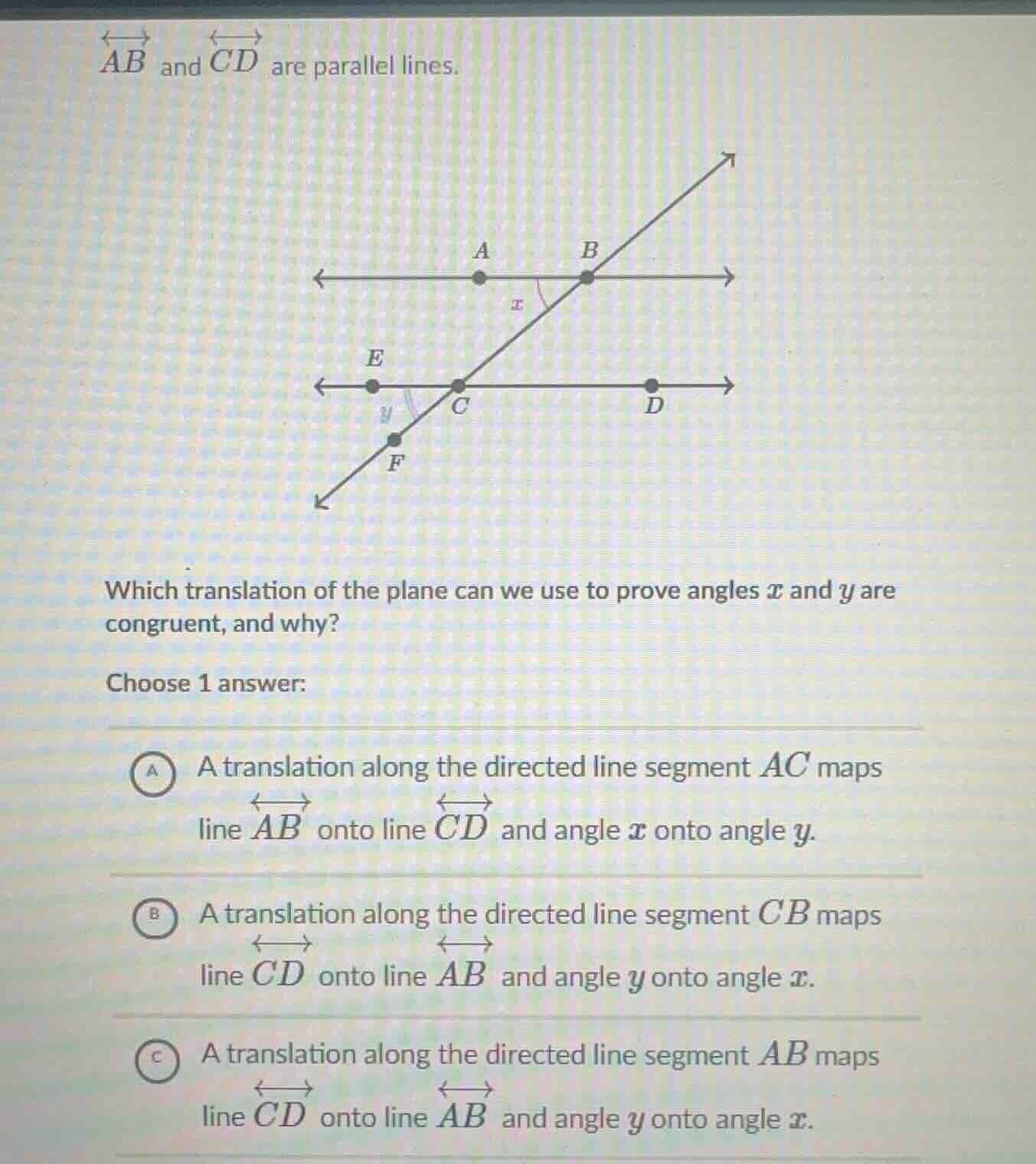
$\overleftrightarrow{ab}$ and $\overleftrightarrow{cd}$ are parallel lines.
which translation of the plane can we use to prove angles $x$ and $y$ are congruent, and why?
choose 1 answer:
a a translation along the directed line segment $ac$ maps line $\overleftrightarrow{ab}$ onto line $\overleftrightarrow{cd}$ and angle $x$ onto angle $y$.
b a translation along the directed line segment $cb$ maps line $\overleftrightarrow{cd}$ onto line $\overleftrightarrow{ab}$ and angle $y$ onto angle $x$.
c a translation along the directed line segment $ab$ maps line $\overleftrightarrow{cd}$ onto line $\overleftrightarrow{ab}$ and angle $y$ onto angle $x$.
To determine the correct translation, we analyze each option:
- Option A: A translation along \( \overrightarrow{AC} \) moves \( \overleftrightarrow{AB} \) (parallel to \( \overleftrightarrow{CD} \)) onto \( \overleftrightarrow{CD} \) because \( AB \parallel CD \) and \( AC \) connects corresponding points. This translation also maps angle \( x \) (at \( B \)) onto angle \( y \) (at \( C \)) since translations preserve angle measures and map corresponding angles formed by parallel lines and a transversal.
- Option B: A translation along \( \overrightarrow{CB} \) would move \( \overleftrightarrow{CD} \) towards \( \overleftrightarrow{AB} \), but \( CB \) is not the correct direction to map \( x \) to \( y \) as it does not align the angles formed by the transversal.
- Option C: A translation along \( \overrightarrow{AB} \) would move \( \overleftrightarrow{CD} \) horizontally, not aligning angle \( y \) with angle \( x \) since \( AB \) is parallel to \( CD \), but the transversal's angle correspondence requires a translation along \( AC \) (or similar connecting the two parallel lines and the transversal).

Snap & solve any problem in the app
Get step-by-step solutions on Sovi AI
Photo-based solutions with guided steps
Explore more problems and detailed explanations
A. A translation along the directed line segment \( AC \) maps line \( \overleftrightarrow{AB} \) onto line \( \overleftrightarrow{CD} \) and angle \( x \) onto angle \( y \).