QUESTION IMAGE
Question
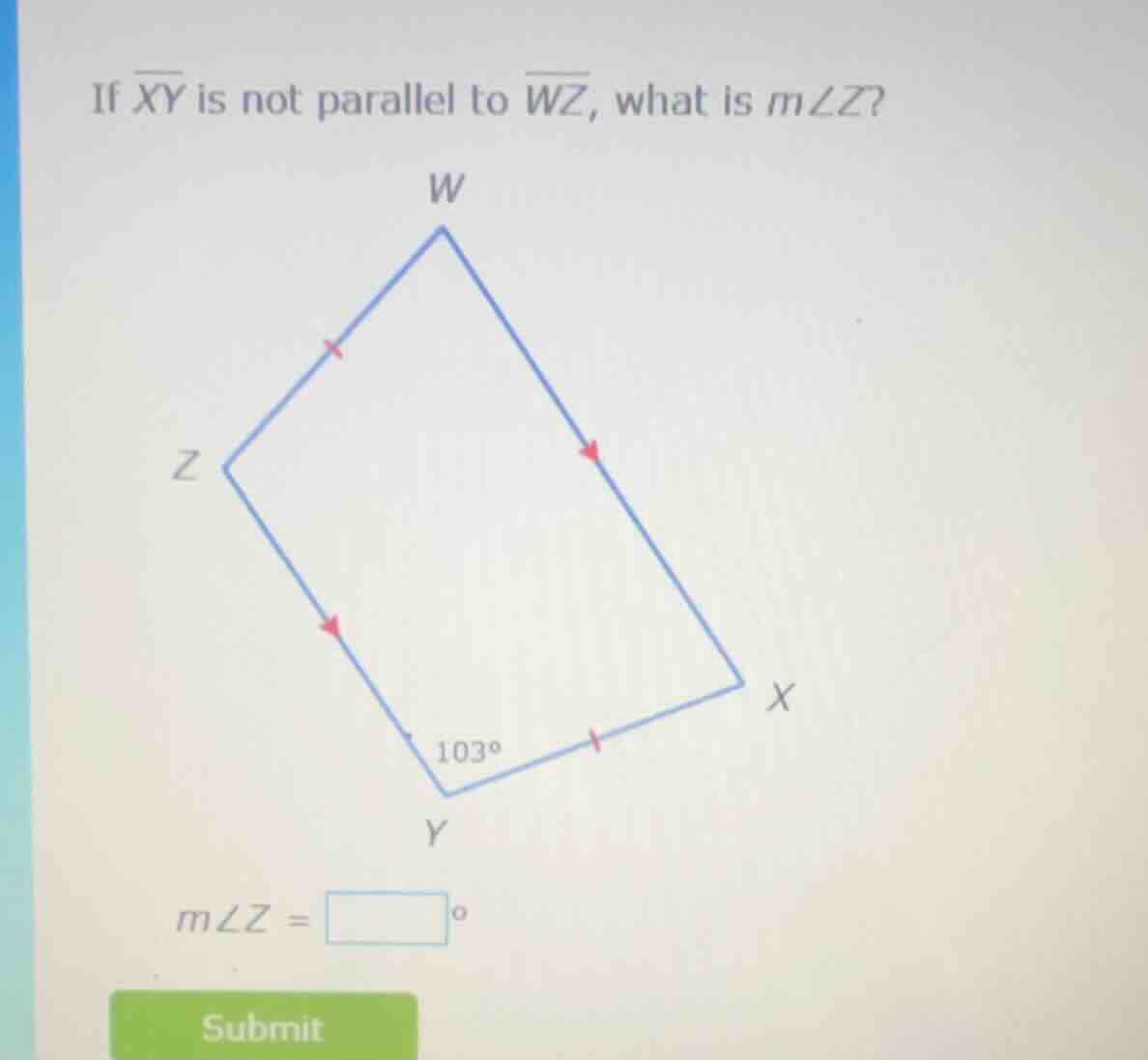
if \\(overline{xy}\\) is not parallel to \\(overline{wz}\\), what is \\(m\angle z\\)?
\\(m\angle z = \square^\circ\\)
Step1: Identify the polygon type
The figure has two pairs of adjacent sides equal (marked with ticks), so it's a kite. In a kite, one pair of opposite angles (between the unequal sides) are equal, and the sum of adjacent angles between the equal sides is \(180^\circ\)? Wait, no, in a kite, one pair of opposite angles (the ones between the unequal sides) are equal, and the other two angles (between the equal sides) are supplementary? Wait, actually, in a kite, one pair of opposite angles are equal, and the sum of the other two angles (the ones adjacent to the unequal sides) is \(180^\circ\)? Wait, no, let's recall: in a kite, two distinct pairs of adjacent sides are equal. The angles between the unequal sides are equal, and the sum of the angles between the equal sides: actually, in a kite, one pair of opposite angles (the ones that are between the unequal sides) are equal, and the other two angles (between the equal sides) are supplementary? Wait, no, let's look at the diagram. The sides: WZ and XY are marked with one tick, WX and ZY are marked with another tick? Wait, no, the diagram: WZ has one tick, ZY has one tick (arrow), WX has one tick (arrow), XY has one tick. Wait, maybe it's a kite with two pairs of adjacent equal sides: WZ = XY and WX = ZY? Wait, no, the markings: WZ has a red tick, ZY has a red arrow, WX has a red arrow, XY has a red tick. So WZ = XY (tick) and WX = ZY (arrow). So it's a kite with WZ = XY and WX = ZY. In a kite, one pair of opposite angles are equal, and the sum of the other two angles: actually, in a kite, the sum of the angles between the unequal sides? Wait, no, let's recall the properties of a kite. A kite has two distinct pairs of adjacent sides equal. One pair of opposite angles (the ones that are between the unequal sides) are equal. The diagonals are perpendicular, and one diagonal bisects the other. Also, in a kite, the sum of the measures of two angles that are between the unequal sides: wait, no, let's look at the given angle. Angle Y is \(103^\circ\). We need to find angle Z. In a kite, the angles between the equal sides: wait, WZ and ZY: WZ is equal to XY, ZY is equal to WX. So angle at Z and angle at X: no, wait, angle at Y is \(103^\circ\), angle at Z: in a kite, if two adjacent sides are equal (WZ and ZY? No, WZ and XY are equal, WX and ZY are equal. So the vertices are W, Z, Y, X. So sides: WZ, ZY, YX, XW. WZ = YX (tick), ZY = XW (arrow). So it's a kite with WZ = YX and ZY = XW. So the angles at Z and at X: no, angles at W and at Y? Wait, angle at Y is \(103^\circ\), angle at Z: in a kite, the sum of angle Y and angle Z: wait, no, in a kite, one pair of opposite angles are equal, and the other two angles are supplementary? Wait, no, let's think again. In a kite, the sum of the measures of two angles that are between the unequal sides: actually, in a kite, if you have two pairs of adjacent equal sides, then the angles between the equal sides (the ones that are not the equal angles) are supplementary. Wait, maybe I'm overcomplicating. Let's see: in a kite, one pair of opposite angles are equal, and the other two angles are supplementary. Wait, no, let's take a kite: two adjacent sides equal (AB = AD) and two adjacent sides equal (BC = DC). Then angle B and angle D are equal, and angle A + angle C = 180°. Wait, no, that's not right. Wait, in a kite with AB = AD and BC = DC, angle at B and angle at D: no, angle at A and angle at C: angle at A is between the two equal sides (AB and AD), angle at C is between the two equal sides (BC and DC). Then angle B and angle D are equal. And angle A +…

Snap & solve any problem in the app
Get step-by-step solutions on Sovi AI
Photo-based solutions with guided steps
Explore more problems and detailed explanations
\(77\)