QUESTION IMAGE
Question
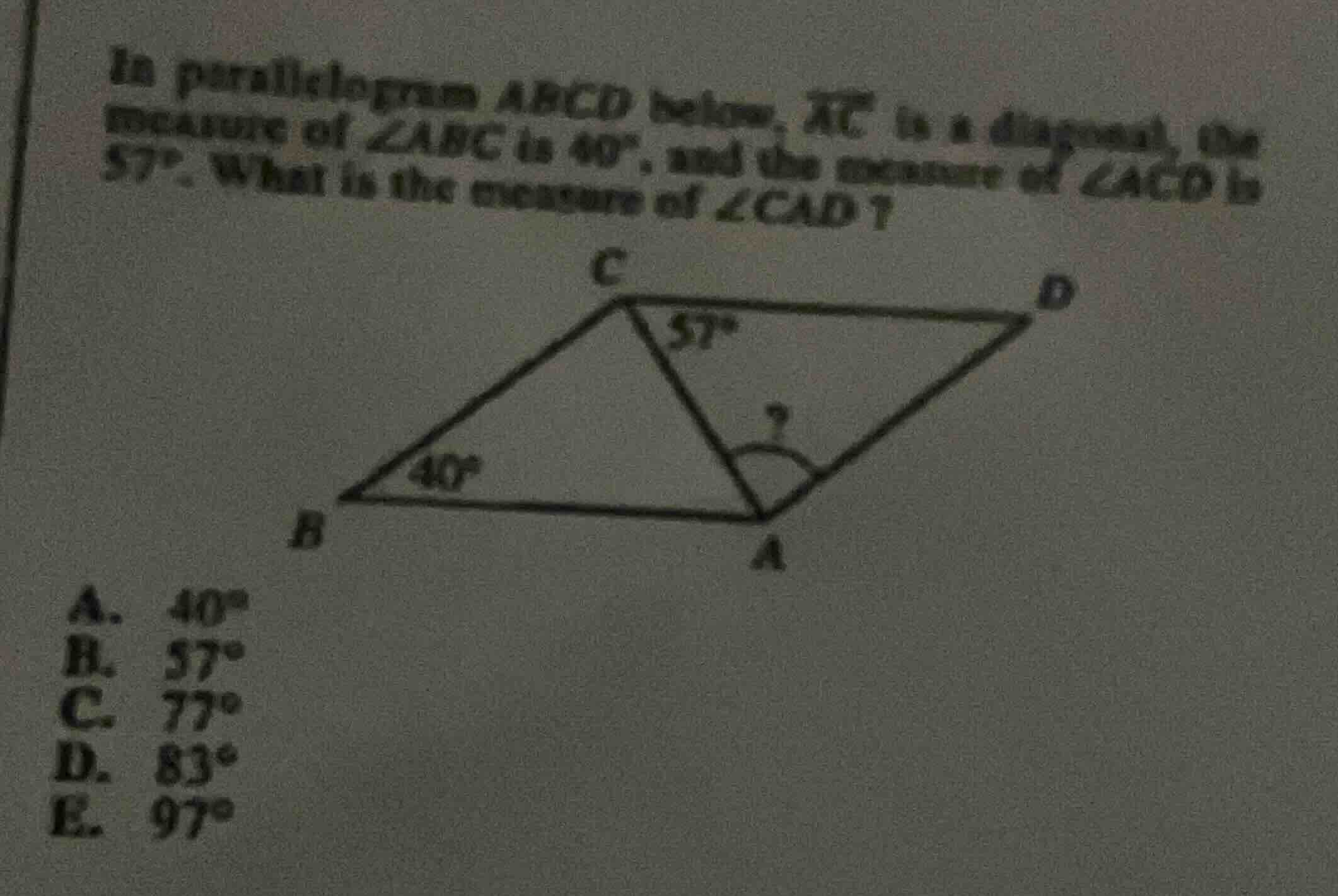
in parallelogram abcd below, ac is a diagonal, the measure of ∠abc is 40°, and the measure of ∠acd is 57°. what is the measure of ∠cad?
a. 40°
b. 57°
c. 77°
d. 83°
e. 97°
Step1: Recall properties of parallelograms
In a parallelogram, \(AB \parallel CD\) and \(AD \parallel BC\). Also, alternate interior angles are equal when two parallel lines are cut by a transversal.
Step2: Identify parallel lines and transversal
Since \(ABCD\) is a parallelogram, \(BC \parallel AD\) and \(AC\) is a transversal. So, \(\angle ACB=\angle CAD\) (alternate interior angles). Now, in \(\triangle ABC\), we know \(\angle ABC = 40^{\circ}\), and we can find \(\angle ACB\) using the fact that in \(\triangle ACD\), we know \(\angle ACD = 57^{\circ}\), but wait, actually, in parallelogram \(AB \parallel CD\), so \(\angle BAC=\angle ACD = 57^{\circ}\) (alternate interior angles). Then in \(\triangle ABC\), the sum of angles is \(180^{\circ}\), so \(\angle ACB=180^{\circ}-\angle ABC - \angle BAC=180 - 40 - 57 = 83^{\circ}\)? Wait, no, wait. Wait, the problem is about \(\angle CAD\). Let's re - examine.
Since \(ABCD\) is a parallelogram, \(AD\parallel BC\), so \(\angle CAD=\angle ACB\) (alternate interior angles). In \(\triangle ABC\), we know \(\angle ABC = 40^{\circ}\), and since \(AB\parallel CD\), \(\angle BAC=\angle ACD = 57^{\circ}\) (alternate interior angles). Then, in \(\triangle ABC\), the sum of angles is \(180^{\circ}\), so \(\angle ACB=180^{\circ}-\angle ABC-\angle BAC\).
Substitute \(\angle ABC = 40^{\circ}\) and \(\angle BAC = 57^{\circ}\) into the formula: \(\angle ACB=180 - 40 - 57=83^{\circ}\)? No, that's not right. Wait, maybe I mixed up the angles. Wait, the question is to find \(\angle CAD\). Let's use the property of parallelogram: \(AD\parallel BC\), so \(\angle CAD\) and \(\angle ACB\) are alternate interior angles. Also, in \(\triangle ABC\), we can find \(\angle ACB\) as follows:
Wait, the sum of angles in a triangle is \(180^{\circ}\). In \(\triangle ABC\), \(\angle ABC = 40^{\circ}\), \(\angle BAC\) is equal to \(\angle ACD = 57^{\circ}\) (because \(AB\parallel CD\) and \(AC\) is a transversal, alternate interior angles). So \(\angle ACB=180-(40 + 57)=83^{\circ}\)? No, that can't be. Wait, maybe the correct approach is:
In parallelogram \(ABCD\), \(AD\parallel BC\), so \(\angle CAD=\angle ACB\) (alternate interior angles). Also, in \(\triangle ABC\), we know \(\angle ABC = 40^{\circ}\), and we can find \(\angle ACB\) such that \(\angle ACB = 180^{\circ}-\angle ABC-\angle BAC\). But \(\angle BAC=\angle ACD = 57^{\circ}\) (since \(AB\parallel CD\), alternate interior angles). So \(\angle ACB=180 - 40 - 57 = 83^{\circ}\)? Wait, but let's check the answer options. Option D is \(83^{\circ}\). Wait, maybe I made a mistake earlier. Let's re - do:
- In parallelogram \(ABCD\), \(AB\parallel CD\), so \(\angle BAC=\angle ACD = 57^{\circ}\) (alternate interior angles).
- In \(\triangle ABC\), the sum of interior angles is \(180^{\circ}\). We know \(\angle ABC = 40^{\circ}\) and \(\angle BAC = 57^{\circ}\), so \(\angle ACB=180^{\circ}-\angle ABC-\angle BAC=180 - 40 - 57 = 83^{\circ}\).
- Since \(AD\parallel BC\) (property of parallelogram) and \(AC\) is a transversal, \(\angle CAD=\angle ACB\) (alternate interior angles). So \(\angle CAD = 83^{\circ}\).
Step3: Conclusion
So the measure of \(\angle CAD\) is \(83^{\circ}\), which corresponds to option D.

Snap & solve any problem in the app
Get step-by-step solutions on Sovi AI
Photo-based solutions with guided steps
Explore more problems and detailed explanations
D. \(83^{\circ}\)