QUESTION IMAGE
Question
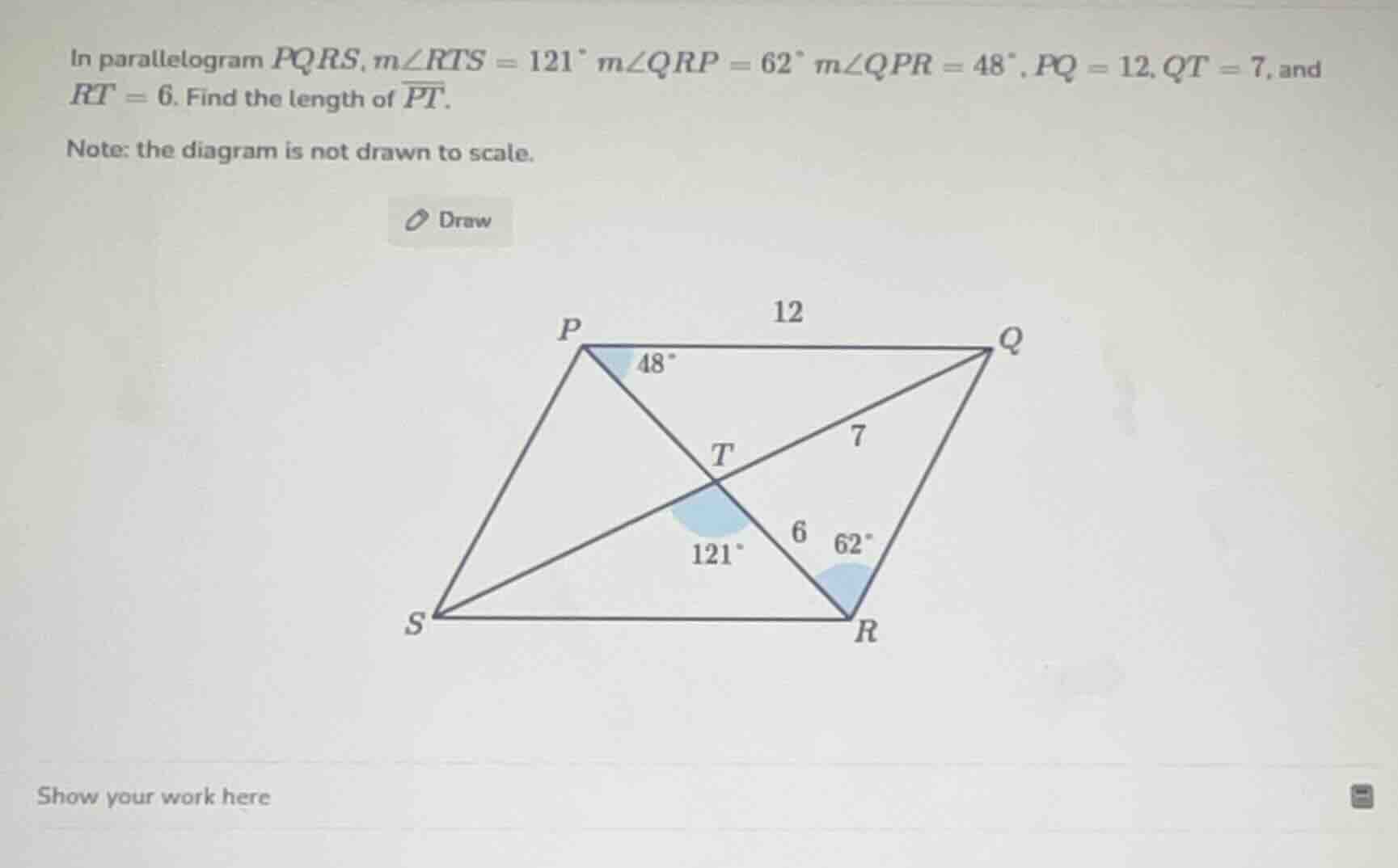
in parallelogram pqrs, ( mangle rts = 121^circ ), ( mangle qrp = 62^circ ), ( mangle qpr = 48^circ ), ( pq = 12 ), ( qt = 7 ), and ( rt = 6 ). find the length of ( overline{pt} ).
note: the diagram is not drawn to scale.
Step1: Identify Parallelogram Properties
In a parallelogram, opposite sides are parallel and equal, and the diagonals bisect each other? Wait, no, wait. Wait, actually, in a parallelogram, the diagonals bisect each other? Wait, no, let's check the angles. Wait, maybe we can use the Law of Sines or Law of Cosines? Wait, no, wait. Wait, first, let's look at the triangles. In parallelogram PQRS, PQ is parallel to SR, and PS is parallel to QR. Also, PQ = SR = 12, and PS = QR.
Wait, but maybe we can use the fact that in a parallelogram, the triangles formed by the diagonals: let's see, angle QPR is 48°, angle QRP is 62°, so in triangle PQR, the sum of angles is 180°, so angle PQR = 180 - 48 - 62 = 70°. But maybe that's not needed. Wait, but the key here is to find PT. Wait, maybe we can use the Law of Sines in triangles PTQ and RTS? Wait, no, wait. Wait, maybe the triangles PTQ and RTS are similar? Wait, no, because PQ is parallel to SR, so angle QPT is equal to angle SRT, and angle PQT is equal to angle RST. Wait, but maybe not. Wait, alternatively, maybe we can use the Law of Sines in triangle PQT and triangle RST? Wait, no, let's check the given lengths. QT is 7, RT is 6, PQ is 12. Wait, maybe we can use the Law of Sines in triangle PQT and triangle RST. Wait, but first, let's check the angles. Angle RTS is 121°, so angle PTQ is also 121° because they are vertical angles. So in triangle PTQ, we have angle at P: 48°, angle at T: 121°, so angle at Q: 180 - 48 - 121 = 11°? Wait, no, that can't be. Wait, no, angle QPR is 48°, which is angle at P in triangle PQR. Wait, maybe I made a mistake. Wait, let's re-examine.
Wait, the problem is to find PT. Let's look at triangles PTQ and RTS. Wait, PQ is parallel to SR, so angle QPT = angle SRT (alternate interior angles), and angle PQT = angle RST (alternate interior angles). Also, angle PTQ = angle RTS (vertical angles). So triangles PTQ and RTS are similar by AA similarity. Wait, is that true? Let's check: angle QPT = angle SRT (alternate interior angles, since PQ || SR and PR is a transversal), angle PTQ = angle RTS (vertical angles). So yes, triangle PTQ ~ triangle RTS by AA similarity.
Step2: Set Up Proportion for Similar Triangles
If triangle PTQ ~ triangle RTS, then the ratio of corresponding sides is equal. So PT/RT = QT/ST = PQ/SR. But PQ = SR = 12, so PQ/SR = 1, which means the triangles are congruent? Wait, no, that can't be, because QT is 7 and RT is 6. Wait, maybe I messed up the similarity. Wait, maybe it's triangle PTQ and triangle STR? Wait, no, let's label the points. PQRS is a parallelogram, so PQ || SR, and PR and QS are diagonals intersecting at T. Wait, no, in the diagram, the diagonals are PR and QS, intersecting at T. Wait, so PR is a diagonal with PT and RT, and QS is a diagonal with QT and ST. So in a parallelogram, diagonals bisect each other? Wait, no, that's only if it's a parallelogram, but wait, no—wait, in a parallelogram, diagonals bisect each other. Wait, that's a property of parallelograms: diagonals bisect each other. Wait, so PT = RT? No, that can't be, because RT is 6, but that would mean PT = 6, but that contradicts. Wait, no, maybe I was wrong. Wait, the property is that diagonals bisect each other, so PT = RT and QT = ST. But in the problem, RT is 6, QT is 7, which would mean PT = 6 and ST = 7, but that would mean the diagonals are not bisecting each other, which contradicts the parallelogram property. So my initial assumption is wrong. So the diagram must not have the diagonals bisecting each other, which means maybe PQRS is not a parallelogram? Wa…

Snap & solve any problem in the app
Get step-by-step solutions on Sovi AI
Photo-based solutions with guided steps
Explore more problems and detailed explanations
\( \boxed{6} \)