QUESTION IMAGE
Question
parallelograms assignment
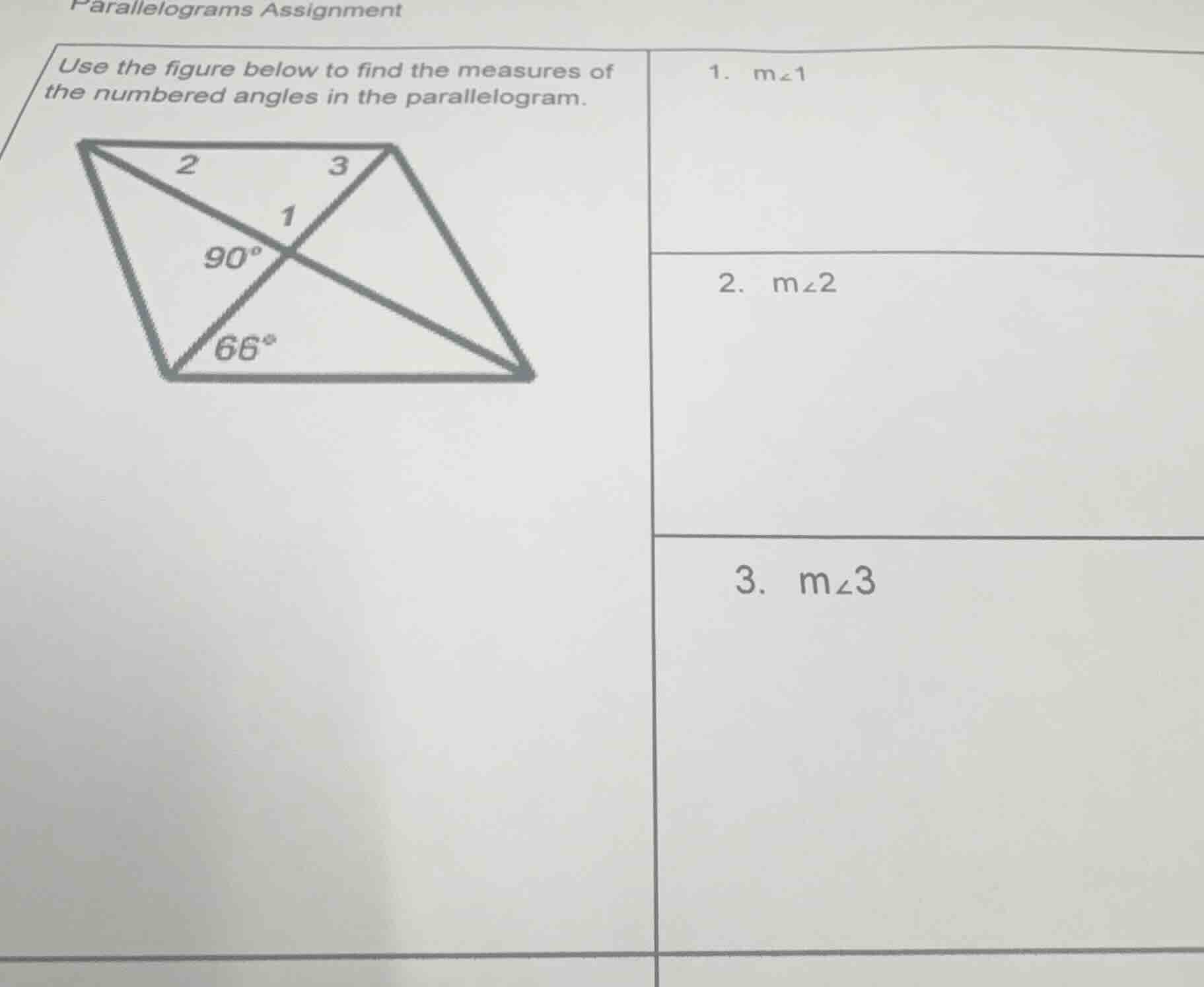
use the figure below to find the measures of
the numbered angles in the parallelogram.
- ( mangle1 )
- ( mangle2 )
- ( mangle3 )
1. Finding \( m\angle 1 \)
Step1: Identify vertical angles
Vertical angles are equal. The angle adjacent to \( 90^\circ \) and \( \angle 1 \) are vertical angles? Wait, no. Wait, in a parallelogram, the diagonals bisect each other, but here, looking at the figure, \( \angle 1 \) and the \( 90^\circ \) angle? Wait, no, actually, \( \angle 1 \) and the angle opposite to it? Wait, no, the lines are intersecting, so \( \angle 1 \) and the \( 90^\circ \) angle? Wait, no, when two lines intersect, vertical angles are equal. Wait, the angle given as \( 90^\circ \) and \( \angle 1 \): are they supplementary? Wait, no, maybe I misread. Wait, the figure shows two diagonals intersecting. Wait, actually, when two lines intersect, they form vertical angles and linear pairs. Wait, the angle labeled \( 90^\circ \) and \( \angle 1 \): are they adjacent? Wait, no, maybe \( \angle 1 \) is a straight angle? Wait, no, the sum of angles on a straight line is \( 180^\circ \). Wait, the angle next to \( 90^\circ \) is \( \angle 1 \)? Wait, no, the figure has a \( 90^\circ \) angle and \( \angle 1 \) formed by the intersection of the diagonals. Wait, actually, when two lines intersect, vertical angles are equal, and linear pairs are supplementary. Wait, maybe \( \angle 1 \) is a straight angle? No, that can't be. Wait, maybe the diagonals intersect at \( \angle 1 \), and one of the adjacent angles is \( 90^\circ \). Wait, no, the key here is that \( \angle 1 \) and the \( 90^\circ \) angle are supplementary? Wait, no, maybe I made a mistake. Wait, actually, in the figure, the two diagonals intersect, so \( \angle 1 \) and the \( 90^\circ \) angle are vertical angles? No, that doesn't make sense. Wait, maybe the angle labeled \( 90^\circ \) and \( \angle 1 \) are adjacent and form a linear pair. So \( m\angle 1 + 90^\circ = 180^\circ \)? Wait, no, that would make \( m\angle 1 = 90^\circ \), but that seems off. Wait, no, maybe the figure is a rhombus? Wait, in a rhombus, the diagonals are perpendicular? No, in a rhombus, the diagonals are perpendicular bisectors. Wait, but the angle given is \( 66^\circ \). Wait, maybe I need to re-examine. Wait, the problem is about a parallelogram. In a parallelogram, diagonals bisect each other, but they aren't necessarily perpendicular unless it's a rhombus. Wait, maybe the figure is a rhombus? Wait, the angle labeled \( 66^\circ \) is in one of the triangles. Wait, maybe \( \angle 1 \) is a right angle? No, that doesn't fit. Wait, maybe I made a mistake. Wait, let's start over.
Wait, the question is to find \( m\angle 1 \). Looking at the figure, the two diagonals intersect, forming \( \angle 1 \) and a \( 90^\circ \) angle. Wait, when two lines intersect, vertical angles are equal, and linear pairs are supplementary. So if one angle is \( 90^\circ \), then the vertical angle is also \( 90^\circ \), and the adjacent angles (linear pairs) are \( 90^\circ \) as well? Wait, no, that would mean the diagonals are perpendicular, so it's a rhombus. So \( \angle 1 = 90^\circ \)? Wait, no, that can't be. Wait, maybe the \( 90^\circ \) angle and \( \angle 1 \) are supplementary. Wait, no, the sum of angles on a straight line is \( 180^\circ \). So if one angle is \( 90^\circ \), the adjacent angle (linear pair) is \( 180^\circ - 90^\circ = 90^\circ \). So \( m\angle 1 = 90^\circ \)? Wait, that seems possible. Wait, maybe the diagonals are perpendicular, so \( \angle 1 = 90^\circ \).
Step2: Confirm
Since the diagonals intersect, and if one angle is \( 90^\circ \), then \( \angle 1 \) is also \( 90^\circ \) (vertical angles or linear pair? Wait, no, i…
Step1: Identify triangle angles
In the triangle containing \( \angle 2 \), \( \angle 1 \) (which is \( 90^\circ \)), and the \( 66^\circ \) angle? Wait, no, the \( 66^\circ \) angle is in another triangle. Wait, maybe the triangles are congruent? In a parallelogram, diagonals bisect each other, so the triangles formed are congruent. Wait, the angle labeled \( 66^\circ \) is in a triangle, and \( \angle 2 \) is in a triangle with \( \angle 1 = 90^\circ \). Wait, the sum of angles in a triangle is \( 180^\circ \). So in the triangle with \( \angle 2 \), \( \angle 1 = 90^\circ \), and the angle opposite to \( 66^\circ \)? Wait, no, maybe the \( 66^\circ \) angle and \( \angle 2 \) are related. Wait, in a parallelogram, opposite sides are parallel, so alternate interior angles are equal. Wait, maybe the triangle with \( 66^\circ \) and the triangle with \( \angle 2 \) are congruent. Wait, the sum of angles in a triangle is \( 180^\circ \). So in the triangle where \( \angle 2 \) is, we have \( \angle 1 = 90^\circ \), and another angle. Wait, maybe the \( 66^\circ \) angle is equal to the angle opposite, and then \( \angle 2 = 180^\circ - 90^\circ - 66^\circ \)? Wait, \( 180 - 90 - 66 = 24 \). So \( m\angle 2 = 24^\circ \).
Step2: Calculate
Sum of angles in a triangle: \( 180^\circ \). So \( m\angle 2 = 180^\circ - 90^\circ - 66^\circ = 24^\circ \).
Step1: Congruent triangles
In a parallelogram, diagonals bisect each other, so the triangles formed are congruent. Therefore, \( \angle 3 \) should be equal to \( \angle 2 \)? Wait, no, or maybe equal to \( 66^\circ \)? Wait, no, earlier we found \( \angle 2 = 24^\circ \), but maybe \( \angle 3 \) is equal to \( 66^\circ \)? Wait, no, let's check. Wait, the triangle with \( \angle 3 \), \( \angle 1 = 90^\circ \), and the angle opposite to \( 66^\circ \). Wait, no, maybe \( \angle 3 \) is equal to \( \angle 2 \) because the triangles are congruent. Wait, since \( \angle 2 = 24^\circ \), then \( \angle 3 = 24^\circ \)? No, that doesn't make sense. Wait, no, maybe \( \angle 3 \) is equal to \( 66^\circ \)? Wait, no, let's re-examine.
Wait, the \( 66^\circ \) angle is in a triangle, and \( \angle 3 \) is in a triangle with \( \angle 1 = 90^\circ \). Wait, maybe the triangles are congruent, so \( \angle 3 = 66^\circ \)? No, that can't be. Wait, no, the sum of angles in a triangle is \( 180^\circ \). Wait, if \( \angle 1 = 90^\circ \), and \( \angle 2 = 24^\circ \), then the third angle is \( 66^\circ \), which matches the given \( 66^\circ \) angle. So \( \angle 3 \) should be equal to \( \angle 2 \)? Wait, no, maybe \( \angle 3 = 66^\circ \)? Wait, no, let's do the math.
Wait, in the triangle with \( \angle 3 \), \( \angle 1 = 90^\circ \), and the angle adjacent to \( 66^\circ \). Wait, no, the \( 66^\circ \) angle and \( \angle 3 \) are in congruent triangles, so \( \angle 3 = 66^\circ \)? No, that's not right. Wait, no, the sum of angles in a triangle is \( 180^\circ \). So if one angle is \( 90^\circ \), and another is \( 66^\circ \), the third is \( 24^\circ \). Wait, maybe I mixed up. Wait, the \( 66^\circ \) angle is in a triangle, and \( \angle 2 \) is in a triangle with \( \angle 1 = 90^\circ \), so \( \angle 2 = 180 - 90 - 66 = 24^\circ \). Then, since the triangles are congruent (because diagonals bisect each other in a parallelogram, so the triangles are congruent), \( \angle 3 = \angle 2 = 24^\circ \)? Wait, no, that doesn't match. Wait, maybe \( \angle 3 = 66^\circ \). Wait, I'm confused. Wait, let's start over.
The \( 66^\circ \) angle is in a triangle. The triangle with \( \angle 3 \) has angles \( \angle 3 \), \( \angle 1 = 90^\circ \), and the angle equal to \( 66^\circ \)? No, the sum of angles in a triangle is \( 180^\circ \). So \( \angle 3 + 90^\circ + 66^\circ = 180^\circ \)? No, that would be \( \angle 3 = 24^\circ \). Wait, that's the same as \( \angle 2 \). So \( m\angle 3 = 24^\circ \).
Step2: Confirm
Since the triangles are congruent (diagonals bisect each other in a parallelogram), the angles \( \angle 2 \) and \( \angle 3 \) are equal. So \( m\angle 3 = 24^\circ \).

Snap & solve any problem in the app
Get step-by-step solutions on Sovi AI
Photo-based solutions with guided steps
Explore more problems and detailed explanations
\( m\angle 1 = 90^\circ \)