QUESTION IMAGE
Question
part 2 of 2
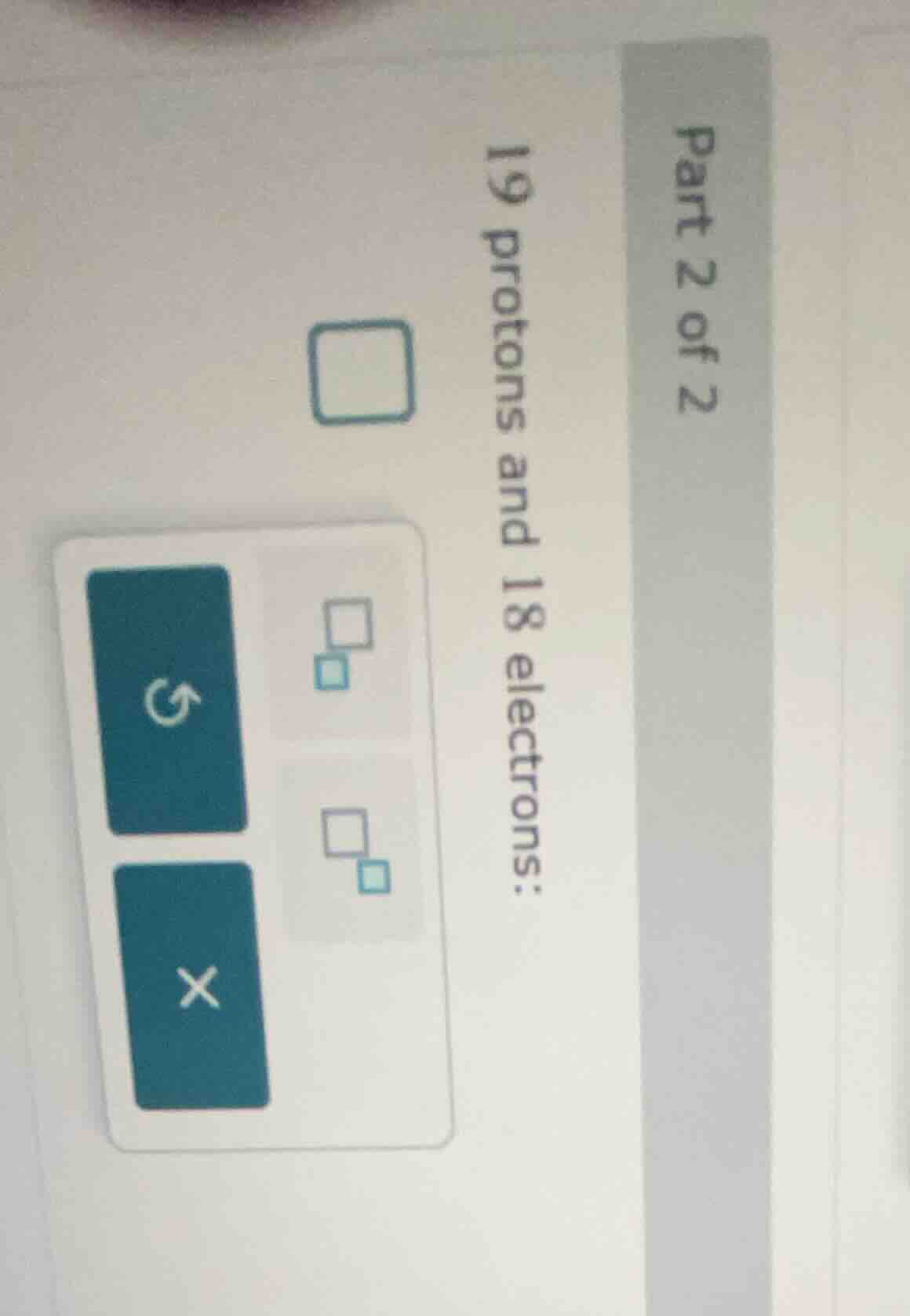
19 protons and 18 electrons:
Step1: Recall ion charge calculation
The charge of an ion is calculated as the number of protons minus the number of electrons. So, charge = protons - electrons.
Step2: Substitute values
Given protons = 19 and electrons = 18. So, charge = \(19 - 18 = +1\). This represents a cation (positive ion) with 19 protons (which is potassium, K) having a +1 charge (\(K^+\)). The ion with 19 protons (atomic number 19) and 18 electrons has a +1 charge, so the electron - proton relationship here is that electrons are one less than protons, so the ion is a cation. If we consider the representation of ions, for an atom with atomic number (protons) 19 (potassium), losing one electron (so 18 electrons) gives \(K^+\). The structure of the ion would have the number of protons (19) determining the element (potassium), and electrons (18) giving it a +1 charge.

Snap & solve any problem in the app
Get step-by-step solutions on Sovi AI
Photo-based solutions with guided steps
Explore more problems and detailed explanations
The species with 19 protons and 18 electrons is the potassium ion (\(K^+\)) with a charge of \(+ 1\). The electron - proton count shows it is a cation (has more protons than electrons) with a charge of \(+1\).