QUESTION IMAGE
Question
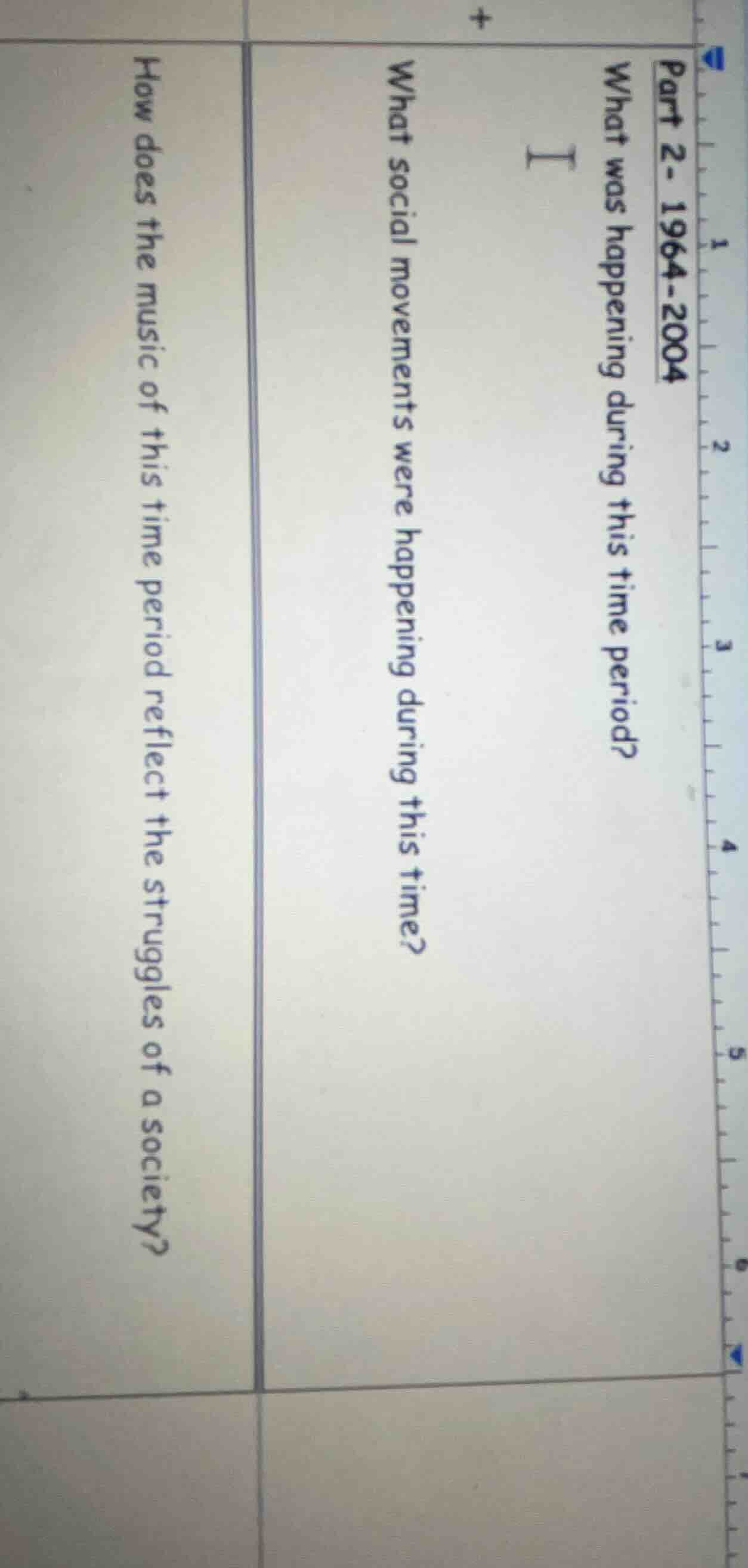
part 2 - 1964-2004
what was happening during this time period?
what social movements were happening during this time?
how does the music of this time period reflect the struggles of a society?
Brief Explanations
- For the general events of 1964-2004: This era saw the latter stages of the Cold War (ending 1991), the rise of personal computing and the internet, globalization of economies, post-Civil Rights era progress and backlash in the US, decolonization in Africa/Asia, the AIDS crisis (1980s onward), and the 9/11 attacks (2001) with subsequent War on Terror.
- For social movements: Key movements include the latter Civil Rights Movement (voting rights, fair housing), second-wave feminism (equal pay, reproductive rights), LGBTQ+ rights (Stonewall 1969 as a turning point), anti-Vietnam War protests, environmental movement (Earth Day 1970), and later, anti-globalization and disability rights movements.
- For music reflecting societal struggles: Protest music (e.g., folk, rock) voiced anti-war and civil rights demands; punk rock reflected disillusionment with 1970s-80s systems; hip-hop gave voice to Black and urban working-class struggles over poverty, police brutality, and systemic racism; LGBTQ+ artists and genres (e.g., disco, later queer pop) reflected identity struggles and demand for acceptance.

Snap & solve any problem in the app
Get step-by-step solutions on Sovi AI
Photo-based solutions with guided steps
Explore more problems and detailed explanations
- General events (1964-2004): Cold War conclusion, digital revolution, globalization, US post-Civil Rights shifts, AIDS crisis, 9/11 and War on Terror, global decolonization.
- Social movements: Late Civil Rights, second-wave feminism, LGBTQ+ rights, anti-Vietnam War, environmental, disability rights, anti-globalization.
- Music reflecting struggles: Protest music (anti-war/civil rights), punk (system disillusionment), hip-hop (urban/racial injustice), queer genres (identity acceptance demands).