QUESTION IMAGE
Question
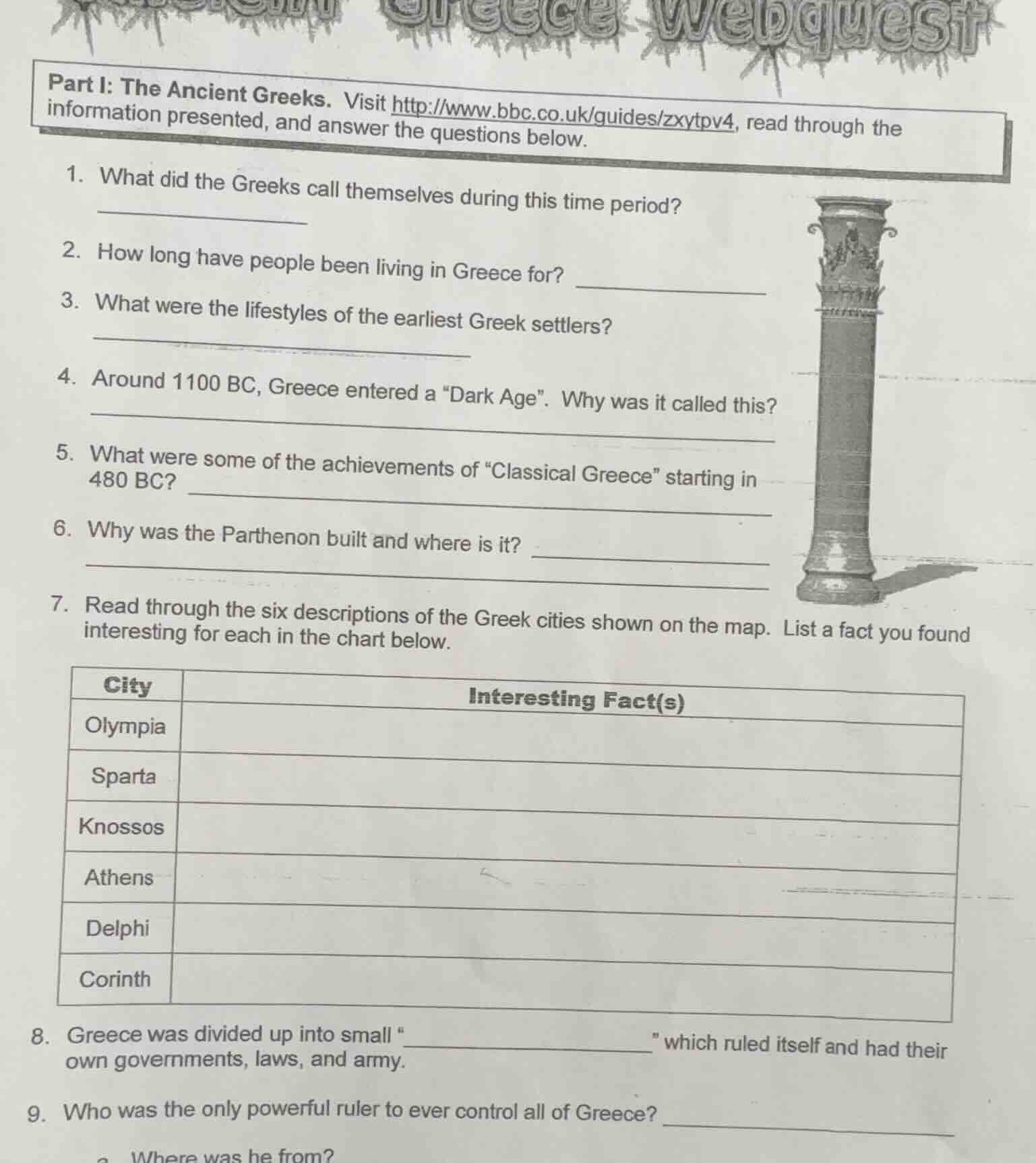
part i: the ancient greeks. visit http://www.bbc.co.uk/guides/zxytpv4, read through the information presented, and answer the questions below.1. what did the greeks call themselves during this time period?2. how long have people been living in greece for?3. what were the lifestyles of the earliest greek settlers?4. around 1100 bc, greece entered a \dark age\. why was it called this?5. what were some of the achievements of \classical greece\ starting in 480 bc?6. why was the parthenon built and where is it?7. read through the six descriptions of the greek cities shown on the map. list a fact you found interesting for each in the chart below.| city | interesting fact(s) || ---- | ---- || olympia | || sparta | || knossos | || athens | || delphi | || corinth | |8. greece was divided up into small \__________\ which ruled itself and had their own governments, laws, and army.9. who was the only powerful ruler to ever control all of greece?a. where was he from?
All answers are sourced from the specified BBC Ancient Greece guide, verified for historical accuracy.

Snap & solve any problem in the app
Get step-by-step solutions on Sovi AI
Photo-based solutions with guided steps
Explore more problems and detailed explanations
- They called themselves Hellenes.
- People have been living in Greece for over 40,000 years.
- The earliest Greek settlers were hunter-gatherers, later transitioning to farming and herding.
- It was called the Dark Age because there was a collapse of writing systems, decline in trade, and little surviving historical record, so our knowledge of this period is limited.
- Achievements included advancements in democracy (in Athens), philosophy (Socrates, Plato, Aristotle), mathematics (Euclid), architecture (classical column styles), and drama (Sophocles, Euripides).
- The Parthenon was built on the Acropolis in Athens to honor the goddess Athena, protect the city, and showcase Athenian power and artistic skill.
7.
| City | Interesting Fact(s) |
|---|---|
| Sparta | Had a society focused entirely on military training for all citizens. |
| Knossos | Home of the Minoan civilization's grand palace, linked to the Minotaur myth. |
| Athens | Founded the world's first known democratic system of government. |
| Delphi | Site of the Oracle of Delphi, a highly respected religious and prophetic center. |
| Corinth | A major trade hub with two strategic ports connecting the Aegean and Ionian Seas. |
- city-states
- Alexander the Great
a. He was from Macedonia (a kingdom north of mainland Greece).