QUESTION IMAGE
Question
part b
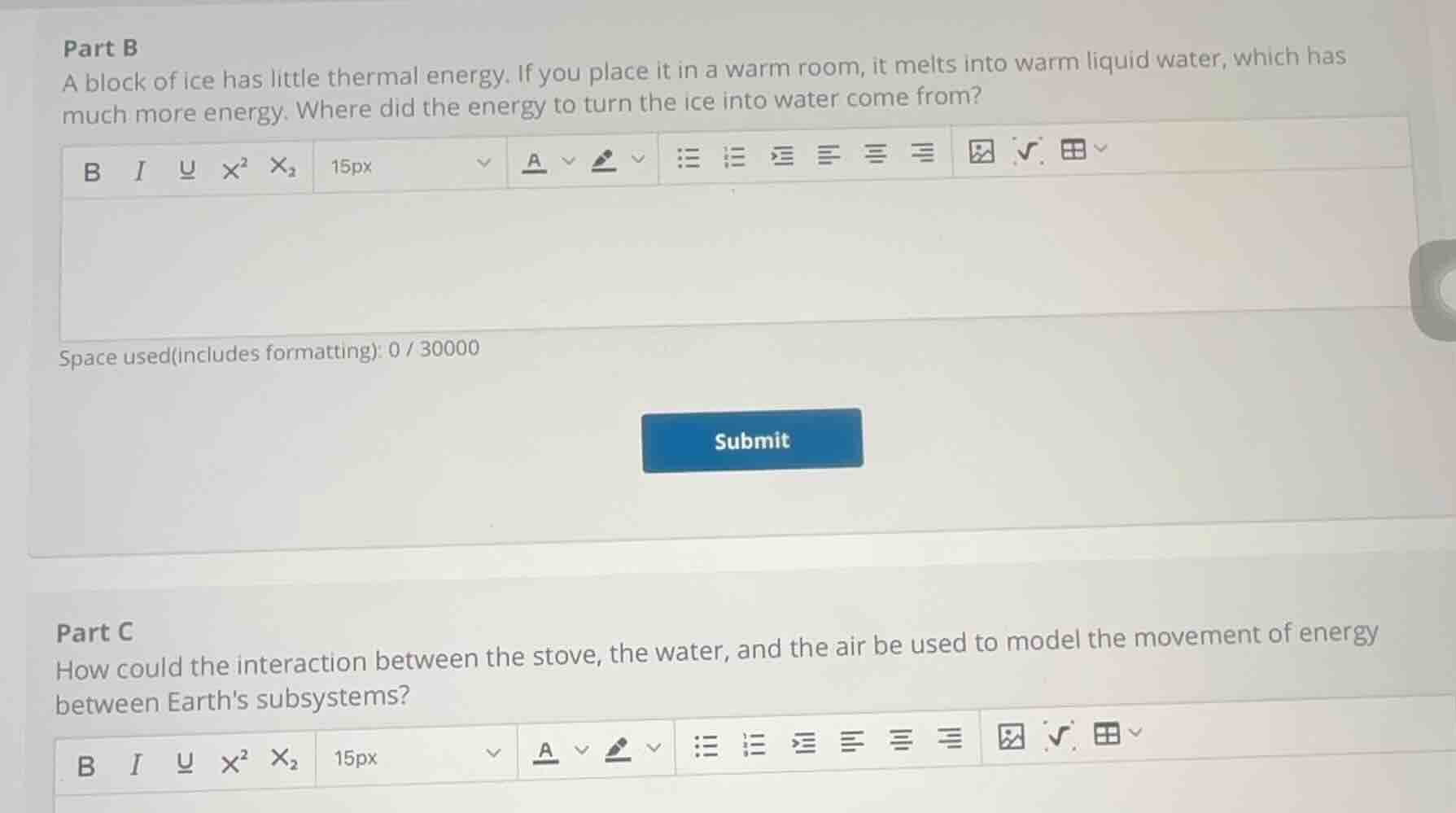
a block of ice has little thermal energy. if you place it in a warm room, it melts into warm liquid water, which has much more energy. where did the energy to turn the ice into water come from?
part c
how could the interaction between the stove, the water, and the air be used to model the movement of energy between earths subsystems?
Part B
The ice melts because of heat transfer. The warm room has higher thermal energy than the ice. Heat flows from the warm air in the room to the ice (due to the temperature difference) through conduction, convection, or radiation. This heat energy is absorbed by the ice, providing the energy needed to break the intermolecular bonds in the ice (overcoming the latent heat of fusion) and turn it into liquid water.
- Stove as a Source (like Earth’s Internal Heat): The stove provides energy (heat), similar to how Earth’s interior (e.g., from radioactive decay, residual heat from formation) provides energy (geothermal energy) to Earth’s subsystems.
- Water as a Reservoir (like Hydrosphere/Biosphere): The water absorbs heat from the stove, similar to how the hydrosphere (oceans, lakes) or biosphere absorbs energy from Earth’s internal heat or solar radiation. The water can also transfer heat (e.g., through convection as it heats up), analogous to how water in the hydrosphere circulates energy (e.g., ocean currents distributing heat).
- Air as a Transporter (like Atmosphere): The air around the water and stove can carry heat (through convection or conduction), similar to how Earth’s atmosphere transports heat (e.g., wind patterns, atmospheric circulation) between different subsystems (e.g., moving heat from the equator to the poles, or from the surface to higher altitudes).
- Energy Transfer Dynamics: The interaction shows energy moving from a source (stove) to a reservoir (water) and being distributed by a medium (air), mirroring how energy moves between Earth’s geosphere (stove ≈ geothermal source), hydrosphere/biosphere (water ≈ these subsystems), and atmosphere (air ≈ atmosphere) as they interact (e.g., geothermal heat warming oceans, atmosphere moving heat globally).

Snap & solve any problem in the app
Get step-by-step solutions on Sovi AI
Photo-based solutions with guided steps
Explore more problems and detailed explanations
The energy to turn the ice into water came from the warm air in the room. Heat is transferred from the warmer air (which has more thermal energy) to the ice (which has less thermal energy) due to the temperature difference. This heat energy is absorbed by the ice, allowing it to melt into liquid water as the heat provides the energy to overcome the intermolecular forces holding the ice in a solid state.