QUESTION IMAGE
Question
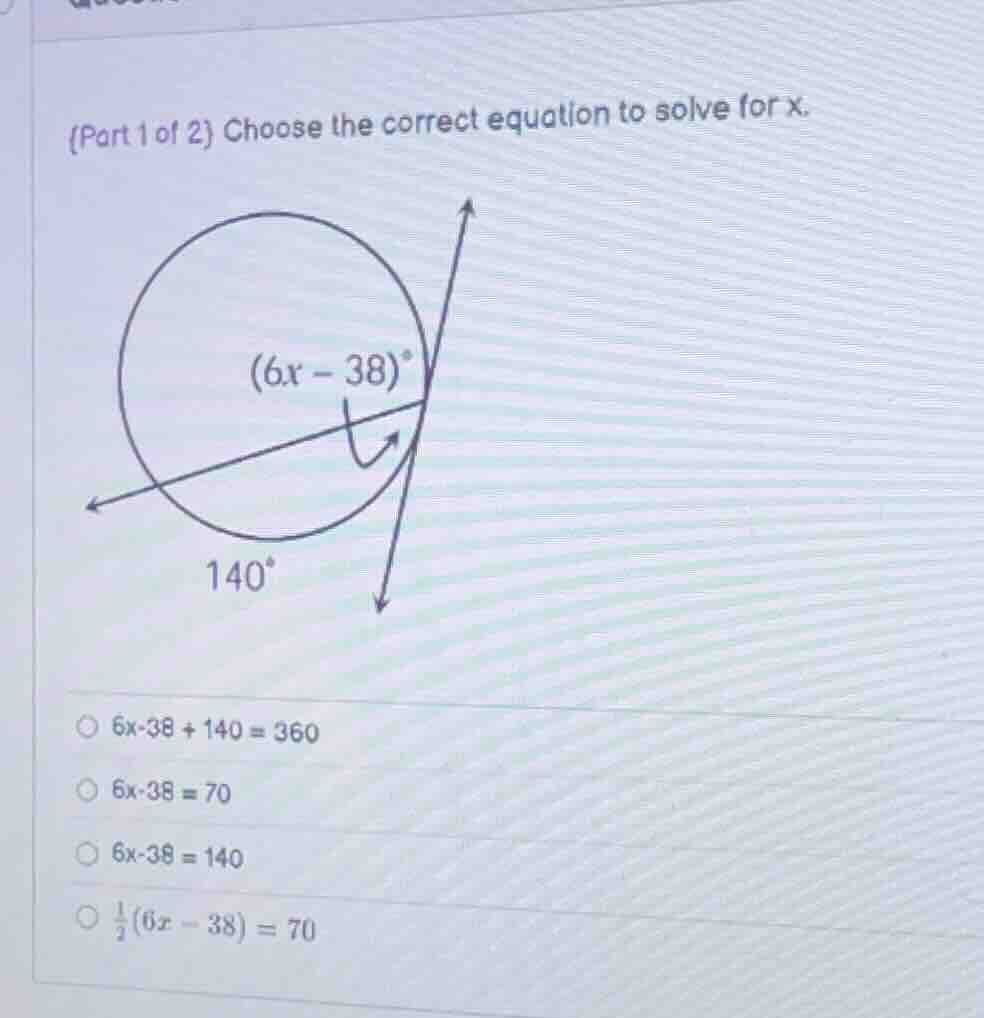
(part 1 of 2) choose the correct equation to solve for x.
140°
(6x - 38)°
○ 6x - 38 + 140 = 360
○ 6x - 38 = 70
○ 6x - 38 = 140
○ \\(\frac{1}{2}(6x - 38) = 70\\)
To determine the correct equation, we use the property of angles formed by a tangent and a chord (or a secant) with a circle. The measure of an inscribed angle (or the angle related to the arc) and the angle formed by a tangent and a secant: the measure of the angle formed by a tangent and a secant is half the difference of the measures of the intercepted arcs. But in this case, we can also use the property that the measure of an angle formed by a tangent and a chord is equal to half the measure of the intercepted arc. Wait, actually, looking at the diagram, the angle \( (6x - 38)^\circ \) is an inscribed angle or a central angle? Wait, no, the \( 140^\circ \) is an arc, and the angle \( (6x - 38)^\circ \) is related to the arc. Wait, the key property here is that the measure of an angle formed by a tangent and a chord is equal to half the measure of the intercepted arc. Wait, no, actually, when you have a tangent and a secant, the angle between them is half the difference of the intercepted arcs. But in this case, maybe the \( (6x - 38)^\circ \) is a central angle? Wait, no, let's think again. The \( 140^\circ \) is an arc, and the angle \( (6x - 38)^\circ \) is related to the arc. Wait, the measure of an inscribed angle is half the measure of its intercepted arc. But if \( (6x - 38)^\circ \) is a central angle, then the inscribed angle would be half of that. Wait, no, maybe the \( 140^\circ \) arc and the angle \( (6x - 38)^\circ \): wait, the angle formed by a tangent and a chord is equal to half the measure of the intercepted arc. Wait, no, the angle between the tangent and the chord is equal to half the measure of the intercepted arc. So if the intercepted arc is \( (6x - 38)^\circ \), then the angle (the one with the tangent) would be half of that. But in the diagram, the angle adjacent to the tangent and the chord: wait, maybe the \( 140^\circ \) is the arc, and the angle \( (6x - 38)^\circ \) is the central angle, and the angle formed by the tangent and the chord is half of the central angle? Wait, no, let's check the options. The options are:
- \( 6x - 38 + 140 = 360 \)
- \( 6x - 38 = 70 \)
- \( 6x - 38 = 140 \)
- \( \frac{1}{2}(6x - 38) = 70 \) Wait, no, the fourth option is \( \frac{1}{2}(6x - 38) = 70 \)? Wait, the original options: the fourth option is \( \frac{1}{2}(6x - 38) = 70 \)? Wait, the user's options are:
- \( 6x - 38 + 140 = 360 \)
- \( 6x - 38 = 70 \)
- \( 6x - 38 = 140 \)
- \( \frac{1}{2}(6x - 38) = 70 \)
Wait, let's re-examine. The key property here is that the measure of an angle formed by a tangent and a chord is equal to half the measure of the intercepted arc. So if the intercepted arc is \( (6x - 38)^\circ \), then the angle (the one with the tangent) is half of that. But in the diagram, the angle adjacent to the tangent and the chord: wait, maybe the \( 140^\circ \) arc and the angle \( (6x - 38)^\circ \): wait, the total around a point is \( 360^\circ \), but no. Wait, another approach: the angle formed by a tangent and a chord is equal to half the measure of the intercepted arc. So if the intercepted arc is \( (6x - 38)^\circ \), then the angle (the one with the tangent) is \( \frac{1}{2}(6x - 38) \). But in the diagram, the angle opposite to the \( 140^\circ \) arc? Wait, no, maybe the \( 140^\circ \) arc is the major arc, and the minor arc is \( 360 - 140 = 220 \)? No, that doesn't make sense. Wait, maybe the \( (6x - 38)^\circ \) is the measure of the arc, and the angle formed by the tangent and the chord is half of that. But in the options, one of the options is \( \frac{1}{2}(6x - 38) = 7…

Snap & solve any problem in the app
Get step-by-step solutions on Sovi AI
Photo-based solutions with guided steps
Explore more problems and detailed explanations
B. \( 6x - 38 = 70 \) (assuming the options are labeled as A, B, C, D with A: \( 6x - 38 + 140 = 360 \), B: \( 6x - 38 = 70 \), C: \( 6x - 38 = 140 \), D: \( \frac{1}{2}(6x - 38) = 70 \))