QUESTION IMAGE
Question
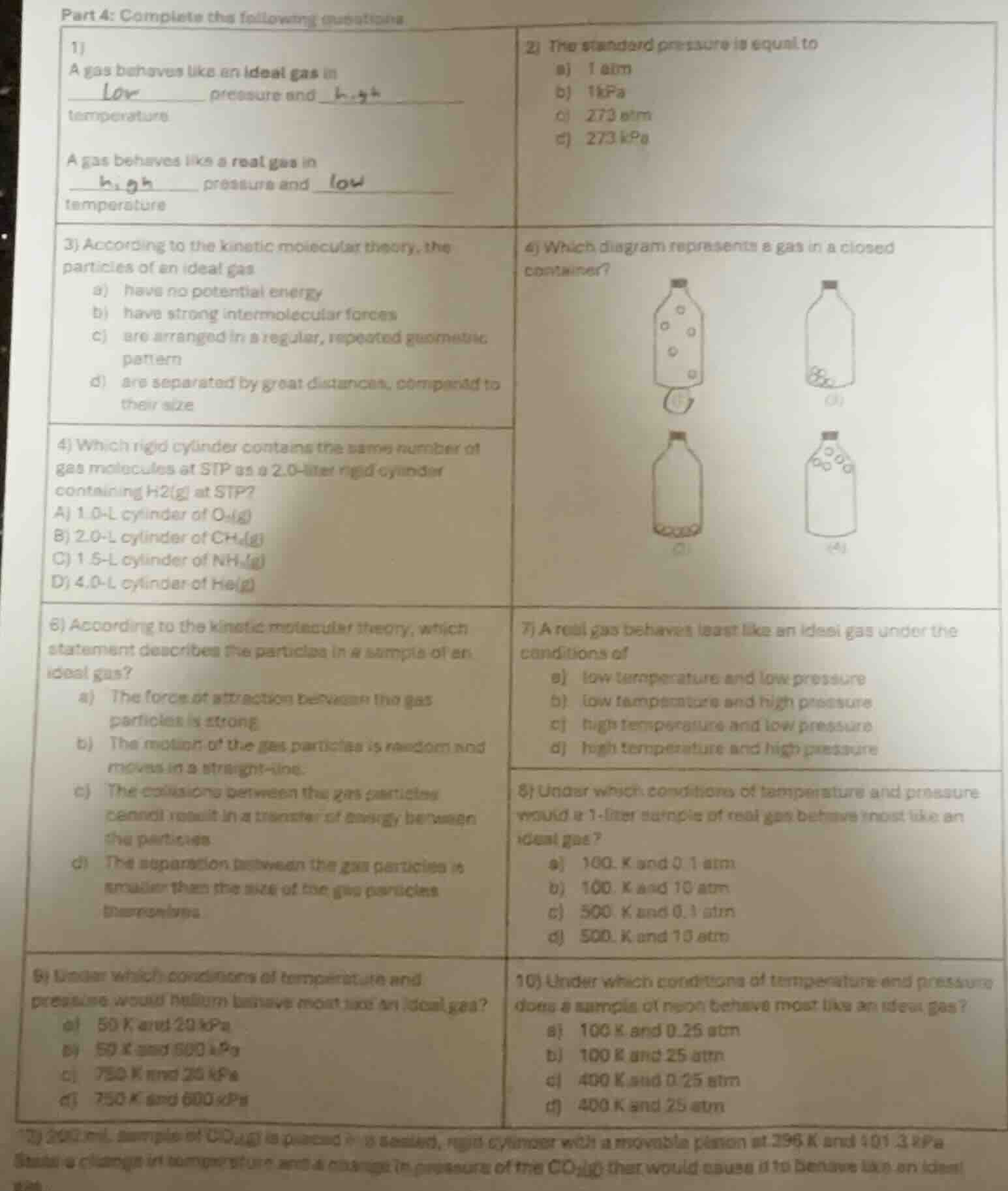
part 4: complete the following questions
1)
a gas behaves like an ideal gas in
______ pressure and ______
temperature.
a gas behaves like a real gas in
______ pressure and ______
temperature
- the standard pressure is equal to
a) 1 atm
b) 1 kpa
c) 273 atm
d) 273 kpa
- according to the kinetic molecular theory, the
particles of an ideal gas
a) have no potential energy
b) have strong intermolecular forces
c) are arranged in a regular, repeated geometric
pattern
d) are separated by great distances, compared to
their size
- which diagram represents a gas in a closed
container?
(images of four bottles with different contents)
- which rigid cylinder contains the same number of
gas molecules at stp as a 2.0 - liter rigid cylinder
containing h₂(g) at stp?
a) 1.0 - l cylinder of o₂(g)
b) 2.0 - l cylinder of ch₄(g)
c) 1.5 - l cylinder of nh₃(g)
d) 4.0 - l cylinder of he(g)
- according to the kinetic molecular theory, which
statement describes the particles in a sample of an
ideal gas?
a) the force of attraction between the gas
particles is strong
b) the motion of the gas particles is random and
moves in a straight - line.
c) the collisions between the gas particles
cannot result in a transfer of energy between
the particles
d) the separation between the gas particles is
smaller than the size of the gas particles
themselves.
- a real gas behaves least like an ideal gas under the
conditions of
a) low temperature and low pressure
b) low temperature and high pressure
c) high temperature and low pressure
d) high temperature and high pressure
- under which conditions of temperature and pressure
would a 1 - liter sample of real gas behave most like an
ideal gas?
a) 100. k and 0.1 atm
b) 100. k and 10 atm
c) 500. k and 0.1 atm
d) 500. k and 10 atm
- under which conditions of temperature and
pressure would helium behave most like an ideal gas?
a) 50 k and 20 kpa
b) 50 k and 600 kpa
c) 750 k and 20 kpa
d) 750 k and 600 kpa
- under which conditions of temperature and pressure
does a sample of neon behave most like an ideal gas?
a) 100 k and 0.25 atm
b) 100 k and 25 atm
c) 400 k and 0.25 atm
d) 400 k and 25 atm
- a 200 ml sample of co₂(g) is placed in a sealed, rigid cylinder with a movable piston at 296 k and 101.3 kpa
state a change in temperature and a change in pressure of the co₂(g) that would cause it to behave like an ideal
gas.
Let's solve these questions one by one:
Question 1
- An ideal gas behaves ideally at low pressure and high temperature (because at low pressure, the volume of gas molecules is negligible compared to the total volume, and at high temperature, the intermolecular forces are negligible as molecules have high kinetic energy).
- A real gas behaves like a real gas (deviates from ideal) at high pressure and low temperature (high pressure makes the volume of molecules significant, low temperature makes intermolecular forces significant).
Question 2
Standard pressure is defined as 1 atm (or 101.3 kPa, or 760 mmHg). So the correct option is:
a) 1 atm
Question 3
Kinetic molecular theory of ideal gases states:
- Molecules have negligible volume, so they are separated by great distances compared to their size (option d).
- They have no intermolecular forces (so no potential energy, but option a is not the main point here; option d is more about the separation).
- They are in random motion, not arranged in a pattern (so c is wrong).
- Intermolecular forces are negligible (so b is wrong).
Thus, answer is d) are separated by great distances, compared to their size
Question 4 (the cylinder one)
At STP, equal volumes of gases contain equal numbers of molecules (Avogadro’s law: \( V \propto n \) at constant T and P). So a 2.0 - L cylinder of any gas at STP will have the same number of molecules as a 2.0 - L cylinder of \( H_2 \) at STP. So option B) 2.0 - L cylinder of \( CH_4(g) \) is correct.
Question 5 (the diagram one - assuming the diagrams: gas in closed container should have molecules spread out, not condensed. So the diagram with molecules spread throughout the container (like a bottle with dots spread) is the gas. But since the diagrams are labeled (1), (2), (3), (4) – typically, gas molecules are far apart and fill the container, so the one with molecules distributed throughout the closed container is the gas.
Question 6 (kinetic molecular theory statement)
Kinetic molecular theory:
- Gas particles move randomly in straight lines (option b).
- Intermolecular forces are negligible (so a is wrong).
- Collisions are elastic (energy is transferred, so c is wrong).
- Separation between particles is larger than their size (so d is wrong).
Thus, answer is b) The motion of the gas particles is random and moves in a straight - line.
Question 7 (real gas least like ideal)
Real gas deviates most from ideal at low temperature and high pressure (low T: intermolecular forces significant; high P: volume of molecules significant). So option b) low temperature and high pressure
Question 8 (real gas most like ideal)
Real gas behaves most like ideal at high temperature and low pressure (high T: intermolecular forces negligible; low P: volume of molecules negligible). Among the options:
- 500 K (high T) and 0.1 atm (low P) is option c. So answer is c) 500 K and 0.1 atm
Question 9 (helium most like ideal)
Same logic: high temperature and low pressure. Among options:
- 750 K (high T) and 20 kPa (low P, since 20 kPa = 0.197 atm, low pressure) is option c. So answer is c) 750 K and 20 kPa
Question 10 (neon most like ideal)
Neon is a noble gas, behaves most like ideal at high T and low P. Among options:
- 400 K (high T) and 0.25 atm (low P) is option c. So answer is c) 400 K and 0.25 atm
Question 11 (CO₂ behave like ideal)
To make \( CO_2 \) behave like an ideal gas, we need high temperature and low pressure (increase temperature to make intermolecular forces negligible, decrease pressu…

Snap & solve any problem in the app
Get step-by-step solutions on Sovi AI
Photo-based solutions with guided steps
Explore more problems and detailed explanations
Let's solve these questions one by one:
Question 1
- An ideal gas behaves ideally at low pressure and high temperature (because at low pressure, the volume of gas molecules is negligible compared to the total volume, and at high temperature, the intermolecular forces are negligible as molecules have high kinetic energy).
- A real gas behaves like a real gas (deviates from ideal) at high pressure and low temperature (high pressure makes the volume of molecules significant, low temperature makes intermolecular forces significant).
Question 2
Standard pressure is defined as 1 atm (or 101.3 kPa, or 760 mmHg). So the correct option is:
a) 1 atm
Question 3
Kinetic molecular theory of ideal gases states:
- Molecules have negligible volume, so they are separated by great distances compared to their size (option d).
- They have no intermolecular forces (so no potential energy, but option a is not the main point here; option d is more about the separation).
- They are in random motion, not arranged in a pattern (so c is wrong).
- Intermolecular forces are negligible (so b is wrong).
Thus, answer is d) are separated by great distances, compared to their size
Question 4 (the cylinder one)
At STP, equal volumes of gases contain equal numbers of molecules (Avogadro’s law: \( V \propto n \) at constant T and P). So a 2.0 - L cylinder of any gas at STP will have the same number of molecules as a 2.0 - L cylinder of \( H_2 \) at STP. So option B) 2.0 - L cylinder of \( CH_4(g) \) is correct.
Question 5 (the diagram one - assuming the diagrams: gas in closed container should have molecules spread out, not condensed. So the diagram with molecules spread throughout the container (like a bottle with dots spread) is the gas. But since the diagrams are labeled (1), (2), (3), (4) – typically, gas molecules are far apart and fill the container, so the one with molecules distributed throughout the closed container is the gas.
Question 6 (kinetic molecular theory statement)
Kinetic molecular theory:
- Gas particles move randomly in straight lines (option b).
- Intermolecular forces are negligible (so a is wrong).
- Collisions are elastic (energy is transferred, so c is wrong).
- Separation between particles is larger than their size (so d is wrong).
Thus, answer is b) The motion of the gas particles is random and moves in a straight - line.
Question 7 (real gas least like ideal)
Real gas deviates most from ideal at low temperature and high pressure (low T: intermolecular forces significant; high P: volume of molecules significant). So option b) low temperature and high pressure
Question 8 (real gas most like ideal)
Real gas behaves most like ideal at high temperature and low pressure (high T: intermolecular forces negligible; low P: volume of molecules negligible). Among the options:
- 500 K (high T) and 0.1 atm (low P) is option c. So answer is c) 500 K and 0.1 atm
Question 9 (helium most like ideal)
Same logic: high temperature and low pressure. Among options:
- 750 K (high T) and 20 kPa (low P, since 20 kPa = 0.197 atm, low pressure) is option c. So answer is c) 750 K and 20 kPa
Question 10 (neon most like ideal)
Neon is a noble gas, behaves most like ideal at high T and low P. Among options:
- 400 K (high T) and 0.25 atm (low P) is option c. So answer is c) 400 K and 0.25 atm
Question 11 (CO₂ behave like ideal)
To make \( CO_2 \) behave like an ideal gas, we need high temperature and low pressure (increase temperature to make intermolecular forces negligible, decrease pressure to make volume of molecules negligible). So a change: increase temperature (e.g., raise above 296 K) and decrease pressure (e.g., lower below 101.3 kPa) would make it behave more ideally.
Final Answers (summarized):
- Ideal: low, high; Real: high, low
- a) 1 atm
- d
- B
- (diagram with molecules spread in closed container)
- b
- b
- c
- c
- c
- Increase temperature (e.g., raise T) and decrease pressure (e.g., lower P)