QUESTION IMAGE
Question
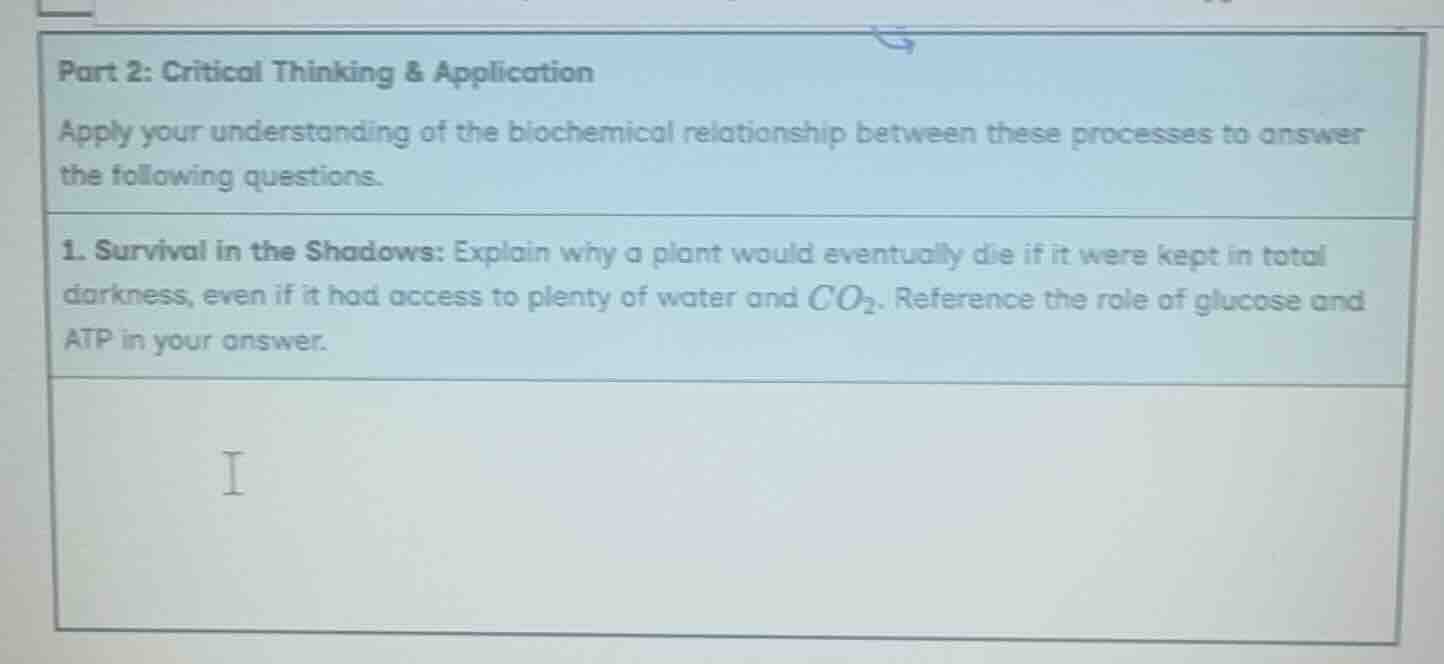
part 2: critical thinking & application
apply your understanding of the biochemical relationship between these processes to answer the following questions.
- survival in the shadows: explain why a plant would eventually die if it were kept in total darkness, even if it had access to plenty of water and $co_2$. reference the role of glucose and atp in your answer.
Plants rely on photosynthesis, which requires light energy, to produce glucose from water and $CO_2$. Glucose serves as both an energy-storing molecule and a building block for plant structures. ATP, the cell's immediate energy currency, is generated when glucose is broken down via cellular respiration. Without light, photosynthesis stops, so no new glucose is made. The plant will use its stored glucose reserves to make ATP for essential cellular functions, but once these reserves are depleted, ATP production ceases. Without ATP, the plant cannot perform critical processes like nutrient transport, DNA replication, and cell maintenance, leading to its death.

Snap & solve any problem in the app
Get step-by-step solutions on Sovi AI
Photo-based solutions with guided steps
Explore more problems and detailed explanations
A plant kept in total darkness will die because it cannot perform photosynthesis, the process that uses light energy to convert water and $CO_2$ into glucose. Glucose is necessary to produce ATP (the cell's usable energy) through cellular respiration, and also acts as a structural building block for the plant. Without light, no new glucose is synthesized; the plant will use up its stored glucose reserves to make ATP for essential cellular functions, but once these reserves are gone, ATP production stops. Without ATP, the plant cannot carry out vital processes like nutrient transport, cell repair, and growth, leading to its eventual death.