QUESTION IMAGE
Question
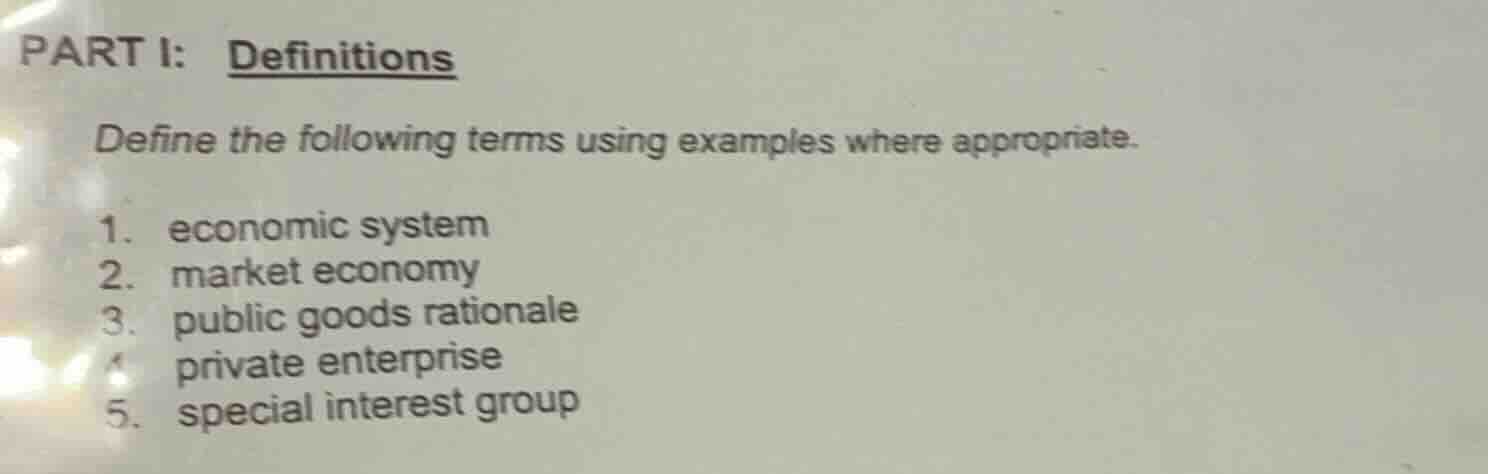
part i: definitions
define the following terms using examples where appropriate.
- economic system
- market economy
- public goods rationale
- private enterprise
- special interest group
Brief Explanations
- economic system: A structured set of institutions, laws, and practices that govern how a society produces, distributes, and consumes goods and services, organizing the allocation of scarce resources.
- market economy: An economic system where supply, demand, and private ownership drive production and pricing, with minimal government intervention.
- public goods rationale: The economic justification for government provision of goods that are non-excludable and non-rivalrous, as private markets will underproduce them.
- private enterprise: Business activity owned and operated by private individuals or groups (not the government), focused on generating profit.
- special interest group: A collection of individuals or organizations united by a shared goal, which advocates for policies that benefit their specific group.

Snap & solve any problem in the app
Get step-by-step solutions on Sovi AI
Photo-based solutions with guided steps
Explore more problems and detailed explanations
- economic system: The structure a society uses to produce, distribute, and consume goods and services, coordinating resource allocation. Example: A command economy (like North Korea's) where the government controls all production and distribution decisions.
- market economy: An economic system where private individuals and businesses make most production and pricing decisions based on supply and demand. Example: The United States' economy, where most businesses are privately owned, and prices are set by market interactions.
- public goods rationale: The argument that governments must provide public goods (non-excludable, non-rivalrous items) because private markets cannot profitably supply them. Example: National defense—once provided, all citizens benefit, and no one can be excluded, so private companies would not fund it.
- private enterprise: Business owned and run by private entities (not the state) to earn profit, with control over production and operations. Example: A local family-owned restaurant or a large corporation like Apple Inc.
- special interest group: An organization that advocates for policies favorable to its members' shared interests. Example: The American Medical Association, which lobbies for policies that benefit doctors and the healthcare industry.