QUESTION IMAGE
Question
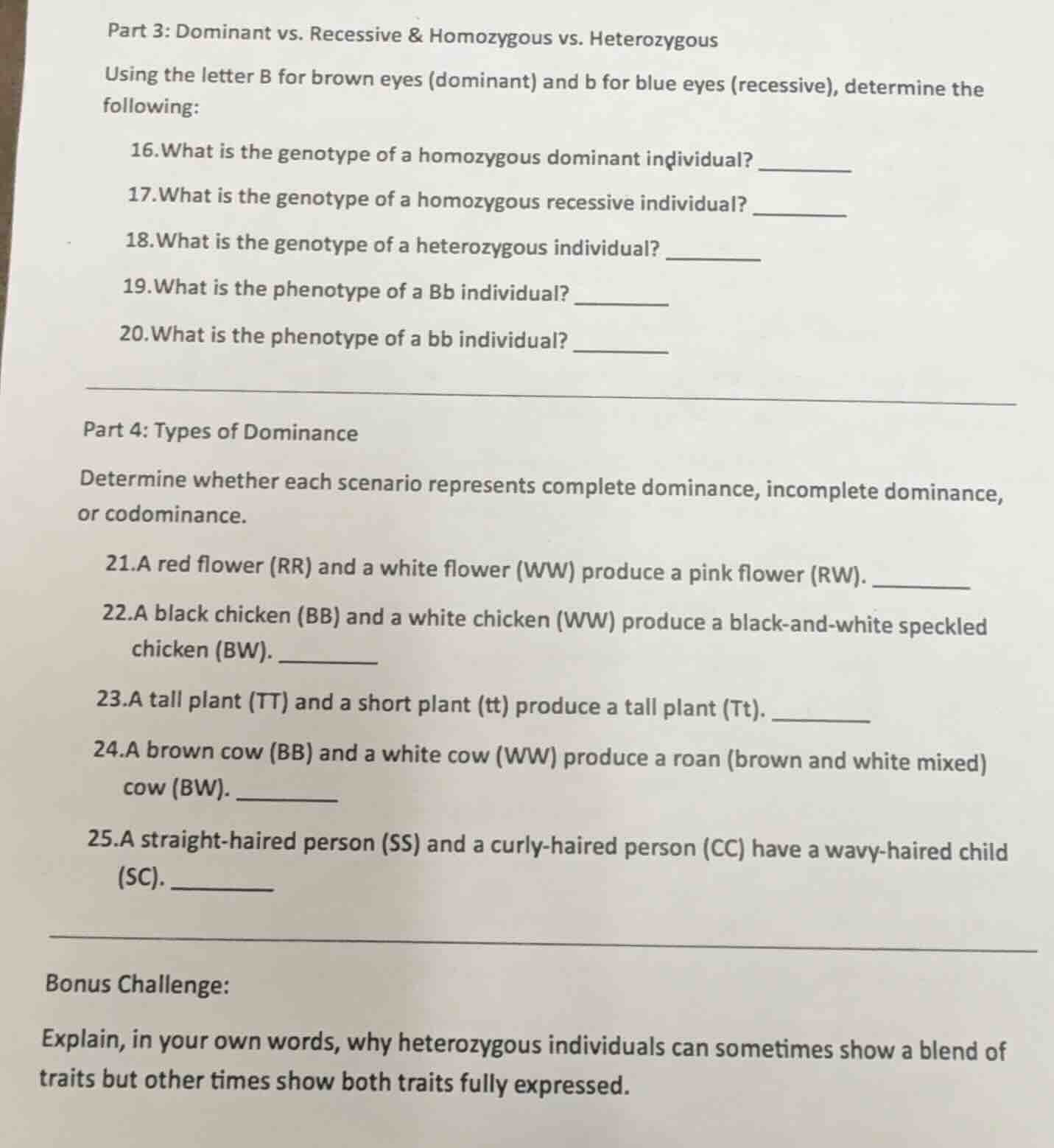
part 3: dominant vs. recessive & homozygous vs. heterozygous
using the letter b for brown eyes (dominant) and b for blue eyes (recessive), determine the following:
- what is the genotype of a homozygous dominant individual?
- what is the genotype of a homozygous recessive individual?
- what is the genotype of a heterozygous individual?
- what is the phenotype of a bb individual?
- what is the phenotype of a bb individual?
part 4: types of dominance
determine whether each scenario represents complete dominance, incomplete dominance, or codominance.
- a red flower (rr) and a white flower (ww) produce a pink flower (rw).
- a black chicken (bb) and a white chicken (ww) produce a black - and - white speckled chicken (bw).
- a tall plant (tt) and a short plant (tt) produce a tall plant (tt).
- a brown cow (bb) and a white cow (ww) produce a roan (brown and white mixed) cow (bw).
- a straight - haired person (ss) and a curly - haired person (cc) have a wavy - haired child (sc).
bonus challenge:
explain, in your own words, why heterozygous individuals can sometimes show a blend of traits but other times show both traits fully expressed.
Part 3:
- Homozygous dominant means two identical dominant alleles.
- Homozygous recessive means two identical recessive alleles.
- Heterozygous means one dominant and one recessive allele.
- Dominant allele (B) masks recessive (b), so brown eyes show.
- Recessive phenotype only shows with two recessive alleles.
Part 4:
- Incomplete dominance creates a blended intermediate trait.
- Codominance shows both parental traits fully expressed.
- Complete dominance: dominant allele masks recessive trait.
- Codominance shows both parental traits simultaneously.
- Incomplete dominance creates a blended intermediate trait.
Bonus Challenge:
The difference depends on the type of dominance: In incomplete dominance, the dominant allele does not fully mask the recessive one, so the heterozygote has a blended, intermediate trait. In codominance, both alleles are fully expressed at the same time, so the heterozygote shows both distinct parental traits instead of a blend.

Snap & solve any problem in the app
Get step-by-step solutions on Sovi AI
Photo-based solutions with guided steps
Explore more problems and detailed explanations
Part 3:
- BB
- bb
- Bb
- Brown eyes
- Blue eyes
Part 4:
- Incomplete dominance
- Codominance
- Complete dominance
- Codominance
- Incomplete dominance
Bonus Challenge:
This depends on the type of genetic dominance. In incomplete dominance, the dominant allele does not fully suppress the recessive allele, so the heterozygote displays a blended, intermediate trait. In codominance, both alleles are fully and independently expressed, so the heterozygote shows both of the distinct parental traits at the same time rather than a blend.