QUESTION IMAGE
Question
part d
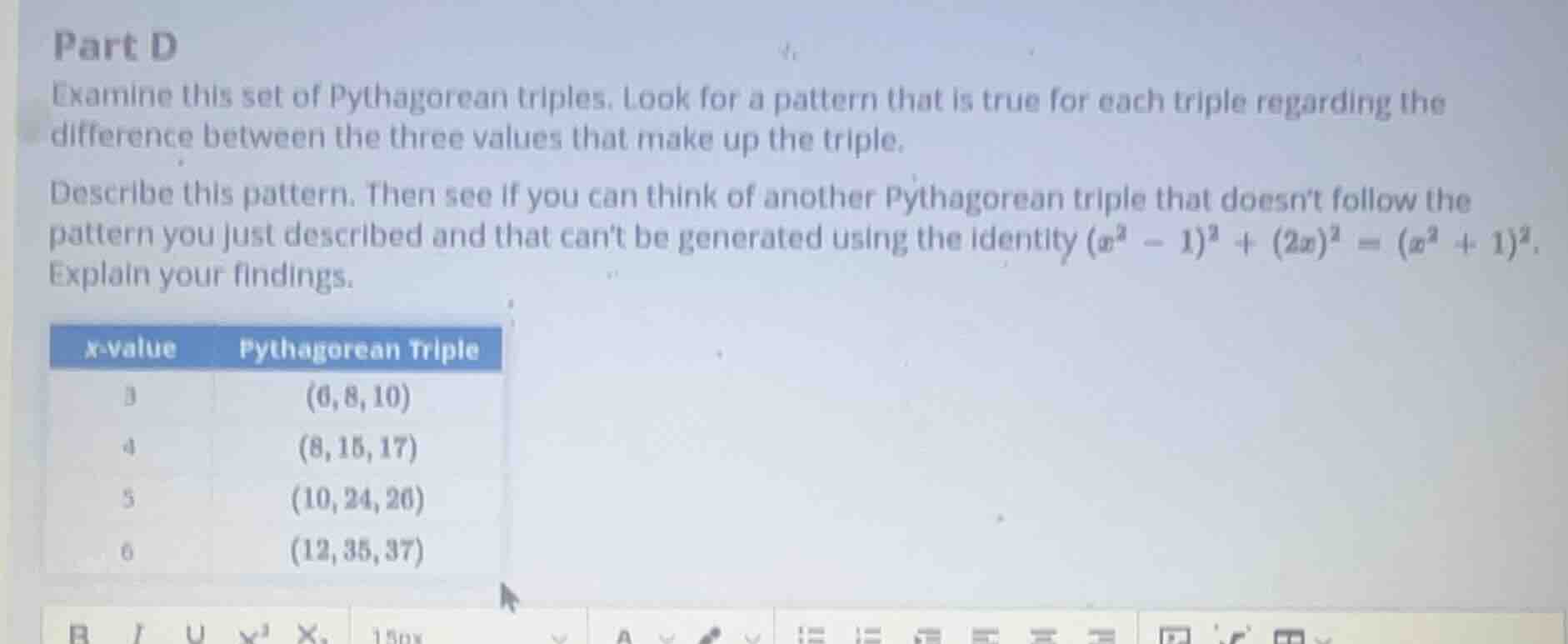
examine this set of pythagorean triples. look for a pattern that is true for each triple regarding the
difference between the three values that make up the triple.
describe this pattern. then see if you can think of another pythagorean triple that doesnt follow the
pattern you just described and that cant be generated using the identity ((x^2 - 1)^2 + (2x)^2 = (x^2 + 1)^2).
explain your findings.
| x - value | pythagorean triple |
|---|---|
| 4 | (8, 15, 17) |
| 5 | (10, 24, 26) |
| 6 | (12, 35, 37) |
Step1: Analyze given triples' differences
For (6,8,10): $10-8=2$, $8-6=2$
For (8,15,17): $17-15=2$, $15-8=7$
For (10,24,26): $26-24=2$, $24-10=14$
For (12,35,37): $37-35=2$, $35-12=23$
Step2: Identify consistent pattern
Notice the largest and middle values in each triple have a difference of 2: $\text{largest} - \text{middle} = 2$. Also, the smallest value is $2x$ (matches $x$-values: $2*3=6$, $2*4=8$, etc.), and the triples fit $(2x)^2 + (x^2-1)^2 = (x^2+1)^2$.
Step3: Find non-pattern triple
Look for a primitive Pythagorean triple not fitting the identity. Take (5,12,13): $13-12=1
eq2$. Test if it fits the given identity:
Set $2x=5 \to x=2.5$, then $x^2-1=5.25
eq12$, $x^2+1=7.25
eq13$. So it cannot be generated by the identity.

Snap & solve any problem in the app
Get step-by-step solutions on Sovi AI
Photo-based solutions with guided steps
Explore more problems and detailed explanations
- Pattern: For all the given Pythagorean triples, the difference between the largest and the middle number is always 2. All these triples can be generated by the identity $(2x)^2 + (x^2 - 1)^2 = (x^2 + 1)^2$, where the smallest number is $2x$, the middle is $x^2-1$, and the largest is $x^2+1$.
- Non-pattern triple: The triple (5, 12, 13) does not follow this pattern. Here, the difference between the largest number (13) and the middle number (12) is 1, not 2. Additionally, this triple cannot be generated by the identity $(x^2 - 1)^2 + (2x)^2 = (x^2 + 1)^2$: there is no integer $x$ such that $2x=5$, and substituting non-integer $x=2.5$ does not produce 12 and 13 for $x^2-1$ and $x^2+1$. This is a primitive Pythagorean triple that follows a different structure.