QUESTION IMAGE
Question
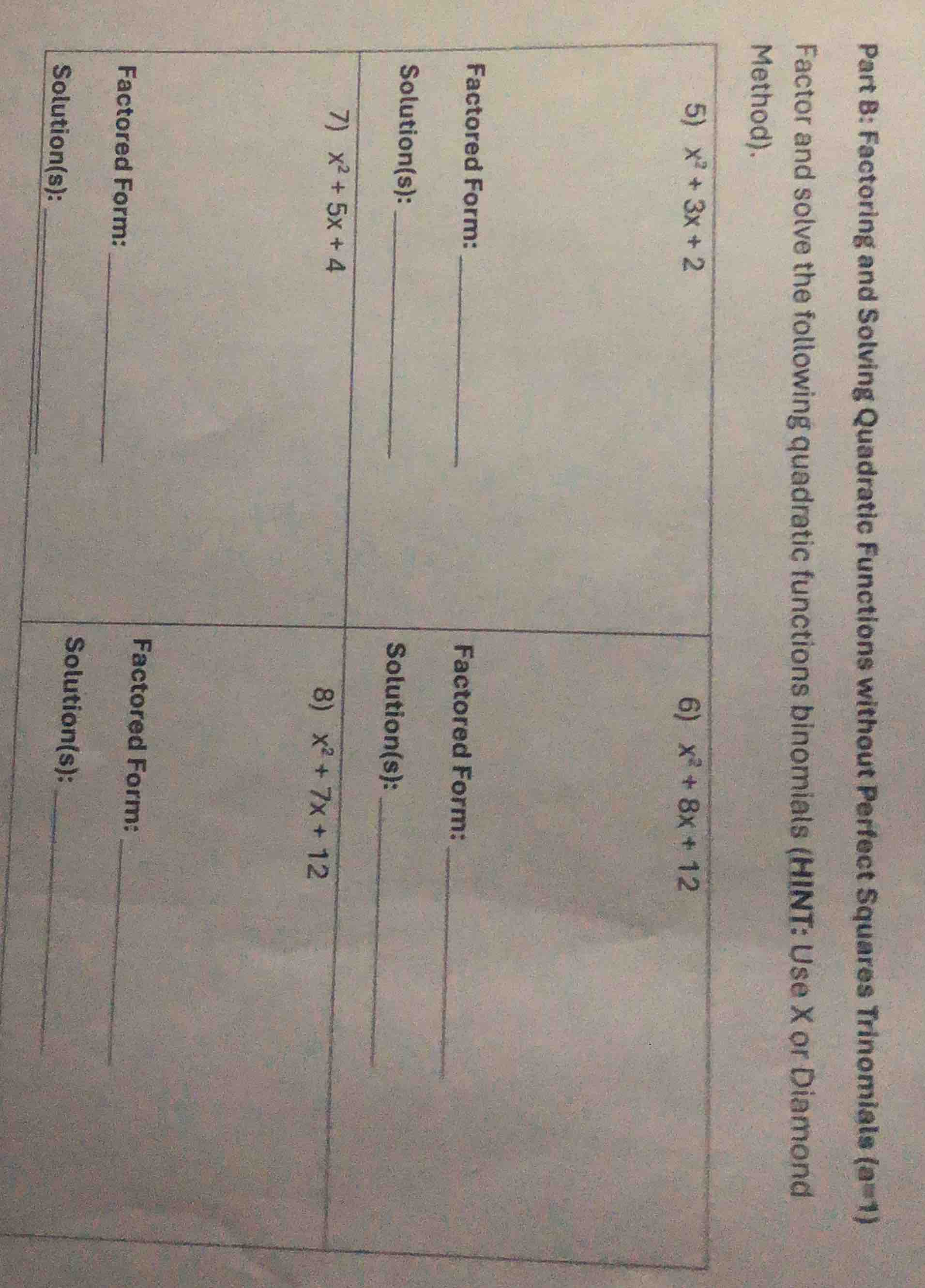
part b: factoring and solving quadratic functions without perfect squares trinomials (a=1) method). factor and solve the following quadratic functions binomials (hint: use x or diamond 5) ( x^2 + 3x + 2 ) factored form: solutions(s): 6) ( x^2 + 8x + 12 ) factored form: solutions(s): 7) ( x^2 + 5x + 4 ) factored form: solutions(s): 8) ( x^2 + 7x + 12 ) factored form: solutions(s):
Problem 5: \( x^2 + 3x + 2 \)
Step 1: Factor the quadratic
We need two numbers that multiply to \( 2 \) and add to \( 3 \). The numbers are \( 1 \) and \( 2 \). So, the factored form is \( (x + 1)(x + 2) \).
Step 2: Solve for \( x \)
Set each factor equal to zero:
\( x + 1 = 0 \) gives \( x = -1 \)
\( x + 2 = 0 \) gives \( x = -2 \)
Factored Form: \( (x + 1)(x + 2) \)
Solution(s): \( x = -1, x = -2 \)
Problem 6: \( x^2 + 8x + 12 \)
Step 1: Factor the quadratic
We need two numbers that multiply to \( 12 \) and add to \( 8 \). The numbers are \( 2 \) and \( 6 \). So, the factored form is \( (x + 2)(x + 6) \).
Step 2: Solve for \( x \)
Set each factor equal to zero:
\( x + 2 = 0 \) gives \( x = -2 \)
\( x + 6 = 0 \) gives \( x = -6 \)
Factored Form: \( (x + 2)(x + 6) \)
Solution(s): \( x = -2, x = -6 \)
Problem 7: \( x^2 + 5x + 4 \)
Step 1: Factor the quadratic
We need two numbers that multiply to \( 4 \) and add to \( 5 \). The numbers are \( 1 \) and \( 4 \). So, the factored form is \( (x + 1)(x + 4) \).
Step 2: Solve for \( x \)
Set each factor equal to zero:
\( x + 1 = 0 \) gives \( x = -1 \)
\( x + 4 = 0 \) gives \( x = -4 \)
Factored Form: \( (x + 1)(x + 4) \)
Solution(s): \( x = -1, x = -4 \)
Problem 8: \( x^2 + 7x + 12 \)

Snap & solve any problem in the app
Get step-by-step solutions on Sovi AI
Photo-based solutions with guided steps
Explore more problems and detailed explanations
Step 1: Factor the quadratic
We need two numbers that multiply to \( 12 \) and add to \( 7 \). The numbers are \( 3 \) and \( 4 \). So, the factored form is \( (x + 3)(x + 4) \).
Step 2: Solve for \( x \)
Set each factor equal to zero:
\( x + 3 = 0 \) gives \( x = -3 \)
\( x + 4 = 0 \) gives \( x = -4 \)