QUESTION IMAGE
Question
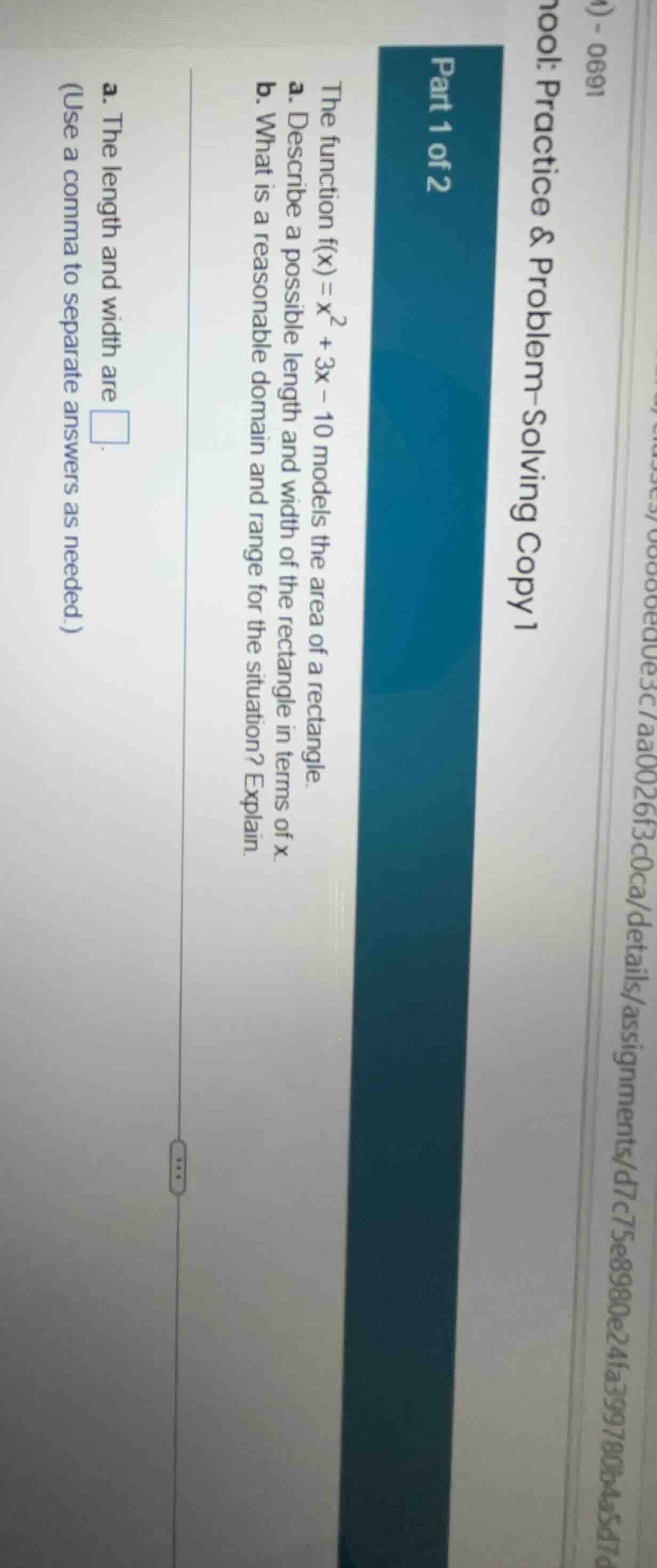
part 1 of 2 the function f(x) = x² + 3x - 10 models the area of a rectangle. a. describe a possible length and width of the rectangle in terms of x. b. what is a reasonable domain and range for the situation? explain. a. the length and width are (use a comma to separate answers as needed.)
Part a:
Step1: Factor the quadratic function
We have the area function \( f(x)=x^{2}+3x - 10 \). To find the length and width, we factor the quadratic. We need two numbers that multiply to \(- 10\) and add up to \(3\). The numbers are \(5\) and \(-2\). So, \(x^{2}+3x - 10=(x + 5)(x-2)\).
Step2: Determine length and width
Since the area of a rectangle is length times width, and the side lengths must be positive (as they represent physical dimensions), we consider \(x+5\) and \(x - 2\) as possible length and width. But we also need to ensure that the side lengths are positive. For \(x-2>0\), \(x > 2\). So a possible length and width (depending on the context, assuming \(x>2\)) are \(x + 5\) and \(x-2\).
Step1: Determine the domain
The side lengths of a rectangle must be positive. From the factors of the area function \(f(x)=(x + 5)(x - 2)\), the width (or length) \(x-2>0\) (because if \(x-2\leqslant0\), then the side length would be non - positive which is not possible for a rectangle). Solving \(x - 2>0\) gives \(x>2\). Also, \(x+5\) is always positive for \(x>2\) (since when \(x > 2\), \(x+5>2 + 5=7>0\)). So the domain is all real numbers \(x\) such that \(x>2\), in interval notation \((2,\infty)\).
Step2: Determine the range
The function \(f(x)=x^{2}+3x - 10\) is a quadratic function with \(a = 1>0\), so it opens upwards. The vertex of a quadratic function \(y=ax^{2}+bx + c\) has its \(x\) - coordinate at \(x=-\frac{b}{2a}\). Here, \(a = 1\) and \(b = 3\), so \(x=-\frac{3}{2\times1}=-\frac{3}{2}\). But our domain starts at \(x = 2\). We evaluate the function at \(x = 2\): \(f(2)=2^{2}+3\times2-10=4 + 6-10=0\). But since \(x>2\), as \(x\) increases, \(f(x)\) (the area) will also increase because the function is increasing for \(x>-\frac{3}{2}\) (since the vertex is at \(x =-\frac{3}{2}\) and the parabola opens upwards). So the range is all real numbers \(y\) such that \(y>0\) (because when \(x>2\), the area is positive and increasing), in interval notation \((0,\infty)\). The reason for the domain is that side lengths of a rectangle must be positive, so \(x-2>0\) (to ensure the smaller side is positive) and \(x + 5>0\) (which is always true for \(x>2\)). For the range, since the quadratic opens upwards and at \(x = 2\) the area is \(0\) (but \(x>2\) so the area is greater than \(0\)) and as \(x\) increases, the area increases without bound.

Snap & solve any problem in the app
Get step-by-step solutions on Sovi AI
Photo-based solutions with guided steps
Explore more problems and detailed explanations
\(x + 5\), \(x-2\) (or vice - versa, as long as both are positive for the domain of \(x\) considered)