QUESTION IMAGE
Question
part iii
answer the question in this part. each correct answer will receive 6 credits. clearly indicate the necessary steps, including appropriate formula substitutions, diagrams, graphs, charts, etc. utilize the information provided for each question to determine your answer. note that diagrams are not necessarily drawn to scale. for all questions in this part, a correct numerical answer with no work shown will receive only 1 credit. all answers should be written in pen, except for graphs and drawings, which should be done in pencil.
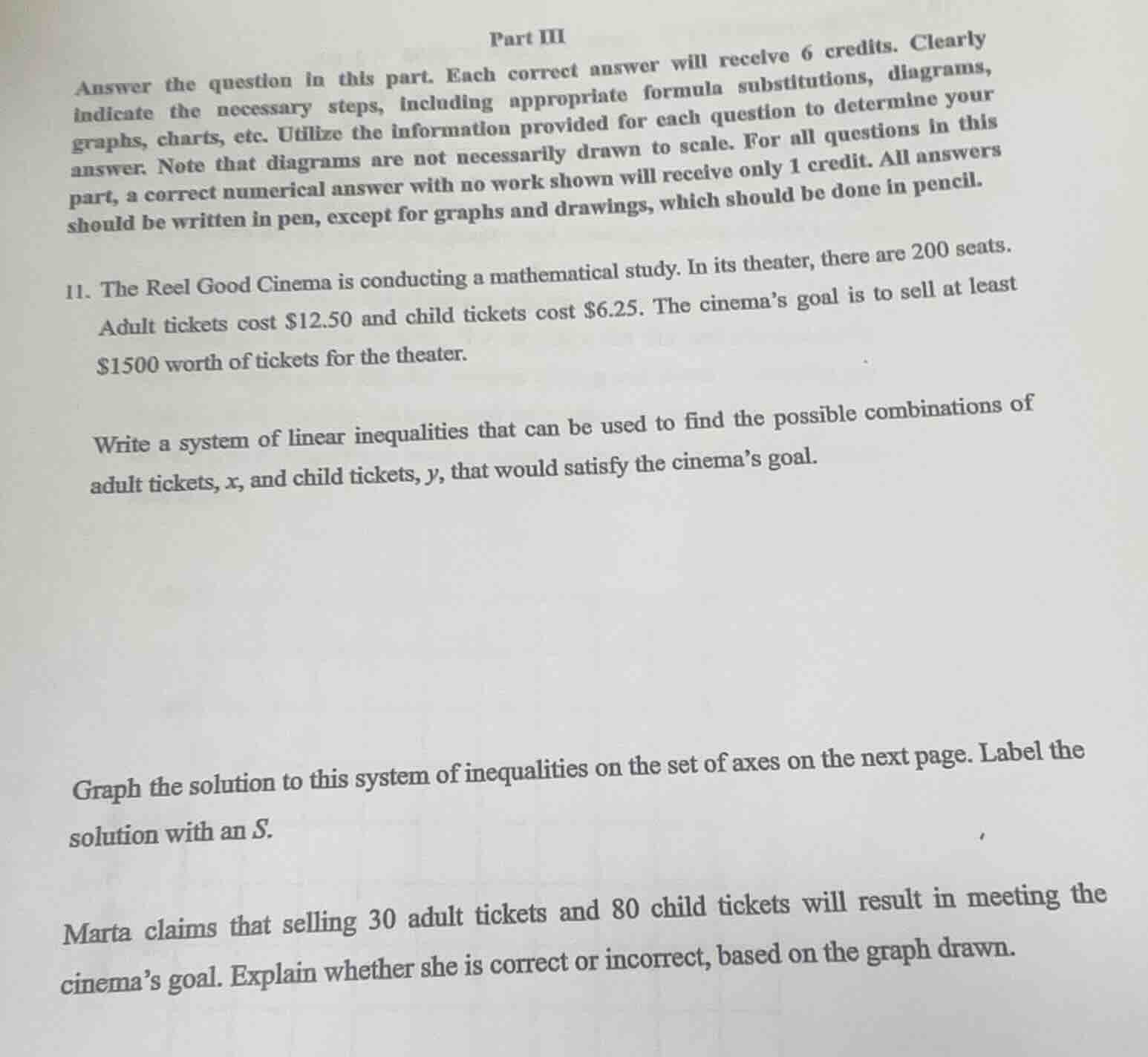
- the reel good cinema is conducting a mathematical study. in its theater, there are 200 seats. adult tickets cost $12.50 and child tickets cost $6.25. the cinema’s goal is to sell at least $1500 worth of tickets for the theater.
write a system of linear inequalities that can be used to find the possible combinations of adult tickets, x, and child tickets, y, that would satisfy the cinema’s goal.
graph the solution to this system of inequalities on the set of axes on the next page. label the solution with an s.
marta claims that selling 30 adult tickets and 80 child tickets will result in meeting the cinema’s goal. explain whether she is correct or incorrect, based on the graph drawn.
First Sub - Question: Write the system of linear inequalities
Step 1: Consider the number of seats
The total number of adult tickets \(x\) and child tickets \(y\) cannot exceed the total number of seats, which is 200. Also, the number of tickets cannot be negative. So we have the inequality \(x + y\leqslant200\) (since the total number of tickets sold is at most 200) and \(x\geqslant0\), \(y\geqslant0\).
Step 2: Consider the revenue
The revenue from adult tickets is \(12.50x\) and from child tickets is \(6.25y\). The cinema wants to sell at least \(\$1500\) worth of tickets, so the revenue inequality is \(12.50x + 6.25y\geqslant1500\).
Combining these, the system of linear inequalities is:
\(
\)
Second Sub - Question: Graph the solution
(Note: Since we can't draw the graph here, we can describe the steps to graph)
- For the line \(x + y=200\), when \(x = 0\), \(y = 200\); when \(y = 0\), \(x=200\). Draw a solid line (since the inequality is \(\leqslant\)) and shade the region below the line (including the line) for \(x + y\leqslant200\).
- For the line \(12.50x+6.25y = 1500\), we can simplify it by dividing throughout by 6.25: \(2x + y=240\). When \(x = 0\), \(y = 240\); when \(y = 0\), \(x = 120\). Draw a solid line (since the inequality is \(\geqslant\)) and shade the region above the line (including the line) for \(12.50x + 6.25y\geqslant1500\).
- For \(x\geqslant0\) and \(y\geqslant0\), we shade the region in the first quadrant. The solution region \(S\) is the intersection of all these shaded regions.
Third Sub - Question: Check Marta's claim
Marta claims to sell \(x = 30\) adult tickets and \(y = 80\) child tickets.
- First, check the seat constraint: \(x + y=30 + 80=110\leqslant200\), so the seat constraint is satisfied.
- Then, check the revenue constraint: Calculate the revenue \(12.50\times30+6.25\times80=375 + 500=875\). Since \(875<1500\), the revenue constraint \(12.50x + 6.25y\geqslant1500\) is not satisfied.
So Marta is incorrect.

Snap & solve any problem in the app
Get step-by-step solutions on Sovi AI
Photo-based solutions with guided steps
Explore more problems and detailed explanations
s:
- The system of linear inequalities is \(\boldsymbol{
}\)
- (Graph description as above, with the solution region labeled \(S\))
- Marta is incorrect because when \(x = 30\) and \(y = 80\), the revenue \(12.50\times30 + 6.25\times80=875<1500\), so the revenue goal is not met.