QUESTION IMAGE
Question
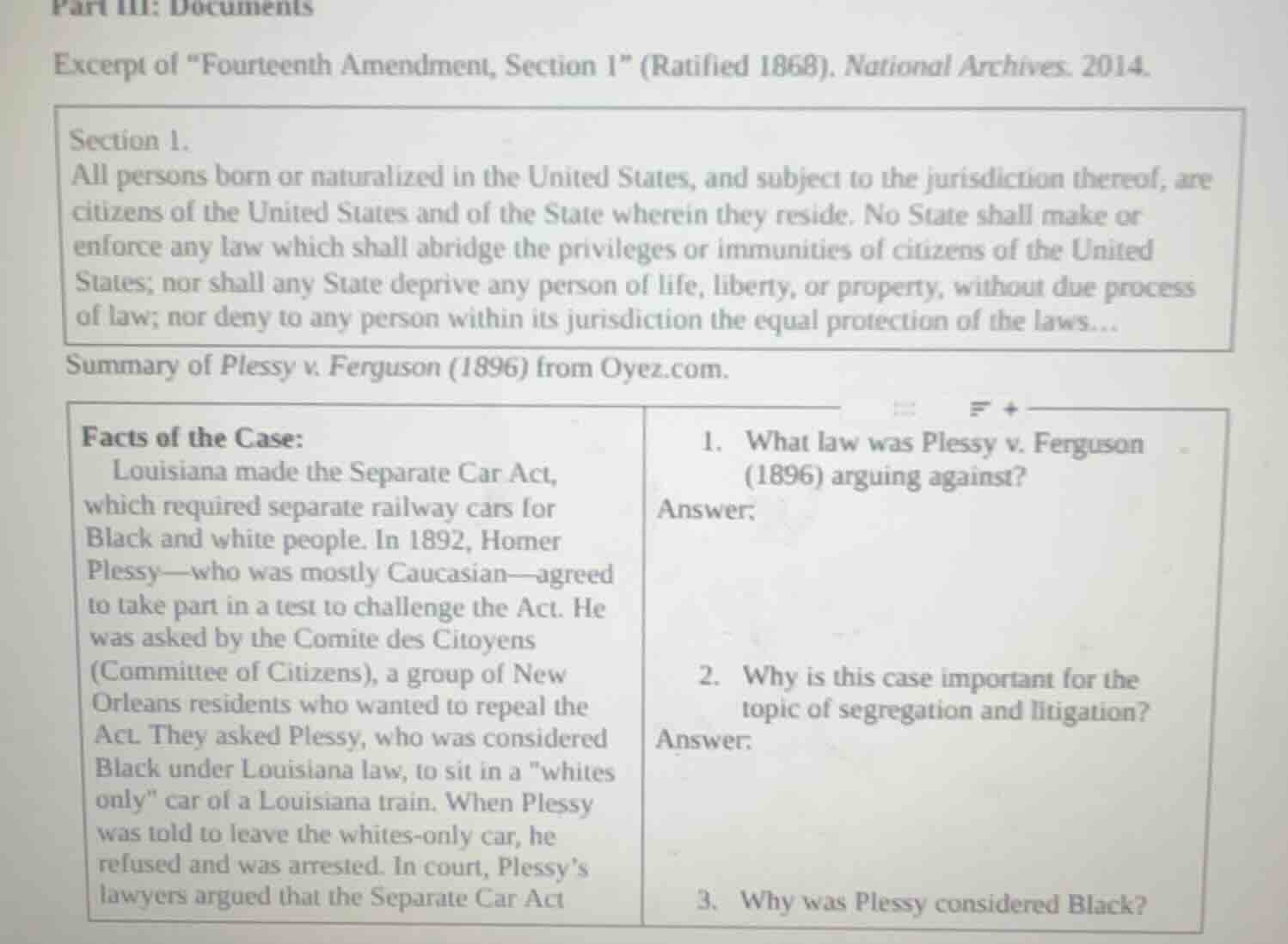
part iii: documents
excerpt of \fourteenth amendment, section 1\ (ratified 1868). national archives. 2014.
section 1.
all persons born or naturalized in the united states, and subject to the jurisdiction thereof, are citizens of the united states and of the state wherein they reside. no state shall make or enforce any law which shall abridge the privileges or immunities of citizens of the united states; nor shall any state deprive any person of life, liberty, or property, without due process of law; nor deny to any person within its jurisdiction the equal protection of the laws...
summary of plessy v. ferguson (1896) from oyez.com.
facts of the case:
louisiana made the separate car act, which required separate railway cars for black and white people. in 1892, homer plessy—who was mostly caucasian—agreed to take part in a test to challenge the act. he was asked by the comite des citoyens (committee of citizens), a group of new orleans residents who wanted to repeal the act. they asked plessy, who was considered black under louisiana law, to sit in a \whites only\ car of a louisiana train. when plessy was told to leave the whites-only car, he refused and was arrested. in court, plessys lawyers argued that the separate car act
- what law was plessy v. ferguson (1896) arguing against?
answer:
- why is this case important for the topic of segregation and litigation?
answer:
- why was plessy considered black?
- The relevant law is explicitly stated in the case facts as the law Plessy challenged.
- This case established a key legal doctrine that shaped segregation policy for decades, impacting segregation and litigation trajectories.
- The case facts note the state's legal definition that determined Plessy's racial classification.

Snap & solve any problem in the app
Get step-by-step solutions on Sovi AI
Photo-based solutions with guided steps
Explore more problems and detailed explanations
- The Separate Car Act (Louisiana's law requiring separate railway cars for Black and white people)
- It upheld the "separate but equal" doctrine, which legally sanctioned racial segregation in public facilities across the United States for nearly 60 years, setting a precedent that enabled systemic segregation through litigation.
- He was considered Black under Louisiana state law, which used a one-drop rule or similar racial classification standard that categorized anyone with Black ancestry as Black.