QUESTION IMAGE
Question
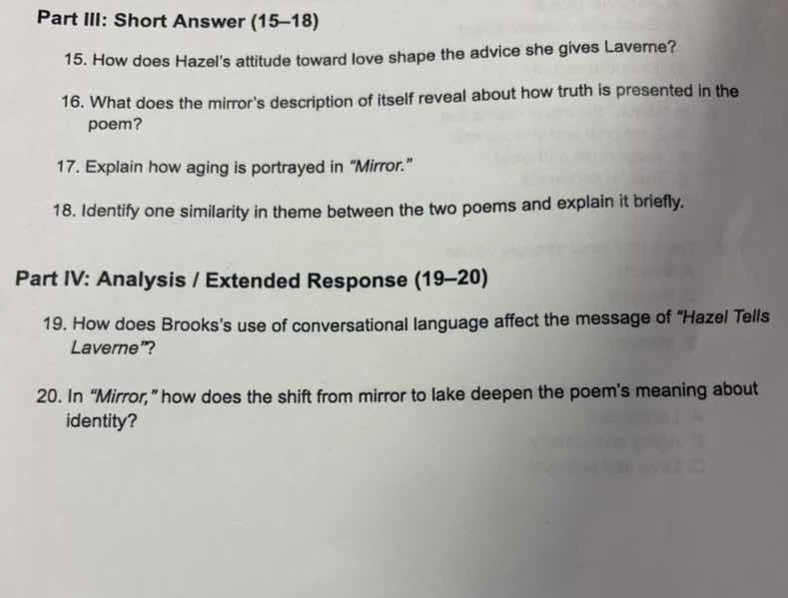
part iii: short answer (15-18)
- how does hazels attitude toward love shape the advice she gives laverne?
- what does the mirrors description of itself reveal about how truth is presented in the poem?
- explain how aging is portrayed in \mirror.\
- identify one similarity in theme between the two poems and explain it briefly.
part iv: analysis / extended response (19-20)
- how does brookss use of conversational language affect the message of \hazel tells laverne\?
- in \mirror,\ how does the shift from mirror to lake deepen the poems meaning about identity?
For 15:
Hazel has a cynical, distrustful attitude toward love, viewing it as a trap that leads to heartbreak and limits women's freedom. This shapes her advice to Laverne to reject romantic advances, prioritize her own independence, and avoid the vulnerability that comes with love, warning Laverne not to let a man "ruin" her life.
For 16:
The mirror describes itself as "exact," "unmisted by love or dislike," and a "little god." This reveals that truth in the poem is presented as unemotional, objective, and unflinching—it does not soften or distort reality to suit human comfort, reflecting what is truly there without bias, even when it is painful to confront.
For 17:
In Mirror, aging is portrayed as a gradual, unavoidable, and distressing process. The mirror reflects the woman's youth fading over time; she grows upset at her changing face, seeking comfort in candles and the moon (which offer softer, distorted views) but is forced to confront her aging self in the mirror's honest reflection, framing aging as a loss of the self she once knew.
For 18:
A shared theme is the tension between societal expectations and individual identity. In Hazel Tells Laverne, Hazel pushes back against the romanticized, passive view of women in love, advocating for personal autonomy over conforming to relationship norms. In Mirror, the woman struggles against the societal pressure to stay young, grappling with her changing identity as she ages and the gap between her idealized self and her real reflection.
For 19:
Brooks’s use of conversational, informal language (like Hazel’s blunt, colloquial speech: "lemme tell you" "aint no prince charming") makes her advice feel authentic and relatable, like a real friend warning another. This casual tone emphasizes the poem's message about the unglamorous, harsh realities of love and female vulnerability, grounding the critique of romantic ideals in everyday, working-class female experience rather than abstract commentary.
For 20:
The shift from mirror to lake deepens the poem's meaning about identity by expanding the scope of self-reflection. The mirror is a fixed, immediate, surface-level reflection of physical identity. The lake, however, is deeper, murkier, and holds the woman's reflection over time, symbolizing the hidden, layered parts of her identity—regret, the weight of time, and the disconnect between her external self and internal sense of self. The lake also shows that identity is not static; it evolves, and the woman's struggle to recognize herself in the lake's waters highlights the complexity of growing older and losing touch with one's former self.

Snap & solve any problem in the app
Get step-by-step solutions on Sovi AI
Photo-based solutions with guided steps
Explore more problems and detailed explanations
- Hazel's cynical, independence-focused attitude toward love leads her to advise Laverne to reject romance, avoid vulnerability, and prioritize her own freedom over relationships.
- The mirror's self-description reveals truth as objective, unemotional, and unflinching—presenting reality without bias or comfort, even when it distresses the viewer.
- Aging is portrayed as an unavoidable, distressing process of fading youth; the woman resents her changing reflection, clinging to softer, distorted views of herself but is forced to confront her growing age.
- A shared theme is resisting societal expectations of identity: Hazel rejects romantic norms for female autonomy, while the woman in Mirror grapples with societal pressure to stay young, confronting the gap between her idealized and real self.
- Brooks’s conversational language makes Hazel’s advice feel authentic and relatable, grounding the poem's critique of romantic ideals in everyday working-class female experience, and emphasizing the harsh, unglamorous reality of female vulnerability in relationships.
- The shift from mirror to lake deepens the poem's exploration of identity by moving from a fixed, surface-level reflection of physical self to a deeper, murkier symbol of layered, evolving identity—capturing the hidden regrets, the weight of time, and the woman's growing disconnect from her former self as she ages.