QUESTION IMAGE
Question
part b
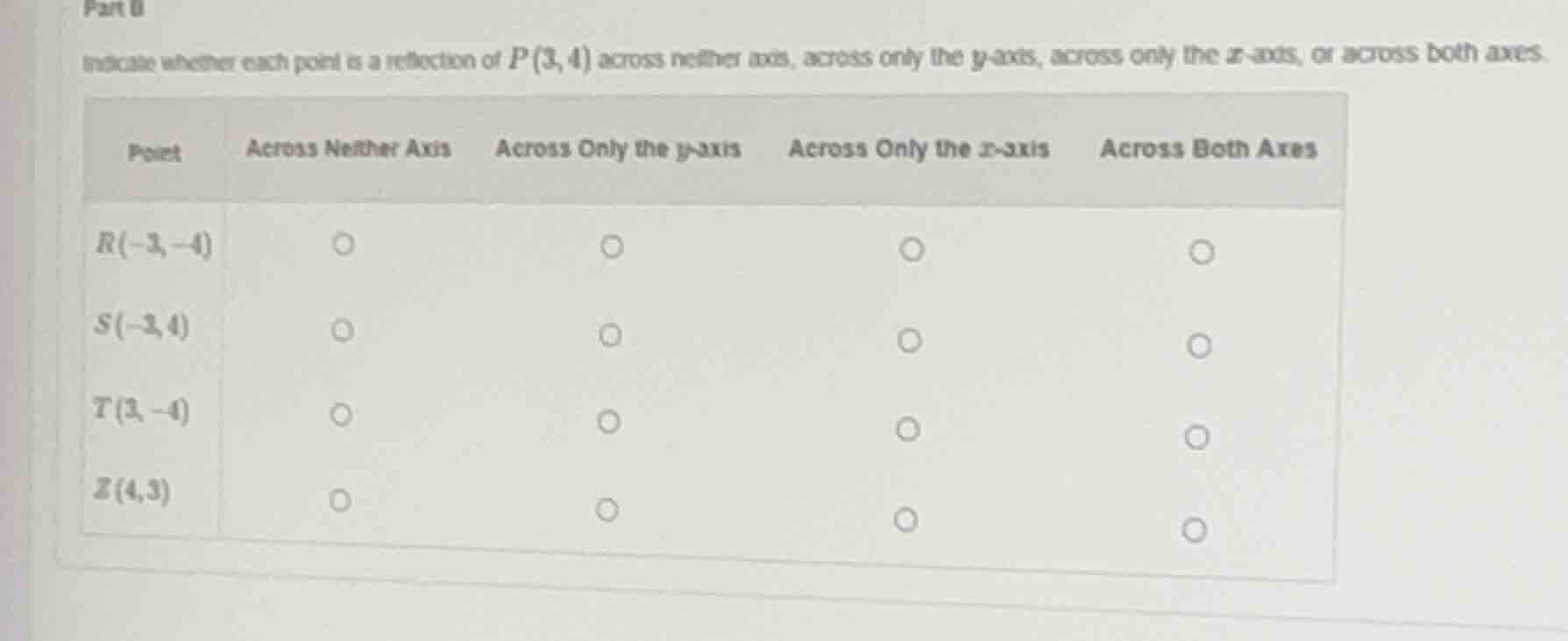
indicate whether each point is a reflection of ( p(3, 4) ) across neither axis, across only the ( y )-axis, across only the ( x )-axis, or across both axes.
| point | across neither axis | across only the ( y )-axis | across only the ( x )-axis | across both axes |
|---|---|---|---|---|
| ( s(-3, 4) ) | ( circ ) | ( circ ) | ( circ ) | ( circ ) |
| ( t(3, -4) ) | ( circ ) | ( circ ) | ( circ ) | ( circ ) |
| ( z(4, 3) ) | ( circ ) | ( circ ) | ( circ ) | ( circ ) |
To solve this, we use the rules for reflecting a point \((x, y)\) across the axes:
- Reflection across the \(y\)-axis: \((-x, y)\)
- Reflection across the \(x\)-axis: \((x, -y)\)
- Reflection across both axes: \((-x, -y)\)
Point \( R(-3, -4) \)
Original point \( P(3, 4) \).
- Reflect across \( y \)-axis: \((-3, 4)\) (not \( R \)).
- Reflect across \( x \)-axis: \((3, -4)\) (not \( R \)).
- Reflect across both axes: \((-3, -4)\) (matches \( R \)).
Thus, \( R \) is a reflection across both axes.
Point \( S(-3, 4) \)
Original point \( P(3, 4) \).
- Reflect across \( y \)-axis: \((-3, 4)\) (matches \( S \)).
- Reflect across \( x \)-axis: \((3, -4)\) (not \( S \)).
Thus, \( S \) is a reflection across only the \( y \)-axis.
Point \( T(3, -4) \)
Original point \( P(3, 4) \).
- Reflect across \( y \)-axis: \((-3, 4)\) (not \( T \)).
- Reflect across \( x \)-axis: \((3, -4)\) (matches \( T \)).
Thus, \( T \) is a reflection across only the \( x \)-axis.
Point \( Z(4, 3) \)
Original point \( P(3, 4) \).
- Reflection across \( y \)-axis: \((-3, 4)\) (not \( Z \)).
- Reflection across \( x \)-axis: \((3, -4)\) (not \( Z \)).
- Reflection across both axes: \((-3, -4)\) (not \( Z \)).
Thus, \( Z \) is a reflection across neither axis.
Final Answers (Check the Corresponding Circles):
- \( R(-3, -4) \): Across Both Axes
- \( S(-3, 4) \): Across Only the \( y \)-axis
- \( T(3, -4) \): Across Only the \( x \)-axis
- \( Z(4, 3) \): Across Neither Axis

Snap & solve any problem in the app
Get step-by-step solutions on Sovi AI
Photo-based solutions with guided steps
Explore more problems and detailed explanations
To solve this, we use the rules for reflecting a point \((x, y)\) across the axes:
- Reflection across the \(y\)-axis: \((-x, y)\)
- Reflection across the \(x\)-axis: \((x, -y)\)
- Reflection across both axes: \((-x, -y)\)
Point \( R(-3, -4) \)
Original point \( P(3, 4) \).
- Reflect across \( y \)-axis: \((-3, 4)\) (not \( R \)).
- Reflect across \( x \)-axis: \((3, -4)\) (not \( R \)).
- Reflect across both axes: \((-3, -4)\) (matches \( R \)).
Thus, \( R \) is a reflection across both axes.
Point \( S(-3, 4) \)
Original point \( P(3, 4) \).
- Reflect across \( y \)-axis: \((-3, 4)\) (matches \( S \)).
- Reflect across \( x \)-axis: \((3, -4)\) (not \( S \)).
Thus, \( S \) is a reflection across only the \( y \)-axis.
Point \( T(3, -4) \)
Original point \( P(3, 4) \).
- Reflect across \( y \)-axis: \((-3, 4)\) (not \( T \)).
- Reflect across \( x \)-axis: \((3, -4)\) (matches \( T \)).
Thus, \( T \) is a reflection across only the \( x \)-axis.
Point \( Z(4, 3) \)
Original point \( P(3, 4) \).
- Reflection across \( y \)-axis: \((-3, 4)\) (not \( Z \)).
- Reflection across \( x \)-axis: \((3, -4)\) (not \( Z \)).
- Reflection across both axes: \((-3, -4)\) (not \( Z \)).
Thus, \( Z \) is a reflection across neither axis.
Final Answers (Check the Corresponding Circles):
- \( R(-3, -4) \): Across Both Axes
- \( S(-3, 4) \): Across Only the \( y \)-axis
- \( T(3, -4) \): Across Only the \( x \)-axis
- \( Z(4, 3) \): Across Neither Axis