QUESTION IMAGE
Question
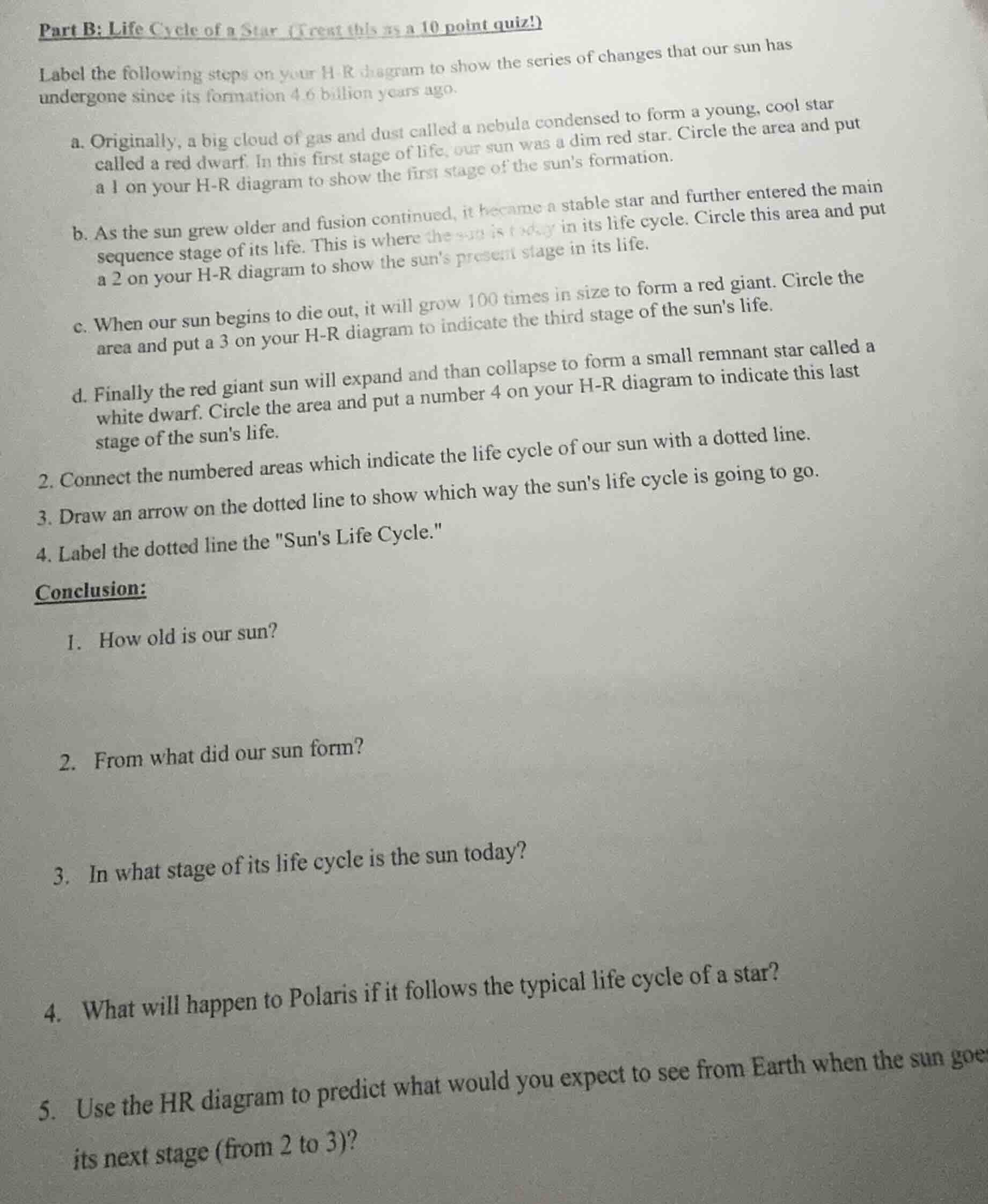
part b: life cycle of a star (treat this as a 10 point quiz!) label the following steps on your h - r diagram to show the series of changes that our sun has undergone since its formation 4.6 billion years ago. a. originally, a big cloud of gas and dust called a nebula condensed to form a young, cool star called a red dwarf. in this first stage of life, our sun was a dim red star. circle the area and put a 1 on your h - r diagram to show the first stage of the suns formation. b. as the sun grew older and fusion continued, it became a stable star and further entered the main sequence stage of its life. this is where the sun is today in its life cycle. circle this area and put a 2 on your h - r diagram to show the suns present stage in its life. c. when our sun begins to die out, it will grow 100 times in size to form a red giant. circle the area and put a 3 on your h - r diagram to indicate the third stage of the suns life. d. finally the red giant sun will expand and than collapse to form a small remnant star called a white dwarf. circle the area and put a number 4 on your h - r diagram to indicate this last stage of the suns life. 2. connect the numbered areas which indicate the life cycle of our sun with a dotted line. 3. draw an arrow on the dotted line to show which way the suns life cycle is going to go. 4. label the dotted line the \suns life cycle.\ conclusion: 1. how old is our sun? 2. from what did our sun form? 3. in what stage of its life cycle is the sun today? 4. what will happen to polaris if it follows the typical life cycle of a star? 5. use the hr diagram to predict what would you expect to see from earth when the sun goes its next stage (from 2 to 3)?
Conclusion Questions (Answered with Explanation Format)
1. How old is our sun?
From the problem statement, it's mentioned the sun formed 4.6 billion years ago, and this is a known scientific fact about the sun's age.
The problem's part (a) states the sun originated from a big cloud of gas and dust called a nebula that condensed. This aligns with stellar formation theory (nebular hypothesis) where stars form from nebulae.
From part (b) of the problem, it says "As the sun grew older... it became a stable star and further entered the main sequence stage of its life. This is where the sun is today in its life cycle." So the sun is in the main sequence stage.

Snap & solve any problem in the app
Get step-by-step solutions on Sovi AI
Photo-based solutions with guided steps
Explore more problems and detailed explanations
Our sun is approximately 4.6 billion years old.