QUESTION IMAGE
Question
part one: across the following questions, select main text...
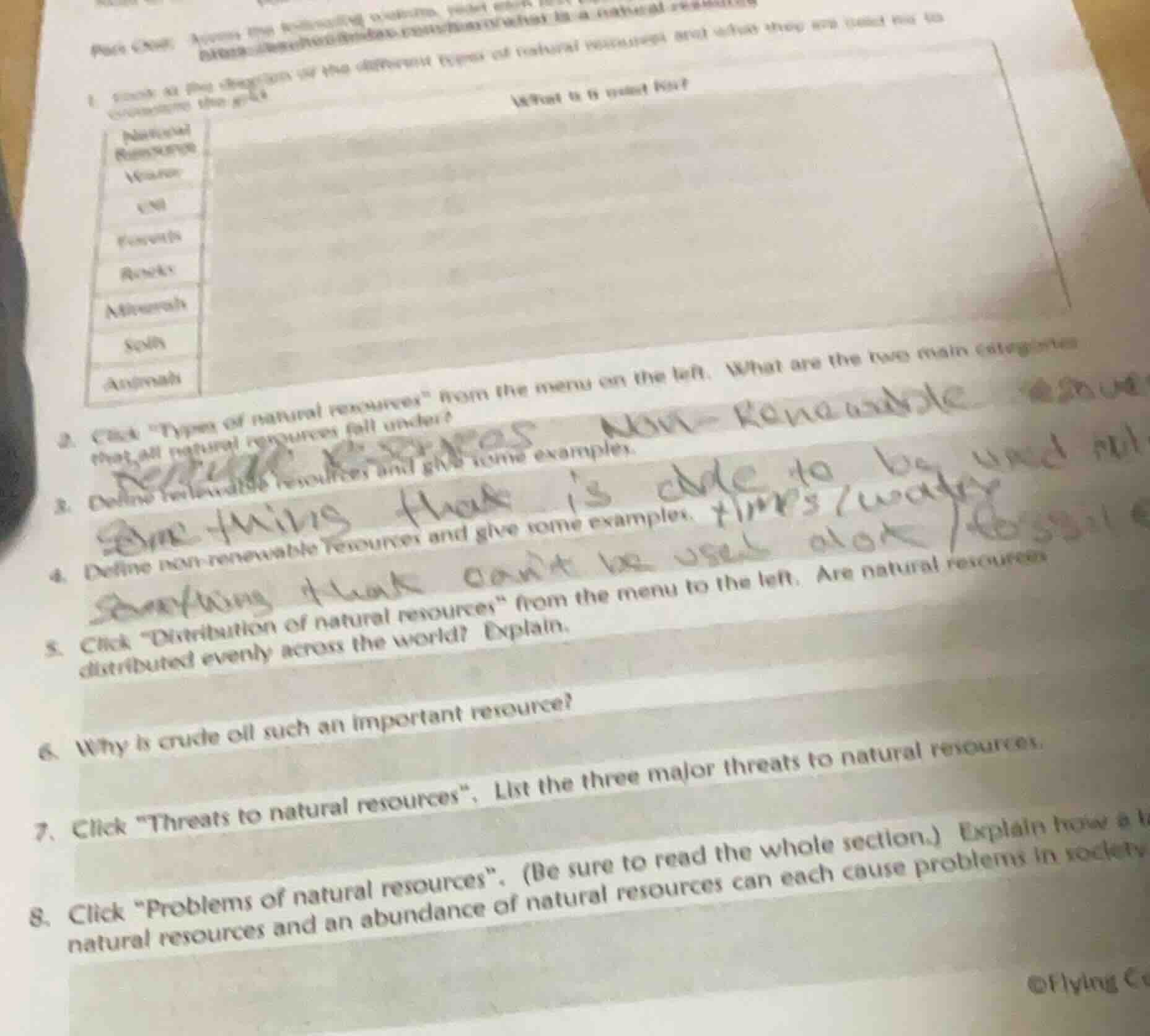
- look at the diagram of the different types of natural resources and what they are used for. complete the grid.
natural resource | what is it used for?
water |
coal |
forests |
rocks |
minerals |
soils |
animals |
- click \types of natural resources\ from the menu on the left. what are the two main categories that all natural resources fall under?
- define renewable resources and give some examples.
- define non - renewable resources and give some examples.
- click \distribution of natural resources\ from the menu to the left. are natural resources distributed evenly across the world? explain.
- why is crude oil such an important resource?
- click \threats to natural resources\. list the three major threats to natural resources.
- click \problems of natural resources\. (be sure to read the whole section.) explain how a lack of natural resources and an abundance of natural resources can each cause problems in society.
Brief Explanations
- For each resource, identify its core use:
- Water: Critical for drinking, agriculture, industry
- Coal: Used for electricity generation, fuel
- Forests: Provide timber, habitat, carbon sequestration
- Rocks: Construction, mineral extraction
- Minerals: Manufacturing, electronics, construction
- Soils: Supports crop growth, ecosystem health
- Animals: Food, labor, ecosystem balance
- The two broad categories cover all natural resources.
- Renewable resources replenish faster than they are used.
- Non-renewable resources form over geological time and are finite.
- Natural resource distribution depends on geological, climatic, and biological factors that are uneven globally.
- Crude oil is a foundational energy source and industrial feedstock.
- The three most widespread threats stem from human activity and overuse.
- Scarcity limits access and drives competition; abundance can lead to mismanagement and conflict.

Snap & solve any problem in the app
Get step-by-step solutions on Sovi AI
Photo-based solutions with guided steps
Explore more problems and detailed explanations
1.
- Water: Used for drinking, farming, industry
- Coal: Used for electricity, fuel
- Forests: Used for timber, ecosystem support
- Rocks: Used for construction, raw materials
- Minerals: Used for manufacturing, tech components
- Soils: Used for growing food, plant support
- Animals: Used for food, ecosystem balance
- Renewable resources and non-renewable resources
- Renewable resources are natural resources that can be replenished naturally over a short period of time. Examples: solar energy, wind energy, freshwater, trees
- Non-renewable resources are natural resources that form over extremely long geological timescales and cannot be replenished within a human lifespan. Examples: crude oil, natural gas, coal, uranium
- No, natural resources are not distributed evenly across the world. This is because their formation depends on specific geological processes, climate conditions, and ecological factors that vary greatly by region (e.g., oil forms in ancient marine basins, tropical rainforests require warm, wet climates).
- Crude oil is critical because it is the primary source of fuel for transportation (gasoline, diesel, jet fuel), a key feedstock for manufacturing plastics, fertilizers, and chemicals, and a major source of electricity generation in many regions. It underpins global industrial and economic systems.
- 1. Overexploitation/overconsumption
- Pollution and contamination
- Habitat destruction and deforestation
- A scarcity of natural resources can lead to competition, rising prices, limited access to essential goods (like water or food), and even conflict between groups or nations. An abundance of natural resources can cause problems like resource curse (over-reliance on one resource leading to economic instability), environmental degradation from over-extraction, and corruption tied to resource control.