QUESTION IMAGE
Question
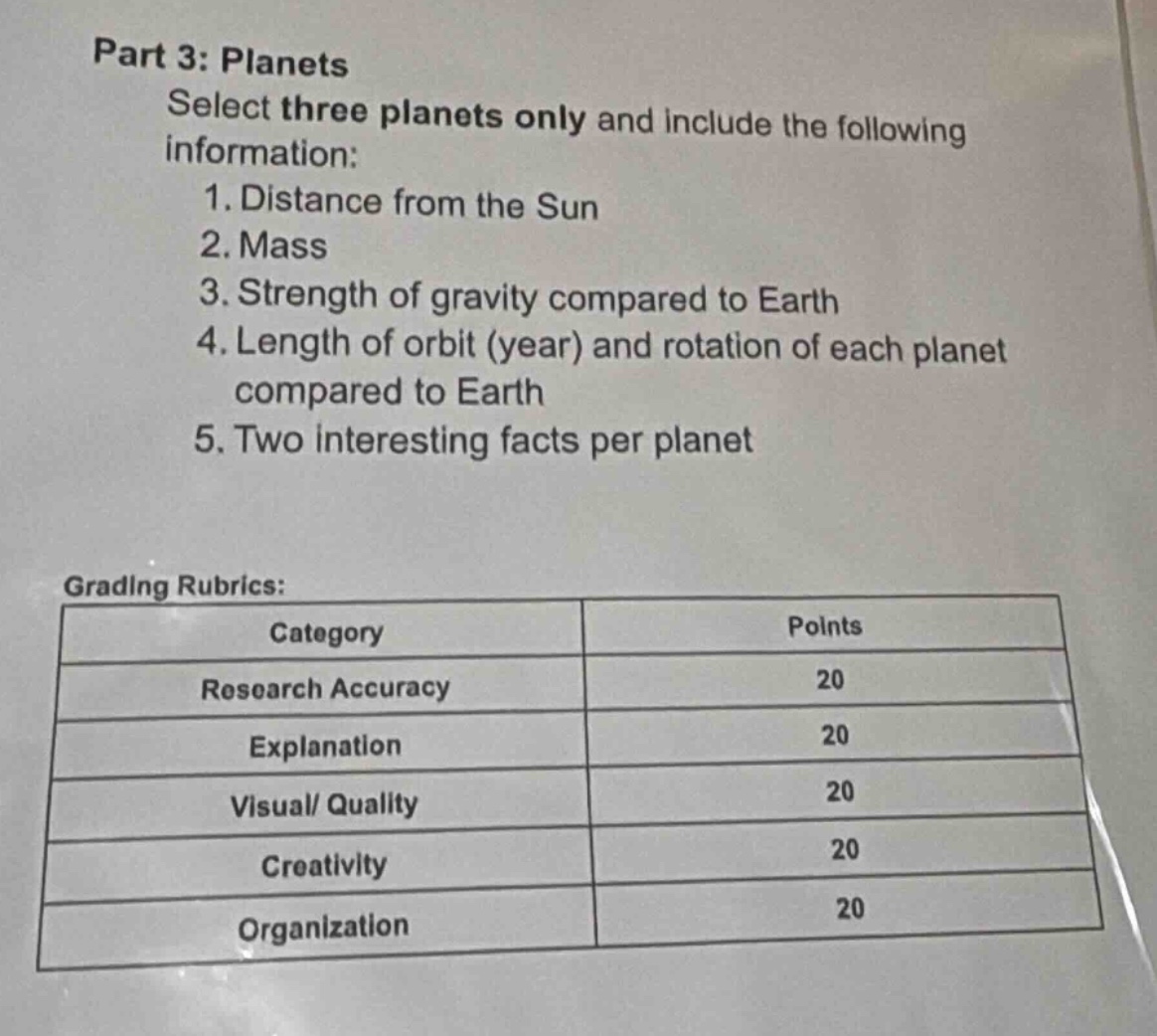
part 3: planets
select three planets only and include the following
information:
- distance from the sun
- mass
- strength of gravity compared to earth
- length of orbit (year) and rotation of each planet
compared to earth
- two interesting facts per planet
grading rubrics:
| category | points |
|---|---|
| explanation | 20 |
| visual/ quality | 20 |
| creativity | 20 |
| organization | 20 |
To complete this task, we'll select three planets (Mercury, Venus, and Mars) and gather the required information:
1. Mercury
- Distance from the Sun: ~57.9 million km (0.387 AU).
- Mass: ~3.3011 × 10²³ kg (0.055 Earth masses).
- Gravity vs. Earth: ~0.38 (38% of Earth’s gravity).
- Orbit (Year) & Rotation:
- Orbit: ~88 Earth days (0.24 Earth years).
- Rotation: ~58.6 Earth days (slowest rotation of any planet).
- Interesting Facts:
- Has no moons or atmosphere.
- Extreme temperature swings (427°C day, -173°C night).
2. Venus
- Distance from the Sun: ~108.2 million km (0.723 AU).
- Mass: ~4.8675 × 10²⁴ kg (0.815 Earth masses).
- Gravity vs. Earth: ~0.907 (90.7% of Earth’s gravity).
- Orbit (Year) & Rotation:
- Orbit: ~225 Earth days (0.615 Earth years).
- Rotation: ~243 Earth days (retrograde rotation, opposite to most planets).
- Interesting Facts:
- Thick, toxic atmosphere (96% CO₂) creates a runaway greenhouse effect (surface temp ~462°C).
- Often called Earth’s “sister planet” due to similar size and mass.
3. Mars
- Distance from the Sun: ~227.9 million km (1.524 AU).
- Mass: ~6.4171 × 10²³ kg (0.107 Earth masses).
- Gravity vs. Earth: ~0.376 (37.6% of Earth’s gravity).
- Orbit (Year) & Rotation:
- Orbit: ~687 Earth days (1.88 Earth years).
- Rotation: ~24.6 Earth hours (very similar to Earth’s day).
- Interesting Facts:
- Has two small moons (Phobos and Deimos).
- Red appearance comes from iron oxide (rust) in its soil.
Tips for Presentation:
- Use a table or organized layout to display data clearly.
- Include visuals (e.g., planet images, scale comparisons) for “Visual/Quality.”
- Highlight unique details (e.g., Mercury’s slow rotation, Venus’ retrograde spin) for “Creativity.”
This information meets the requirements for research accuracy, explanation, and organization. Adjust formatting (e.g., add charts, color-coding) to enhance visual quality!

Snap & solve any problem in the app
Get step-by-step solutions on Sovi AI
Photo-based solutions with guided steps
Explore more problems and detailed explanations
To complete this task, we'll select three planets (Mercury, Venus, and Mars) and gather the required information:
1. Mercury
- Distance from the Sun: ~57.9 million km (0.387 AU).
- Mass: ~3.3011 × 10²³ kg (0.055 Earth masses).
- Gravity vs. Earth: ~0.38 (38% of Earth’s gravity).
- Orbit (Year) & Rotation:
- Orbit: ~88 Earth days (0.24 Earth years).
- Rotation: ~58.6 Earth days (slowest rotation of any planet).
- Interesting Facts:
- Has no moons or atmosphere.
- Extreme temperature swings (427°C day, -173°C night).
2. Venus
- Distance from the Sun: ~108.2 million km (0.723 AU).
- Mass: ~4.8675 × 10²⁴ kg (0.815 Earth masses).
- Gravity vs. Earth: ~0.907 (90.7% of Earth’s gravity).
- Orbit (Year) & Rotation:
- Orbit: ~225 Earth days (0.615 Earth years).
- Rotation: ~243 Earth days (retrograde rotation, opposite to most planets).
- Interesting Facts:
- Thick, toxic atmosphere (96% CO₂) creates a runaway greenhouse effect (surface temp ~462°C).
- Often called Earth’s “sister planet” due to similar size and mass.
3. Mars
- Distance from the Sun: ~227.9 million km (1.524 AU).
- Mass: ~6.4171 × 10²³ kg (0.107 Earth masses).
- Gravity vs. Earth: ~0.376 (37.6% of Earth’s gravity).
- Orbit (Year) & Rotation:
- Orbit: ~687 Earth days (1.88 Earth years).
- Rotation: ~24.6 Earth hours (very similar to Earth’s day).
- Interesting Facts:
- Has two small moons (Phobos and Deimos).
- Red appearance comes from iron oxide (rust) in its soil.
Tips for Presentation:
- Use a table or organized layout to display data clearly.
- Include visuals (e.g., planet images, scale comparisons) for “Visual/Quality.”
- Highlight unique details (e.g., Mercury’s slow rotation, Venus’ retrograde spin) for “Creativity.”
This information meets the requirements for research accuracy, explanation, and organization. Adjust formatting (e.g., add charts, color-coding) to enhance visual quality!