QUESTION IMAGE
Question
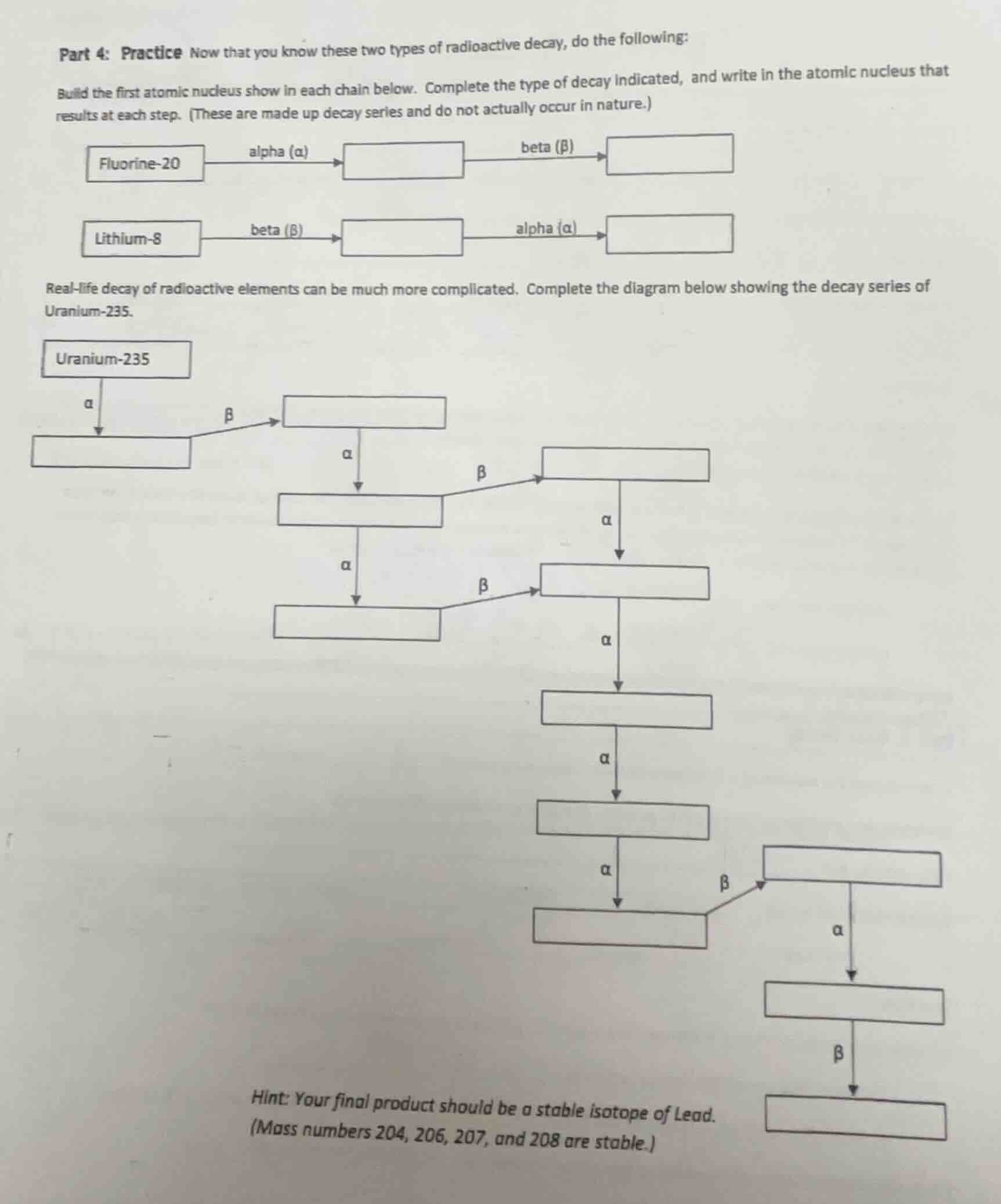
part 4: practice now that you know these two types of radioactive decay, do the following:
build the first atomic nucleus show in each chain below. complete the type of decay indicated, and write in the atomic nucleus that results at each step. (these are made up decay series and do not actually occur in nature.)
fluorine-20 → (alpha ($alpha$)) → $square$ → (beta ($\beta$)) → $square$
lithium-8 → (beta ($\beta$)) → $square$ → (alpha ($alpha$)) → $square$
real - life decay of radioactive elements can be much more complicated. complete the diagram below showing the decay series of uranium - 235.
uranium - 235 ↓ (a) ↓ $square$ → (β) → $square$ ↓ (α) ↓ $square$ → (β) → $square$ ↓ (α) ↓ $square$ → (β) → $square$ ↓ (α) ↓ $square$ ↓ (α) ↓ $square$ ↓ (α) ↓ $square$ → (β) → $square$ ↓ (α) ↓ $square$ → (β) ↓ $square$
hint: your final product should be a stable isotope of lead.
(mass numbers 204, 206, 207, and 208 are stable.)
Step1: Recall decay particle properties
Alpha ($\alpha$) = $^4_2\text{He}$: mass number -4, atomic number -2.
Beta ($\beta^-$) = $^{\ \ 0}_{-1}e$: mass number 0, atomic number +1.
Step2: Solve Fluorine-20 chain
Fluorine (F): atomic number 9, mass 20.
Alpha decay: $^{20}_{9}\text{F}
ightarrow ^{20-4}_{9-2}\text{X} = ^{16}_{7}\text{N}$ (Nitrogen-16)
Beta decay: $^{16}_{7}\text{N}
ightarrow ^{16}_{7+1}\text{X} = ^{16}_{8}\text{O}$ (Oxygen-16)
Step3: Solve Lithium-8 chain
Lithium (Li): atomic number 3, mass 8.
Beta decay: $^{8}_{3}\text{Li}
ightarrow ^{8}_{3+1}\text{X} = ^{8}_{4}\text{Be}$ (Beryllium-8)
Alpha decay: $^{8}_{4}\text{Be}
ightarrow ^{8-4}_{4-2}\text{X} = ^{4}_{2}\text{He}$ (Helium-4)
Step4: Solve Uranium-235 series
Uranium (U): atomic number 92, mass 235.
- Alpha decay: $^{235}_{92}\text{U}
ightarrow ^{235-4}_{92-2}\text{X} = ^{231}_{90}\text{Th}$ (Thorium-231)
- Beta decay: $^{231}_{90}\text{Th}
ightarrow ^{231}_{90+1}\text{X} = ^{231}_{91}\text{Pa}$ (Protactinium-231)
- Alpha decay: $^{231}_{91}\text{Pa}
ightarrow ^{231-4}_{91-2}\text{X} = ^{227}_{89}\text{Ac}$ (Actinium-227)
- Beta decay: $^{227}_{89}\text{Ac}
ightarrow ^{227}_{89+1}\text{X} = ^{227}_{90}\text{Th}$ (Thorium-227)
- Alpha decay: $^{227}_{90}\text{Th}
ightarrow ^{227-4}_{90-2}\text{X} = ^{223}_{88}\text{Ra}$ (Radium-223)
- Alpha decay: $^{223}_{88}\text{Ra}
ightarrow ^{223-4}_{88-2}\text{X} = ^{219}_{86}\text{Rn}$ (Radon-219)
- Alpha decay: $^{219}_{86}\text{Rn}
ightarrow ^{219-4}_{86-2}\text{X} = ^{215}_{84}\text{Po}$ (Polonium-215)
- Alpha decay: $^{215}_{84}\text{Po}
ightarrow ^{215-4}_{84-2}\text{X} = ^{211}_{82}\text{Pb}$ (Lead-211)
- Beta decay: $^{211}_{82}\text{Pb}
ightarrow ^{211}_{82+1}\text{X} = ^{211}_{83}\text{Bi}$ (Bismuth-211)
- Alpha decay: $^{211}_{83}\text{Bi}
ightarrow ^{211-4}_{83-2}\text{X} = ^{207}_{81}\text{Tl}$ (Thallium-207)
- Beta decay: $^{207}_{81}\text{Tl}
ightarrow ^{207}_{81+1}\text{X} = ^{207}_{82}\text{Pb}$ (Lead-207, stable)

Snap & solve any problem in the app
Get step-by-step solutions on Sovi AI
Photo-based solutions with guided steps
Explore more problems and detailed explanations
- First Decay Chain:
- Fluorine-20 → alpha (α) → Nitrogen-16
- Nitrogen-16 → beta (β) → Oxygen-16
- Second Decay Chain:
- Lithium-8 → beta (β) → Beryllium-8
- Beryllium-8 → alpha (α) → Helium-4
- Uranium-235 Decay Series:
- Uranium-235 → α → Thorium-231
- Thorium-231 → β → Protactinium-231
- Protactinium-231 → α → Actinium-227
- Actinium-227 → β → Thorium-227
- Thorium-227 → α → Radium-223
- Radium-223 → α → Radon-219
- Radon-219 → α → Polonium-215
- Polonium-215 → α → Lead-211
- Lead-211 → β → Bismuth-211
- Bismuth-211 → α → Thallium-207
- Thallium-207 → β → Lead-207