QUESTION IMAGE
Question
part a
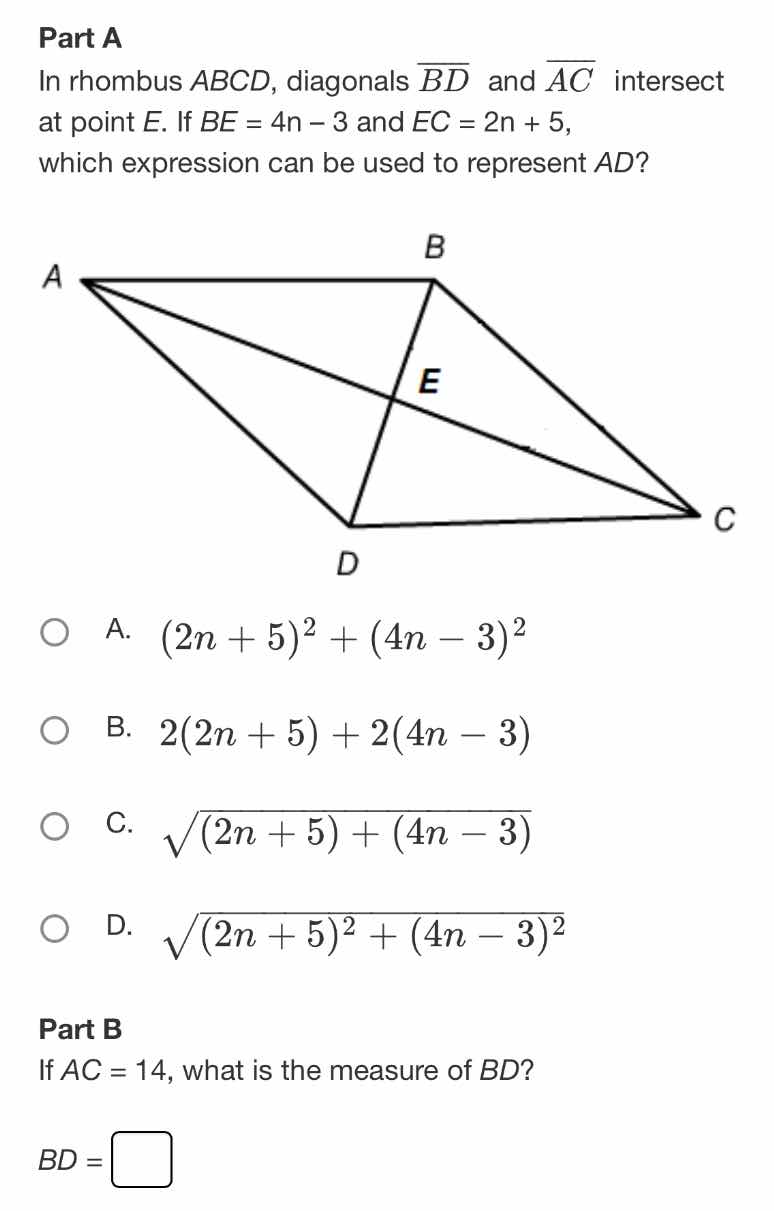
in rhombus (abcd), diagonals (overline{bd}) and (overline{ac}) intersect at point (e). if (be = 4n - 3) and (ec = 2n + 5), which expression can be used to represent (ad)?
image of rhombus (abcd) with diagonals intersecting at (e)
a. ((2n + 5)^2 + (4n - 3)^2)
b. (2(2n + 5) + 2(4n - 3))
c. (sqrt{(2n + 5) + (4n - 3)})
d. (sqrt{(2n + 5)^2 + (4n - 3)^2})
part b
if (ac = 14), what is the measure of (bd)?
(bd = square)
Step1: Recall rhombus diagonal properties
Diagonals of a rhombus bisect each other at right angles, so $AE=EC=2n+5$, $DE=BE=4n-3$, and $\angle AED=90^\circ$.
Step2: Apply Pythagorean theorem to $\triangle AED$
$AD$ is the hypotenuse, so $AD=\sqrt{AE^2 + DE^2}$
Substitute values: $AD=\sqrt{(2n+5)^2 + (4n-3)^2}$
Step3: Solve for $n$ using $AC=14$
Since $AC=2\times EC$, set $14=2(2n+5)$
Solve: $7=2n+5 \implies 2n=2 \implies n=1$
Step4: Calculate length of $BD$
$BD=2\times BE$, substitute $n=1$: $BE=4(1)-3=1$
So $BD=2\times1=2$

Snap & solve any problem in the app
Get step-by-step solutions on Sovi AI
Photo-based solutions with guided steps
Explore more problems and detailed explanations
Part A: D. $\sqrt{(2n + 5)^2 + (4n - 3)^2}$
Part B: $2$