QUESTION IMAGE
Question
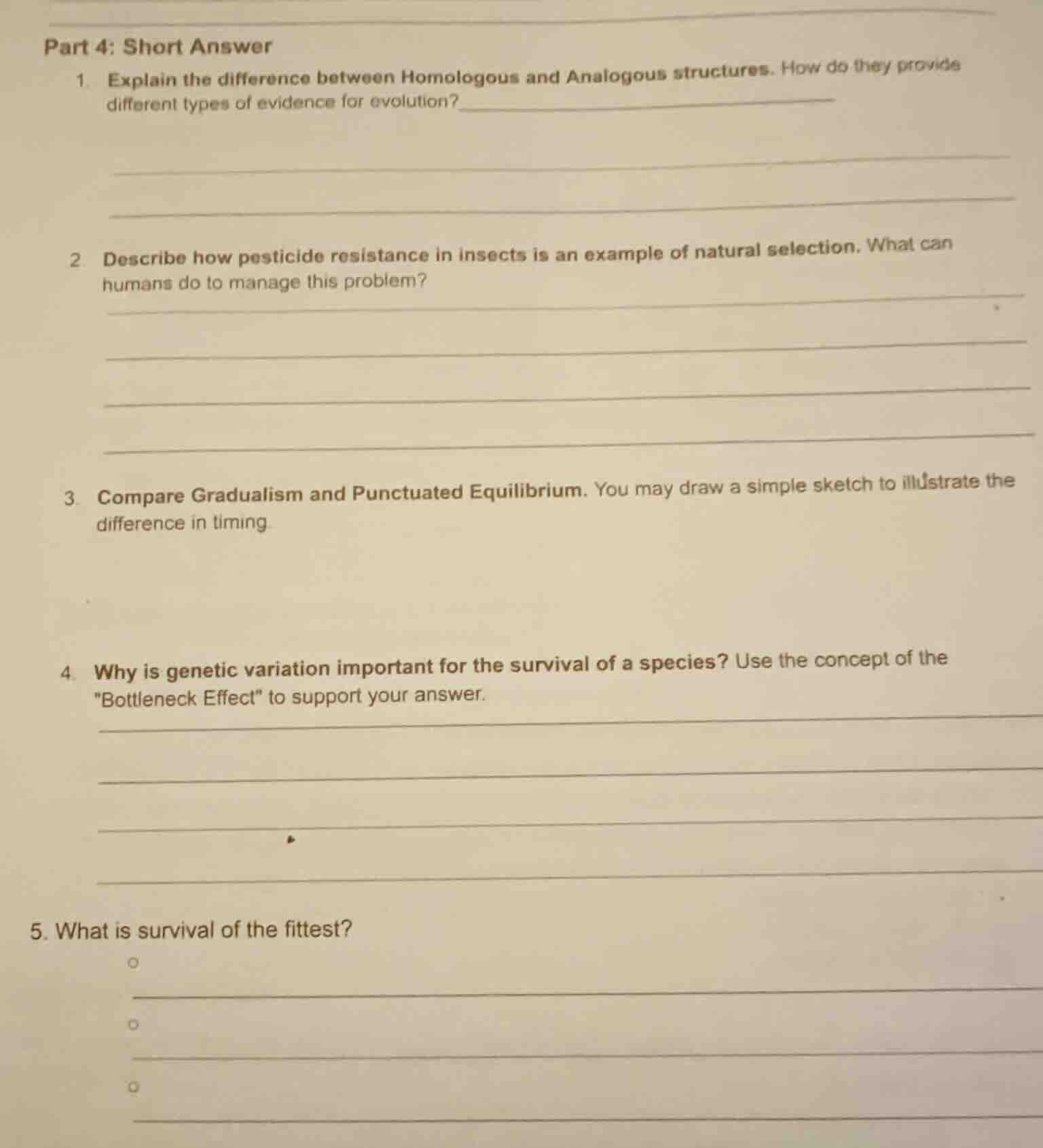
part 4: short answer
- explain the difference between homologous and analogous structures. how do they provide different types of evidence for evolution?
- describe how pesticide resistance in insects is an example of natural selection. what can humans do to manage this problem?
- compare gradualism and punctuated equilibrium. you may draw a simple sketch to illustrate the difference in timing
- why is genetic variation important for the survival of a species? use the concept of the \bottleneck effect\ to support your answer.
- what is survival of the fittest?
- Homologous vs Analogous Structures:
Homologous structures share a similar embryonic/structural origin (e.g., bat wings and human arms) but may have different functions. They show divergent evolution, proving species share common ancestors. Analogous structures (e.g., insect wings and bird wings) have similar functions but different origins, showing convergent evolution where species adapt independently to similar environments.
- Pesticide Resistance as Natural Selection:
Insect populations have genetic variation; some individuals have genes that make them immune to pesticides. When pesticides are applied, susceptible insects die, while resistant ones survive, reproduce, and pass on resistance genes, making the population resistant over time. Management strategies include rotating pesticide types, using integrated pest management (combining biological controls and limited pesticide use), and planting pesticide-free refuges to maintain susceptible insect populations.
- Gradualism vs Punctuated Equilibrium:
Gradualism proposes that evolution happens slowly and steadily over long periods, with small, incremental changes accumulating to form new species. Punctuated equilibrium argues that species stay stable (in equilibrium) for long periods, then undergo rapid, short bursts of evolutionary change that produce new species, followed by another long stable period.
- Genetic Variation and Bottleneck Effect:
Genetic variation gives a species a range of traits to adapt to environmental changes (e.g., new diseases, climate shifts). The bottleneck effect occurs when a population is drastically reduced, losing most genetic variation. With low variation, the surviving population has fewer traits to adapt to new threats, making the species more likely to go extinct. High genetic variation ensures some individuals will have traits that help them survive environmental stressors.
- Survival of the Fittest:
It is a term describing natural selection: individuals with heritable traits that are best suited to their environment are more likely to survive, reproduce, and pass those advantageous traits to their offspring, increasing the frequency of those traits in the population over time. "Fitness" here refers to reproductive success, not physical strength.

Snap & solve any problem in the app
Get step-by-step solutions on Sovi AI
Photo-based solutions with guided steps
Explore more problems and detailed explanations
- Homologous structures share structural/embryonic origins (divergent evolution, evidence of common ancestry); analogous structures share functions but not origins (convergent evolution, evidence of independent adaptation to environments.
- Pesticide resistance arises when resistant insects survive treatment, reproduce, and pass on resistance genes (natural selection). Management: rotate pesticides, use integrated pest management, plant pesticide-free refuges.
- Gradualism: slow, steady evolutionary change over time. Punctuated Equilibrium: long periods of species stability, interrupted by short bursts of rapid evolutionary change.
- Genetic variation provides traits for environmental adaptation. The bottleneck effect reduces variation, leaving species with limited traits to survive new threats, so high variation prevents this vulnerability.
- Survival of the fittest is the idea that individuals with environment-suited heritable traits have higher reproductive success, passing these traits to offspring to increase their population frequency.