QUESTION IMAGE
Question
part 2 of 2
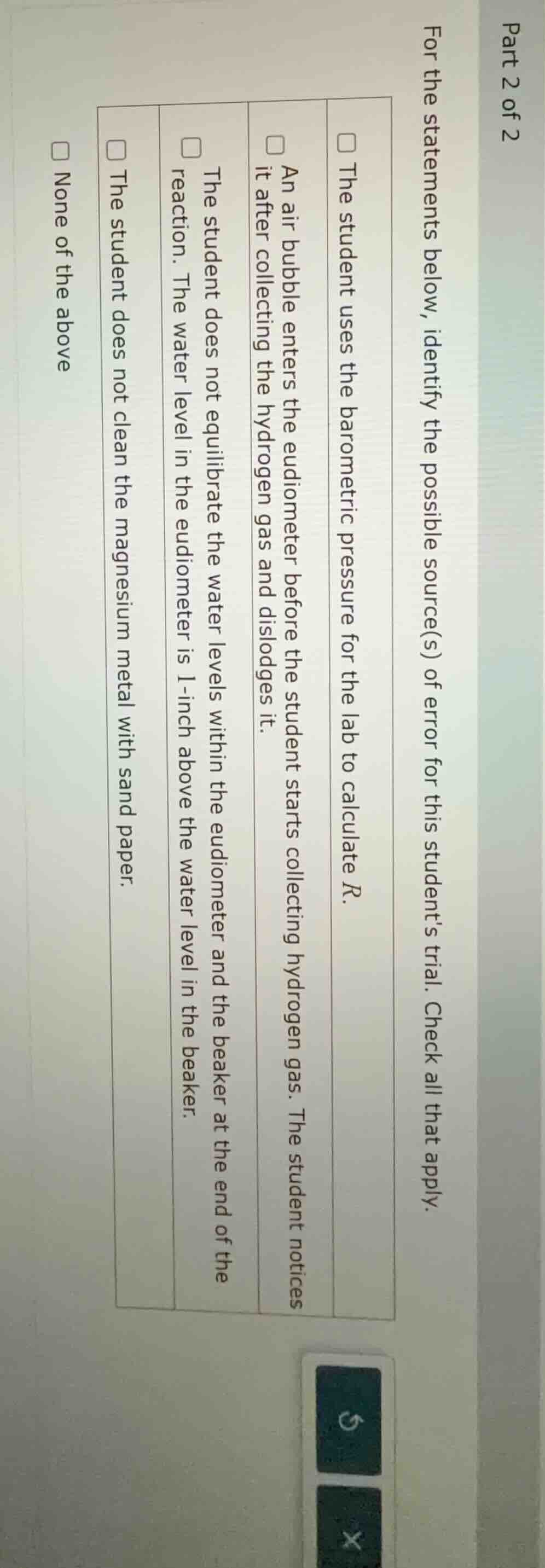
for the statements below, identify the possible source(s) of error for this student’s trial. check all that apply.
□ the student uses the barometric pressure for the lab to calculate ( r ).
□ an air bubble enters the eudiometer before the student starts collecting hydrogen gas. the student notices it after collecting the hydrogen gas and dislodges it.
□ the student does not equilibrate the water levels within the eudiometer and the beaker at the end of the reaction. the water level in the eudiometer is 1 - inch above the water level in the beaker.
□ the student does not clean the magnesium metal with sand paper.
□ none of the above
- "The student uses the barometric pressure for the lab to calculate \( R \)": If the gas (hydrogen) is collected over water, the pressure of the gas is the barometric pressure minus the vapor pressure of water. Using only barometric pressure (atmospheric pressure) would overestimate the gas pressure, leading to error in \( R \) calculation (since \( R=\frac{PV}{nT} \), incorrect \( P \) affects \( R \)).
- "An air bubble enters the eudiometer before the student starts collecting hydrogen gas. The student notices it after collecting the hydrogen gas and dislodges it": Air bubbles contain air (a mixture of gases, mostly nitrogen and oxygen), so the collected "gas" would be a mixture of hydrogen and air. This changes the moles of gas (since air is added) and the pressure/volume, leading to error in \( R \) (as \( n \) or \( P/V \) is incorrect).
- "The student does not equilibrate the water levels within the eudiometer and the beaker at the end of the reaction. The water level in the eudiometer is 1 - inch above the water level in the beaker": Equilibrating water levels ensures that the pressure of the gas in the eudiometer equals the atmospheric pressure (barometric pressure). If the eudiometer water level is higher, the gas pressure is less than atmospheric pressure (since pressure from the water column \( P =
ho gh \) opposes atmospheric pressure). Using atmospheric pressure instead of the actual gas pressure (lower) would overestimate \( P \), affecting \( R \).
- "The student does not clean the magnesium metal with sand paper": Magnesium metal often has a layer of magnesium oxide (\( \text{MgO} \)) on its surface. If not cleaned, the reaction \( \text{Mg} + 2\text{HCl}
ightarrow \text{MgCl}_2 + \text{H}_2 \) will be slower or less complete (since \( \text{MgO} + 2\text{HCl}
ightarrow \text{MgCl}_2 + \text{H}_2\text{O} \) produces no hydrogen). This leads to fewer moles of \( \text{H}_2 \) collected, so \( n \) is incorrect, affecting \( R \) (since \( R=\frac{PV}{nT} \), incorrect \( n \) changes \( R \)).

Snap & solve any problem in the app
Get step-by-step solutions on Sovi AI
Photo-based solutions with guided steps
Explore more problems and detailed explanations
- The student uses the barometric pressure for the lab to calculate \( R \)
- An air bubble enters the eudiometer before the student starts collecting hydrogen gas. The student notices it after collecting the hydrogen gas and dislodges it
- The student does not equilibrate the water levels within the eudiometer and the beaker at the end of the reaction. The water level in the eudiometer is 1 - inch above the water level in the beaker
- The student does not clean the magnesium metal with sand paper