QUESTION IMAGE
Question
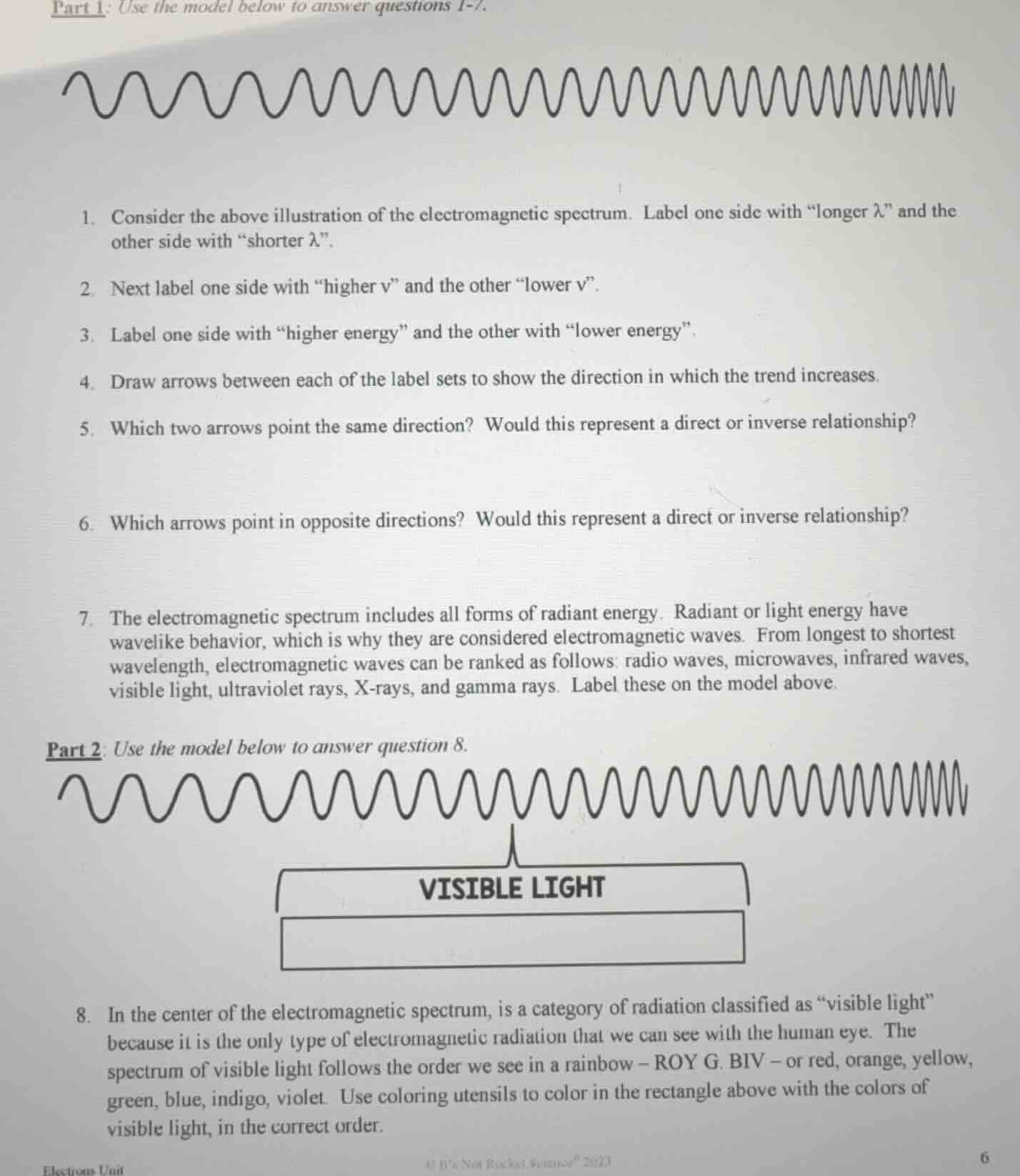
part 1: use the model below to answer questions 1-7.
- consider the above illustration of the electromagnetic spectrum. label one side with \longer \\(\lambda\\)\ and the other side with \shorter \\(\lambda\\).
- next label one side with \higher \\(\
u\\)\ and the other \lower \\(\
u\\).
- label one side with \higher energy\ and the other with \lower energy\.
- draw arrows between each of the label sets to show the direction in which the trend increases.
- which two arrows point the same direction? would this represent a direct or inverse relationship?
- which arrows point in opposite directions? would this represent a direct or inverse relationship?
- the electromagnetic spectrum includes all forms of radiant energy. radiant or light energy have wavelike behavior, which is why they are considered electromagnetic waves. from longest to shortest wavelength, electromagnetic waves can be ranked as follows: radio waves, microwaves, infrared waves, visible light, ultraviolet rays, x - rays, and gamma rays. label these on the model above.
part 2: use the model below to answer question 8.
- in the center of the electromagnetic spectrum, is a category of radiation classified as \visible light\ because it is the only type of electromagnetic radiation that we can see with the human eye. the spectrum of visible light follows the order we see in a rainbow - roy g. biv - or red, orange, yellow, green, blue, indigo, violet. use coloring utensils to color in the rectangle above with the colors of visible light, in the correct order.
Question 1
Step1: Recall wavelength - frequency relationship
The electromagnetic spectrum wave model: wavelength ($\lambda$) is the distance between two consecutive peaks. Frequency ($
u$) is the number of waves per unit time. The relationship is $c=\lambda
u$ (where $c$ is speed of light, constant). So as $\lambda$ increases, $
u$ decreases and vice - versa.
Step2: Label "longer $\lambda$" and "shorter $\lambda$"
Looking at the wave diagram, the left - most waves are more spread out (longer distance between peaks), so left side: "longer $\lambda$", right side: "shorter $\lambda$".
Question 2
Step1: Use $c = \lambda
u$
Since $c$ is constant, when $\lambda$ is longer, $
u$ (frequency) is lower and when $\lambda$ is shorter, $
u$ is higher.
Step2: Label "higher $
u$" and "lower $
u$"
From the wavelength labeling, right side has shorter $\lambda$, so right side: "higher $
u$", left side: "lower $
u$".
Question 3
Step1: Recall energy - frequency relationship
The energy of a photon is given by $E = h
u$ (where $h$ is Planck's constant). So energy is directly proportional to frequency.
Step2: Label "higher energy" and "lower energy"
Since frequency is higher on the right (from question 2), right side: "higher energy", left side: "lower energy".
Question 4

Snap & solve any problem in the app
Get step-by-step solutions on Sovi AI
Photo-based solutions with guided steps
Explore more problems and detailed explanations
s:
- Left: "longer $\lambda$", Right: "shorter $\lambda$"
- Left: "lower $
u$", Right: "higher $
u$"
- Left: "lower energy", Right: "higher energy"
- Arrow for $\lambda$: right $\to$ left; Arrow for $
u$: left $\to$ right; Arrow for energy: left $\to$ right
- Arrows for frequency ($
u$) and energy ($E$) point in the same direction. This is a direct relationship.
- Arrow for wavelength ($\lambda$) points opposite to arrows for frequency ($
u$) and energy ($E$). This is an inverse relationship.
- From left (longest $\lambda$) to right (shortest $\lambda$): radio waves, microwaves, infrared waves, visible light, ultraviolet rays, X - rays, gamma rays.
- Color the rectangle from left to right: Red, Orange, Yellow, Green, Blue, Indigo, Violet.