QUESTION IMAGE
Question
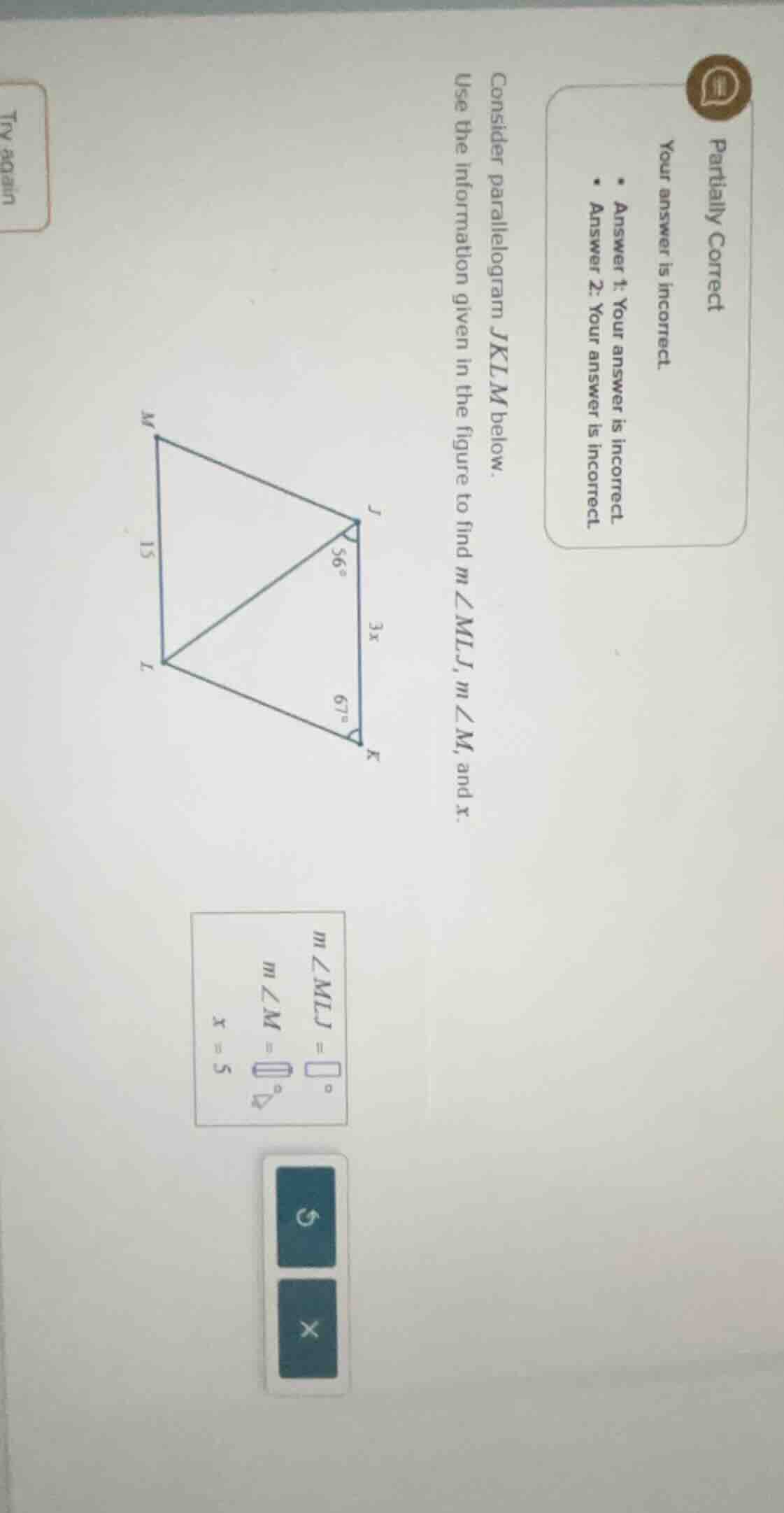
partially correct your answer is incorrect answer 1: your answer is incorrect answer 2: your answer is incorrect consider parallelogram jklm below. use the information given in the figure to find m∠mlj, m∠m, and x.
Step1: Find x (opposite sides of parallelogram)
In parallelogram \(JKLM\), \(JM = KL\) and \(JK = ML\). Given \(ML = 15\) and \(JK = 3x\), so \(3x = 15\). Solving for \(x\): \(x=\frac{15}{3}=5\).
Step2: Find \(m\angle MLJ\) (alternate interior angles)
Since \(JM\parallel KL\) and \(JL\) is a transversal, \(\angle MLJ=\angle KJL\). Wait, no, let's check triangle \(JKL\). Wait, in triangle \(JKL\), angles at \(J\) is \(56^\circ\), at \(K\) is \(67^\circ\), so angle at \(L\) (in triangle \(JKL\)) is \(180 - 56 - 67 = 57^\circ\)? Wait, no, \(JKLM\) is a parallelogram, so \(JM\parallel KL\), so \(\angle M=\angle K\)? No, consecutive angles in parallelogram are supplementary. Wait, first, let's find \(\angle MLJ\). Wait, \(JL\) is a diagonal, so \(\triangle JML\) and \(\triangle KLJ\) are congruent (SSS, since \(JM = KL\), \(ML = JK\), \(JL\) common). So \(\angle MLJ=\angle KJL\)? Wait, no, in \(\triangle JKL\), angles: \(\angle KJL = 56^\circ\), \(\angle K = 67^\circ\), so \(\angle KLJ=180 - 56 - 67 = 57^\circ\). But since \(JM\parallel KL\), \(\angle MLJ=\angle KLJ\)? Wait, no, \(JM\parallel KL\), so alternate interior angles: \(\angle MLJ=\angle KJL\)? Wait, I think I messed up. Wait, in parallelogram, \(JK\parallel ML\), so \(\angle KJL=\angle MLJ\) (alternate interior angles). Wait, \(\angle KJL = 56^\circ\)? No, the angle at \(J\) in triangle \(JKL\) is \(56^\circ\), so \(\angle KJL = 56^\circ\), so \(\angle MLJ = 56^\circ\)? No, wait, let's recast.
Wait, in parallelogram \(JKLM\), \(JK\parallel ML\), so \(JL\) is transversal, so \(\angle KJL=\angle MLJ\) (alternate interior angles). So \(\angle MLJ = 56^\circ\)? Wait, no, the angle at \(J\) is \(56^\circ\) (between \(JK\) and \(JL\)), so \(\angle KJL = 56^\circ\), so \(\angle MLJ = 56^\circ\)? Wait, no, let's check triangle angles. In \(\triangle JKL\), sum of angles is \(180^\circ\): \(m\angle KJL + m\angle K + m\angle KLJ = 180\). So \(56 + 67 + m\angle KLJ = 180\), so \(m\angle KLJ = 180 - 56 - 67 = 57^\circ\). But since \(JM\parallel KL\), \(\angle MLJ=\angle KLJ\) (alternate interior angles, since \(JM\parallel KL\) and \(JL\) transversal). So \(m\angle MLJ = 57^\circ\)? Wait, maybe I confused the angles.
Wait, another approach: consecutive angles in parallelogram are supplementary. So \(\angle M + \angle K = 180^\circ\)? No, \(\angle M\) and \(\angle K\) are opposite? No, in parallelogram, opposite angles are equal, consecutive angles are supplementary. So \(\angle J=\angle L\), \(\angle M=\angle K\). Wait, \(\angle K = 67^\circ\), so \(\angle M = 67^\circ\)? No, wait, in triangle \(JKL\), angle at \(K\) is \(67^\circ\), but \(\angle K\) is also an angle of the parallelogram. Wait, the angle at \(K\) in the parallelogram is \(67^\circ\), so \(\angle M\) (opposite to \(\angle K\)) is also \(67^\circ\)? No, consecutive angles: \(\angle K\) and \(\angle J\) are consecutive, so \(\angle K + \angle J = 180^\circ\). Wait, angle at \(J\) is \(56^\circ\)? No, the angle at \(J\) in the diagram is \(56^\circ\) (between \(JK\) and \(JL\)), not the angle of the parallelogram. Oh! That's the mistake. The \(56^\circ\) is an angle in triangle \(JKL\), not the angle of the parallelogram. So the angle of the parallelogram at \(J\) is \(\angle KJM\), which is adjacent to the \(56^\circ\) angle? Wait, no, the diagram shows a diagonal \(JL\) splitting the parallelogram into two triangles. So in \(\triangle JKL\), angles: \(\angle KJL = 56^\circ\), \(\angle K = 67^\circ\), so \(\angle KLJ = 180 - 56 - 67 = 57^\circ\). Now, in parallelogram \(JKLM\), \(JM\parallel KL\), so \(\angle MLJ = \…

Snap & solve any problem in the app
Get step-by-step solutions on Sovi AI
Photo-based solutions with guided steps
Explore more problems and detailed explanations
\(m\angle MLJ = \boldsymbol{57^\circ}\), \(m\angle M = \boldsymbol{67^\circ}\), \(x = \boldsymbol{5}\)