QUESTION IMAGE
Question
participation activity 1 4.4: types of bias.
match each description to the correct type of bias.
how to use this tool
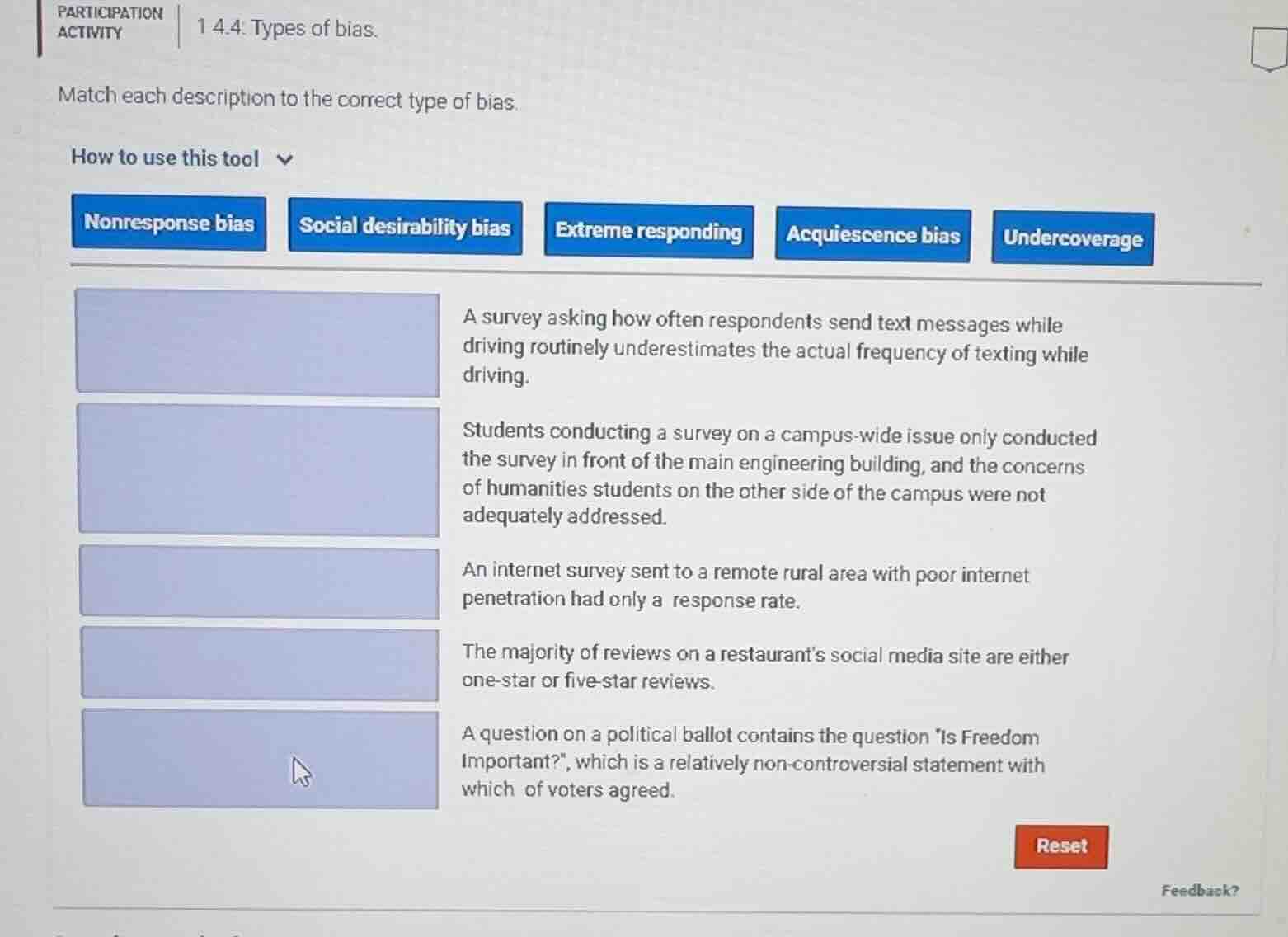
nonresponse bias social desirability bias extreme responding acquiescence bias undercoverage
a survey asking how often respondents send text messages while driving routinely underestimates the actual frequency of texting while driving.
students conducting a survey on a campus - wide issue only conducted the survey in front of the main engineering building, and the concerns of humanities students on the other side of the campus were not adequately addressed.
an internet survey sent to a remote rural area with poor internet penetration had only a response rate.
the majority of reviews on a restaurant’s social media site are either one - star or five - star reviews.
a question on a political ballot contains the question is freedom important?, which is a relatively non - controversial statement with which of voters agreed.
reset
feedback?
- Social desirability bias: Respondents underreport behaviors seen as negative (texting while driving) to appear favorable.
- Undercoverage: The sample excludes a key group (humanities students), failing to represent the full population.
- Nonresponse bias: Poor internet access prevents many in the target group from responding, skewing results.
- Extreme responding: Reviewers tend to give very high or very low ratings instead of moderate ones.
- Acquiescence bias: Respondents agree with a universally accepted, non-controversial statement without critical consideration.

Snap & solve any problem in the app
Get step-by-step solutions on Sovi AI
Photo-based solutions with guided steps
Explore more problems and detailed explanations
- Social desirability bias: A survey asking how often respondents send text messages while driving routinely underestimates the actual frequency of texting while driving.
- Undercoverage: Students conducting a survey on a campus-wide issue only conducted the survey in front of the main engineering building, and the concerns of humanities students on the other side of the campus were not adequately addressed.
- Nonresponse bias: An internet survey sent to a remote rural area with poor internet penetration had only a low response rate.
- Extreme responding: The majority of reviews on a restaurant's social media site are either one-star or five-star reviews.
- Acquiescence bias: A question on a political ballot contains the question "Is Freedom Important?", which is a relatively non-controversial statement with which most voters agreed.