QUESTION IMAGE
Question
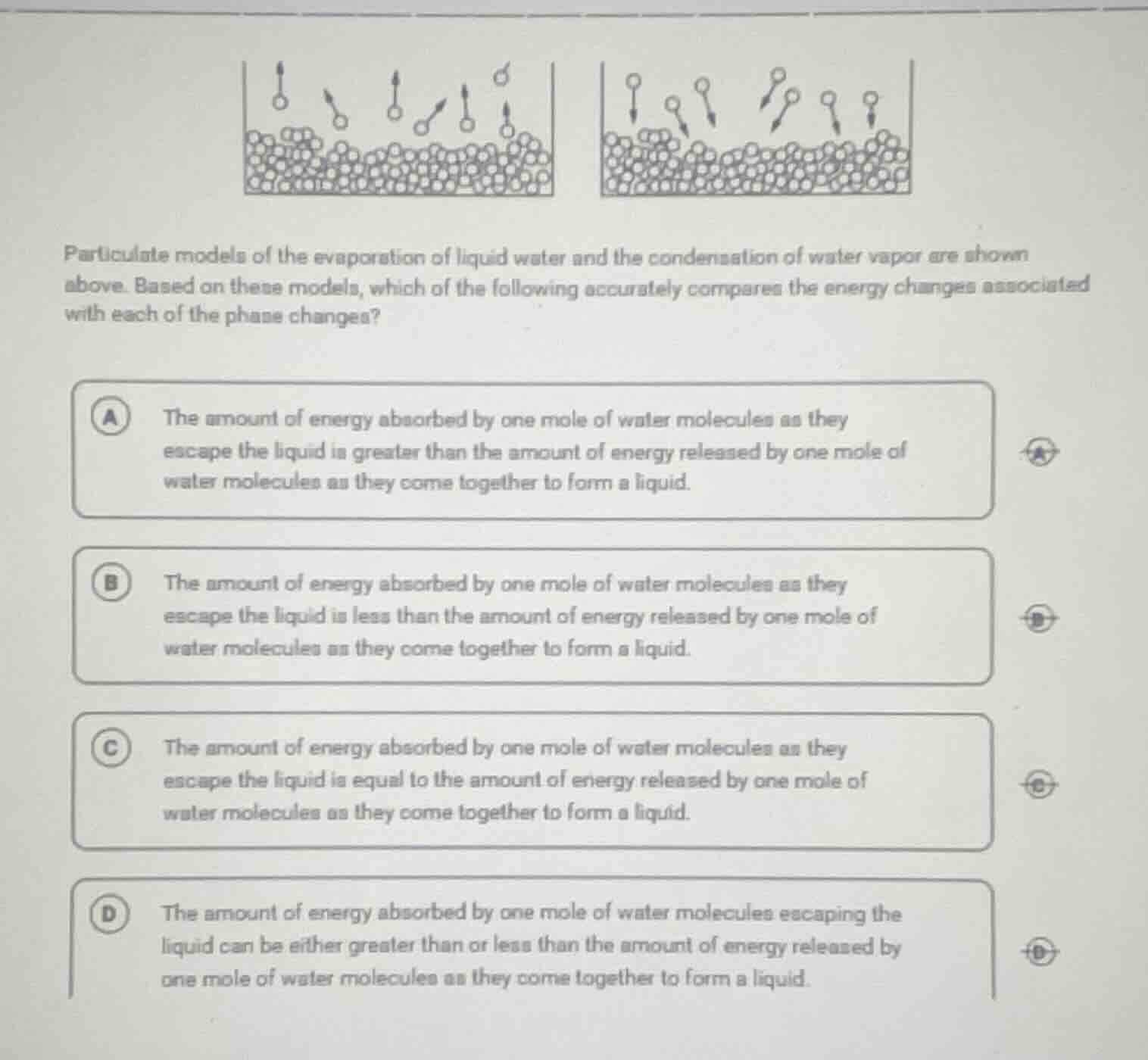
particulate models of the evaporation of liquid water and the condensation of water vapor are shown above. based on these models, which of the following accurately compares the energy changes associated with each of the phase changes?
a the amount of energy absorbed by one mole of water molecules as they escape the liquid is greater than the amount of energy released by one mole of water molecules as they come together to form a liquid.
b the amount of energy absorbed by one mole of water molecules as they escape the liquid is less than the amount of energy released by one mole of water molecules as they come together to form a liquid.
c the amount of energy absorbed by one mole of water molecules as they escape the liquid is equal to the amount of energy released by one mole of water molecules as they come together to form a liquid.
d the amount of energy absorbed by one mole of water molecules escaping the liquid can be either greater than or less than the amount of energy released by one mole of water molecules as they come together to form a liquid.
Evaporation (liquid to gas) is an endothermic process where water molecules absorb energy to break intermolecular forces. Condensation (gas to liquid) is the reverse, exothermic, where molecules release energy as intermolecular forces form. For a phase change and its reverse (like evaporation and condensation of water), the energy absorbed in the endothermic process equals the energy released in the exothermic process (conservation of energy, and these are reverse phase changes with equal magnitude energy changes, opposite signs). So one mole of water absorbing energy to evaporate (escape liquid) has the same energy magnitude as one mole releasing energy to condense (form liquid).

Snap & solve any problem in the app
Get step-by-step solutions on Sovi AI
Photo-based solutions with guided steps
Explore more problems and detailed explanations
C. The amount of energy absorbed by one mole of water molecules as they escape the liquid is equal to the amount of energy released by one mole of water molecules as they come together to form a liquid.