QUESTION IMAGE
Question
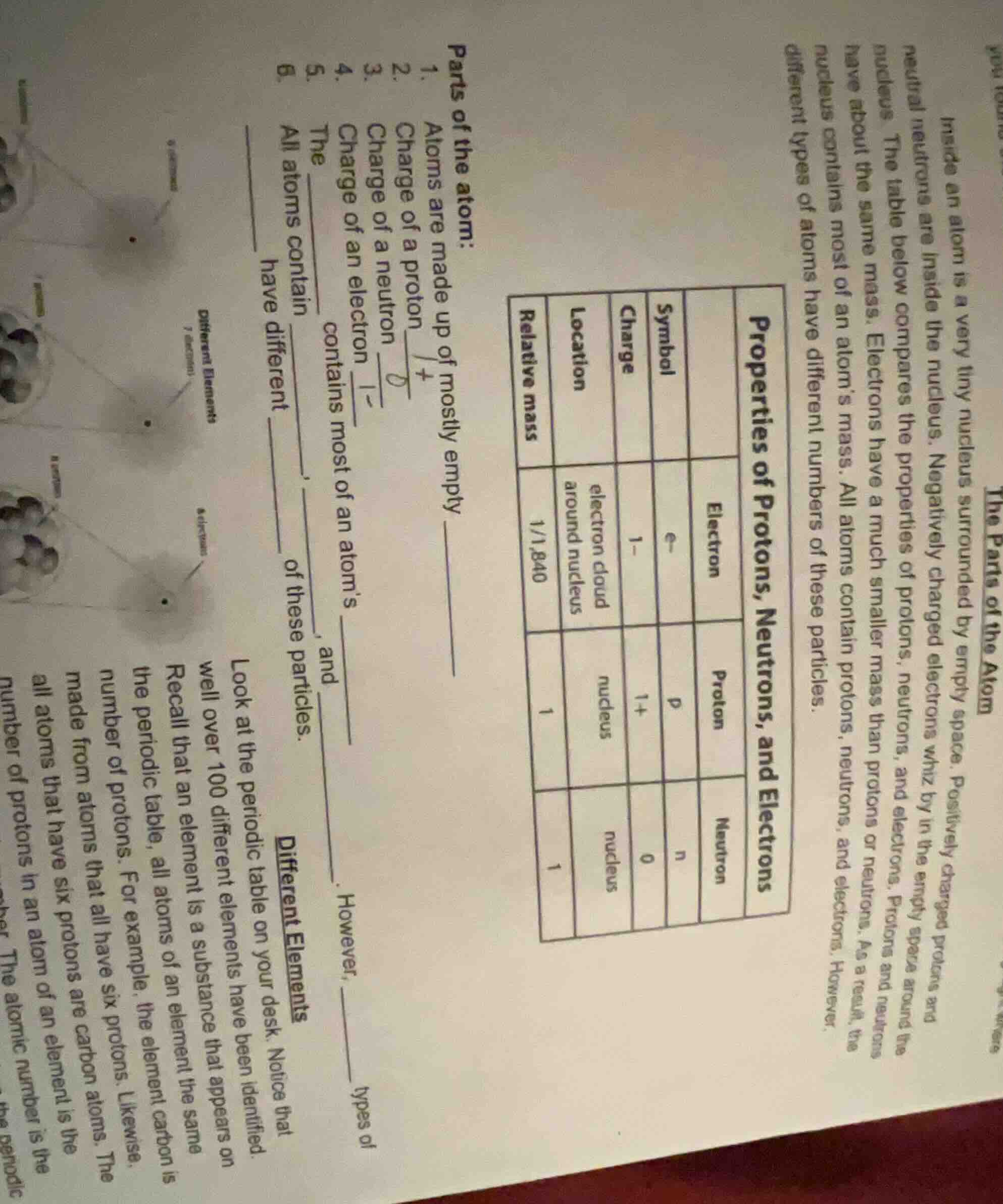
parts of the atom:
- atoms are made up of mostly empty ______
- charge of a proton ______
- charge of a neutron ______
- charge of an electron ______
- the ____ contains most of an atom’s __. however, ____ types of
all atoms contain ____, __, and __ have different ____ of these particles.
different elements
look at the periodic table on your desk. notice that well over 100 different elements have been identified. recall that an element is a substance that appears on the periodic table, all atoms of an element the same number of protons. for example, the element carbon is made from atoms that all have six protons. likewise, all atoms that have six protons are carbon atoms. the number of protons in an atom of an element is the atomic number the periodic
properties of protons, neutrons, and electrons
| symbol | charge | location | relative mass | |
| electron | e⁻ | 1⁻ | electron cloud around nucleus | 1/1,840 |
| proton | p | 1+ | nucleus | 1 |
| neutron | n | 0 | nucleus | 1 |
Step1: Fill atom empty space
Atoms are mostly empty space (electron cloud area).
Step2: Fill proton charge
Proton has a positive 1 charge: $1+$
Step3: Fill neutron charge
Neutron has no charge: $0$
Step4: Fill electron charge
Electron has a negative 1 charge: $1-$
Step5: Fill mass-containing part
Nucleus holds most of an atom's mass.
Step6: Fill universal atomic particles
All atoms have protons, neutrons, electrons; different elements have different numbers of these particles.

Snap & solve any problem in the app
Get step-by-step solutions on Sovi AI
Photo-based solutions with guided steps
Explore more problems and detailed explanations
- space
- $1+$
- $0$
- $1-$
- nucleus; mass
- protons, neutrons, electrons; elements; numbers