QUESTION IMAGE
Question
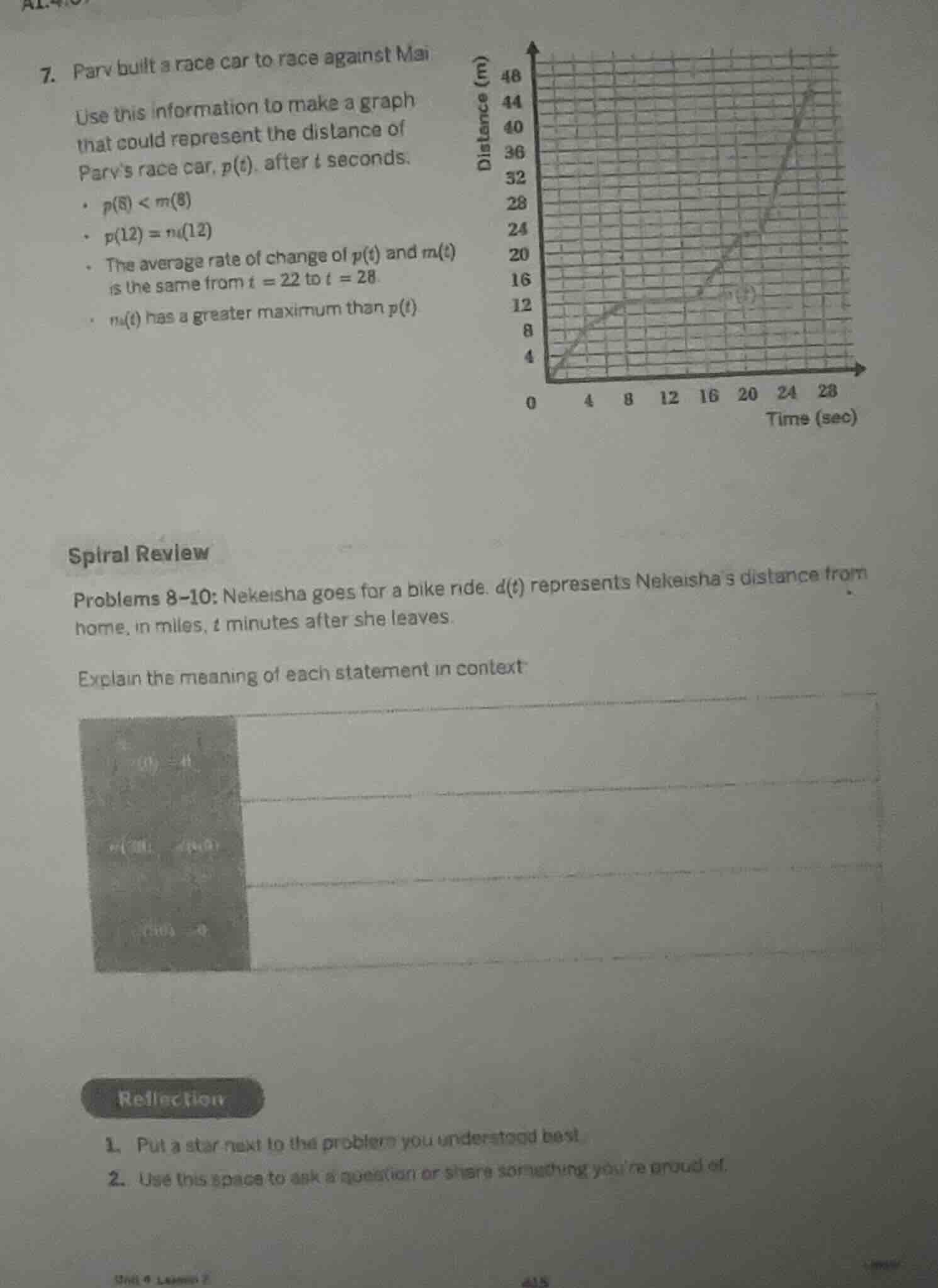
- parv built a race car to race against mai
use this information to make a graph
that could represent the distance of
parv’s race car, ( p(t) ), after ( t ) seconds.
- ( p(8) < m(8) )
- ( p(12) = m(12) )
- the average rate of change of ( p(t) ) and ( m(t) )
is the same from ( t = 22 ) to ( t = 28 )
- ( m(t) ) has a greater maximum than ( p(t) )
spiral review
problems 8–10: nekeisha goes for a bike ride. ( d(t) ) represents nekeisha’s distance from
home, in miles, ( t ) minutes after she leaves.
explain the meaning of each statement in context
reflection
- put a star next to the problem you understood best.
- use this space to ask a question or share something you’re proud of.
Problem 7 (Graphing \( p(t) \))
Step 1: Analyze \( p(8) < m(8) \)
At \( t = 8 \) seconds, Parv’s car distance (\( p(8) \)) is less than Mai’s (\( m(8) \)). So \( p(8) \)’s y - value at \( t = 8 \) is lower than \( m(t) \)’s.
Step 2: Analyze \( p(12) = m(12) \)
At \( t = 12 \) seconds, both cars have the same distance. So \( p(12) \) and \( m(12) \) share the same point.
Step 3: Analyze Average Rate of Change (22–28 sec)
The average rate of change (slope) of \( p(t) \) and \( m(t) \) is equal here. So their graphs have parallel segments (or same slope) between \( t = 22 \) and \( t = 28 \).
Step 4: Analyze Maximum Distance
Mai’s car (\( m(t) \)) has a greater maximum than Parv’s (\( p(t) \)). So \( m(t) \)’s peak is higher than \( p(t) \)’s.
Step 5: Sketch \( p(t) \)
- Start with a point at \( t = 8 \) below \( m(8) \).
- Connect to \( (12, p(12)) \) where \( p(12) = m(12) \).
- From \( t = 22 \) to \( t = 28 \), draw a segment with the same slope as \( m(t) \)’s segment there.
- Ensure \( p(t) \)’s maximum is lower than \( m(t) \)’s.
Spiral Review (Problems 8–10, assuming statements like \( d(0) = 4 \), \( d(10) > d(5) \), \( d(60) = 0 \))
for Typical Statements:
- \( d(0) = 4 \): At \( t = 0 \) minutes (start), Nekeisha is 4 miles from home.
- \( d(10) > d(5) \): At \( t = 10 \) minutes, she is farther from home than at \( t = 5 \) minutes (she’s moving away or not returning yet).
- \( d(60) = 0 \): At \( t = 60 \) minutes, she is 0 miles from home (back home).
Problem 7 Graph Description (Final Answer for Graph):
A possible graph for \( p(t) \):
- At \( t = 8 \), \( p(8) \) is below \( m(8) \) (e.g., \( p(8) = 10 \), \( m(8) = 12 \) if \( m(8) \) is 12).
- At \( t = 12 \), \( p(12) = m(12) \) (e.g., both at 14).
- From \( t = 22 \) to \( t = 28 \), \( p(t) \) has the same slope as \( m(t) \) (e.g., slope \( = 4 \) if \( m(t) \)’s slope is 4 there).
- \( p(t) \)’s maximum (e.g., 40) is less than \( m(t) \)’s maximum (e.g., 46).
Spiral Review Final Answers (Contextual Meanings):
- If \( d(0) = 4 \): Nekeisha starts 4 miles from home.
- If \( d(10) > d(5) \): After 10 minutes, she is farther from home than after 5 minutes.
- If \( d(60) = 0 \): After 60 minutes, she is back home (0 miles from home).
(Note: For exact answers, more precise statement details from the blurred text would be needed, but the above follows typical context clues.)

Snap & solve any problem in the app
Get step-by-step solutions on Sovi AI
Photo-based solutions with guided steps
Explore more problems and detailed explanations
for Typical Statements:
- \( d(0) = 4 \): At \( t = 0 \) minutes (start), Nekeisha is 4 miles from home.
- \( d(10) > d(5) \): At \( t = 10 \) minutes, she is farther from home than at \( t = 5 \) minutes (she’s moving away or not returning yet).
- \( d(60) = 0 \): At \( t = 60 \) minutes, she is 0 miles from home (back home).
Problem 7 Graph Description (Final Answer for Graph):
A possible graph for \( p(t) \):
- At \( t = 8 \), \( p(8) \) is below \( m(8) \) (e.g., \( p(8) = 10 \), \( m(8) = 12 \) if \( m(8) \) is 12).
- At \( t = 12 \), \( p(12) = m(12) \) (e.g., both at 14).
- From \( t = 22 \) to \( t = 28 \), \( p(t) \) has the same slope as \( m(t) \) (e.g., slope \( = 4 \) if \( m(t) \)’s slope is 4 there).
- \( p(t) \)’s maximum (e.g., 40) is less than \( m(t) \)’s maximum (e.g., 46).
Spiral Review Final Answers (Contextual Meanings):
- If \( d(0) = 4 \): Nekeisha starts 4 miles from home.
- If \( d(10) > d(5) \): After 10 minutes, she is farther from home than after 5 minutes.
- If \( d(60) = 0 \): After 60 minutes, she is back home (0 miles from home).
(Note: For exact answers, more precise statement details from the blurred text would be needed, but the above follows typical context clues.)