QUESTION IMAGE
Question
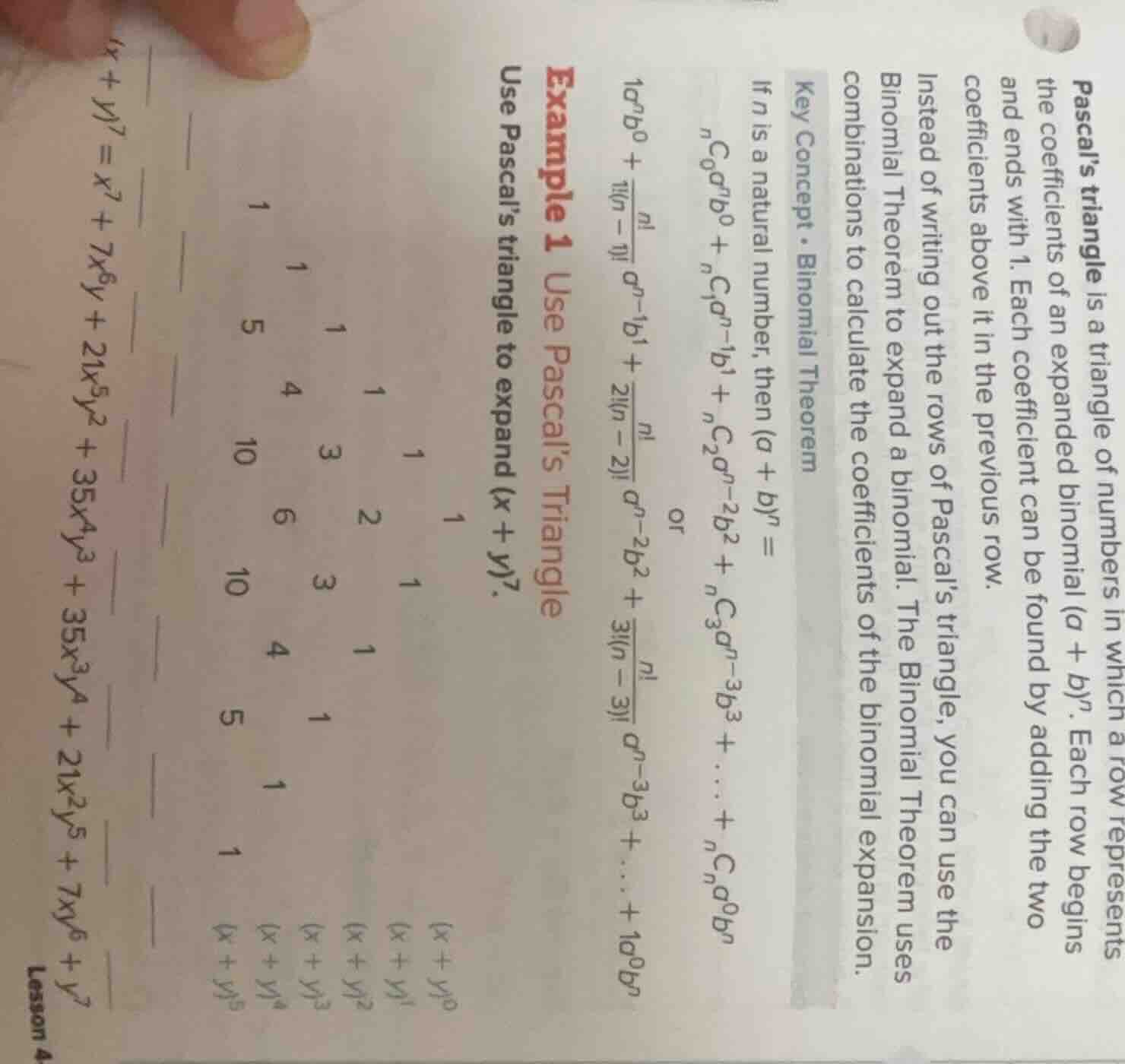
pascal’s triangle is a triangle of numbers in which a row represents the coefficients of an expanded binomial ((a + b)^n). each row begins and ends with 1. each coefficient can be found by adding the two coefficients above it in the previous row. instead of writing out the rows of pascal’s triangle, you can use the binomial theorem to expand a binomial. the binomial theorem uses combinations to calculate the coefficients of the binomial expansion.
key concept • binomial theorem
if ( n ) is a natural number, then ((a + b)^n = )_ ( _nc_0a^nb^0 + _nc_1a^{n - 1}b^1 + _nc_2a^{n - 2}b^2 + _nc_3a^{n - 3}b^3 + dots + _nc_na^0b^n ) or ( 1a^nb^0 + \frac{n!}{1!(n - 1)!}a^{n - 1}b^1 + \frac{n!}{2!(n - 2)!}a^{n - 2}b^2 + \frac{n!}{3!(n - 3)!}a^{n - 3}b^3 + dots + 1a^0b^n )
example 1 use pascal’s triangle
use pascal’s triangle to expand ((x + y)^7).
To expand \((x + y)^7\) using Pascal's Triangle, we follow these steps:
Step 1: Recall Pascal's Triangle Rows
Pascal's Triangle rows correspond to the binomial expansion \((a + b)^n\), where the \(n\)-th row (starting from \(n = 0\)) gives the coefficients. For \(n = 7\), we need the 7th row (note: row numbering starts at 0). The rows of Pascal's Triangle are:
- Row 0: \(1\)
- Row 1: \(1, 1\)
- Row 2: \(1, 2, 1\)
- Row 3: \(1, 3, 3, 1\)
- Row 4: \(1, 4, 6, 4, 1\)
- Row 5: \(1, 5, 10, 10, 5, 1\)
- Row 6: \(1, 6, 15, 20, 15, 6, 1\)
- Row 7: \(1, 7, 21, 35, 35, 21, 7, 1\)
Step 2: Apply the Binomial Expansion Formula
The binomial expansion of \((x + y)^n\) is given by:
\[
(x + y)^n = \sum_{k=0}^{n} \binom{n}{k} x^{n - k} y^{k}
\]
For \(n = 7\), we use the coefficients from Row 7 of Pascal's Triangle (\(1, 7, 21, 35, 35, 21, 7, 1\)) and substitute into the formula:
- For \(k = 0\): \(\binom{7}{0} x^{7 - 0} y^{0} = 1 \cdot x^7 \cdot 1 = x^7\)
- For \(k = 1\): \(\binom{7}{1} x^{7 - 1} y^{1} = 7 \cdot x^6 \cdot y = 7x^6y\)
- For \(k = 2\): \(\binom{7}{2} x^{7 - 2} y^{2} = 21 \cdot x^5 \cdot y^2 = 21x^5y^2\)
- For \(k = 3\): \(\binom{7}{3} x^{7 - 3} y^{3} = 35 \cdot x^4 \cdot y^3 = 35x^4y^3\)
- For \(k = 4\): \(\binom{7}{4} x^{7 - 4} y^{4} = 35 \cdot x^3 \cdot y^4 = 35x^3y^4\)
- For \(k = 5\): \(\binom{7}{5} x^{7 - 5} y^{5} = 21 \cdot x^2 \cdot y^5 = 21x^2y^5\)
- For \(k = 6\): \(\binom{7}{6} x^{7 - 6} y^{6} = 7 \cdot x^1 \cdot y^6 = 7xy^6\)
- For \(k = 7\): \(\binom{7}{7} x^{7 - 7} y^{7} = 1 \cdot x^0 \cdot y^7 = y^7\)
Step 3: Combine the Terms
Adding all these terms together, we get:
\[
(x + y)^7 = x^7 + 7x^6y + 21x^5y^2 + 35x^4y^3 + 35x^3y^4 + 21x^2y^5 + 7xy^6 + y^7
\]

Snap & solve any problem in the app
Get step-by-step solutions on Sovi AI
Photo-based solutions with guided steps
Explore more problems and detailed explanations
\[
\boxed{(x + y)^7 = x^7 + 7x^6y + 21x^5y^2 + 35x^4y^3 + 35x^3y^4 + 21x^2y^5 + 7xy^6 + y^7}
\]