QUESTION IMAGE
Question
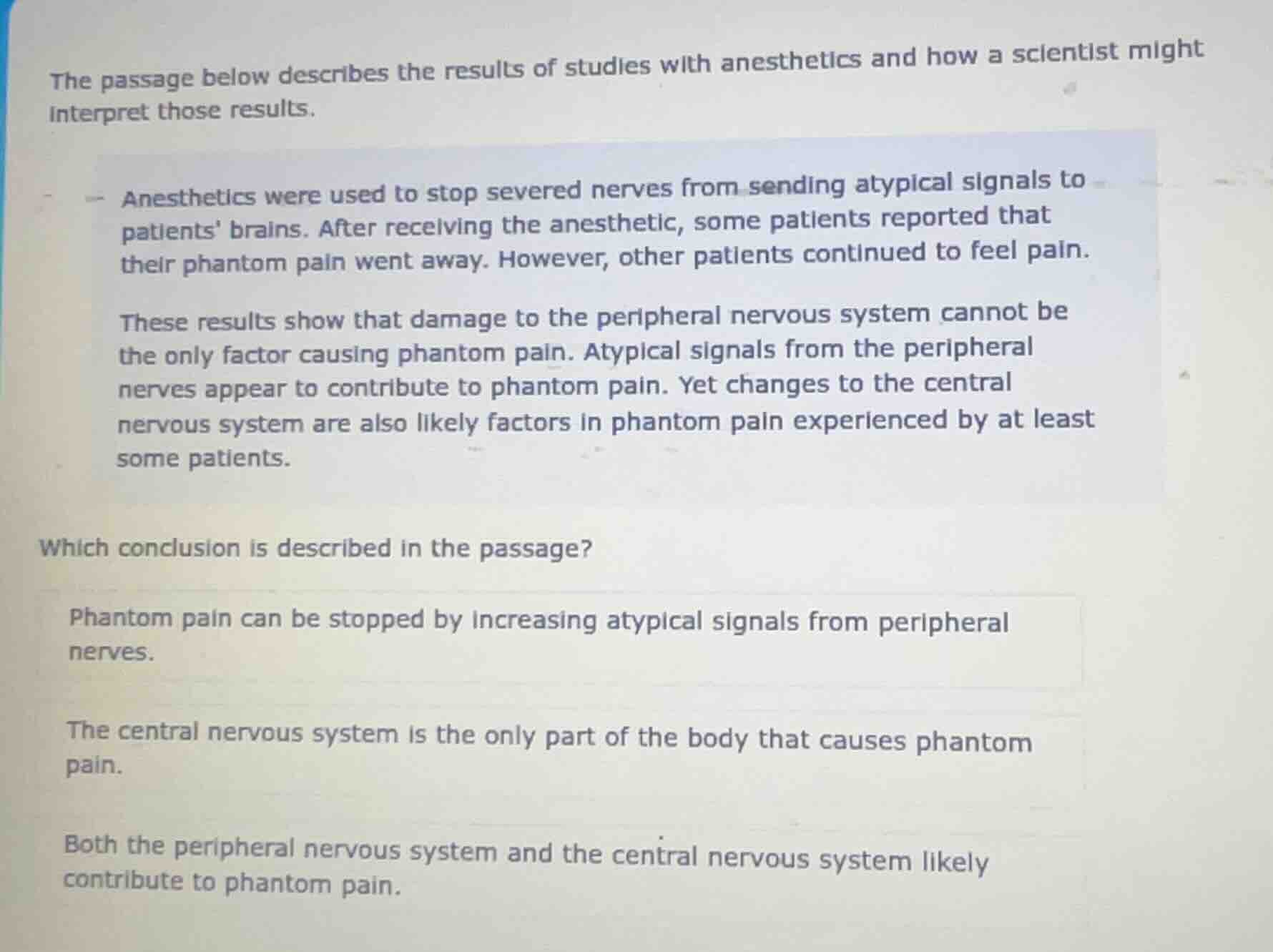
the passage below describes the results of studies with anesthetics and how a scientist might interpret those results.
anesthetics were used to stop severed nerves from sending atypical signals to patients brains. after receiving the anesthetic, some patients reported that their phantom pain went away. however, other patients continued to feel pain.
these results show that damage to the peripheral nervous system cannot be the only factor causing phantom pain. atypical signals from the peripheral nerves appear to contribute to phantom pain. yet changes to the central nervous system are also likely factors in phantom pain experienced by at least some patients.
which conclusion is described in the passage?
phantom pain can be stopped by increasing atypical signals from peripheral nerves.
the central nervous system is the only part of the body that causes phantom pain.
both the peripheral nervous system and the central nervous system likely contribute to phantom pain.
The passage states that atypical signals from peripheral nerves contribute to phantom pain, and changes to the central nervous system are also likely factors for some patients. This directly matches the third option, while the first option is incorrect (anesthetics reduced signals, not increased them) and the second option is wrong (the passage says peripheral damage is not the only factor, not that central is the only one).

Snap & solve any problem in the app
Get step-by-step solutions on Sovi AI
Photo-based solutions with guided steps
Explore more problems and detailed explanations
Both the peripheral nervous system and the central nervous system likely contribute to phantom pain.