QUESTION IMAGE
Question
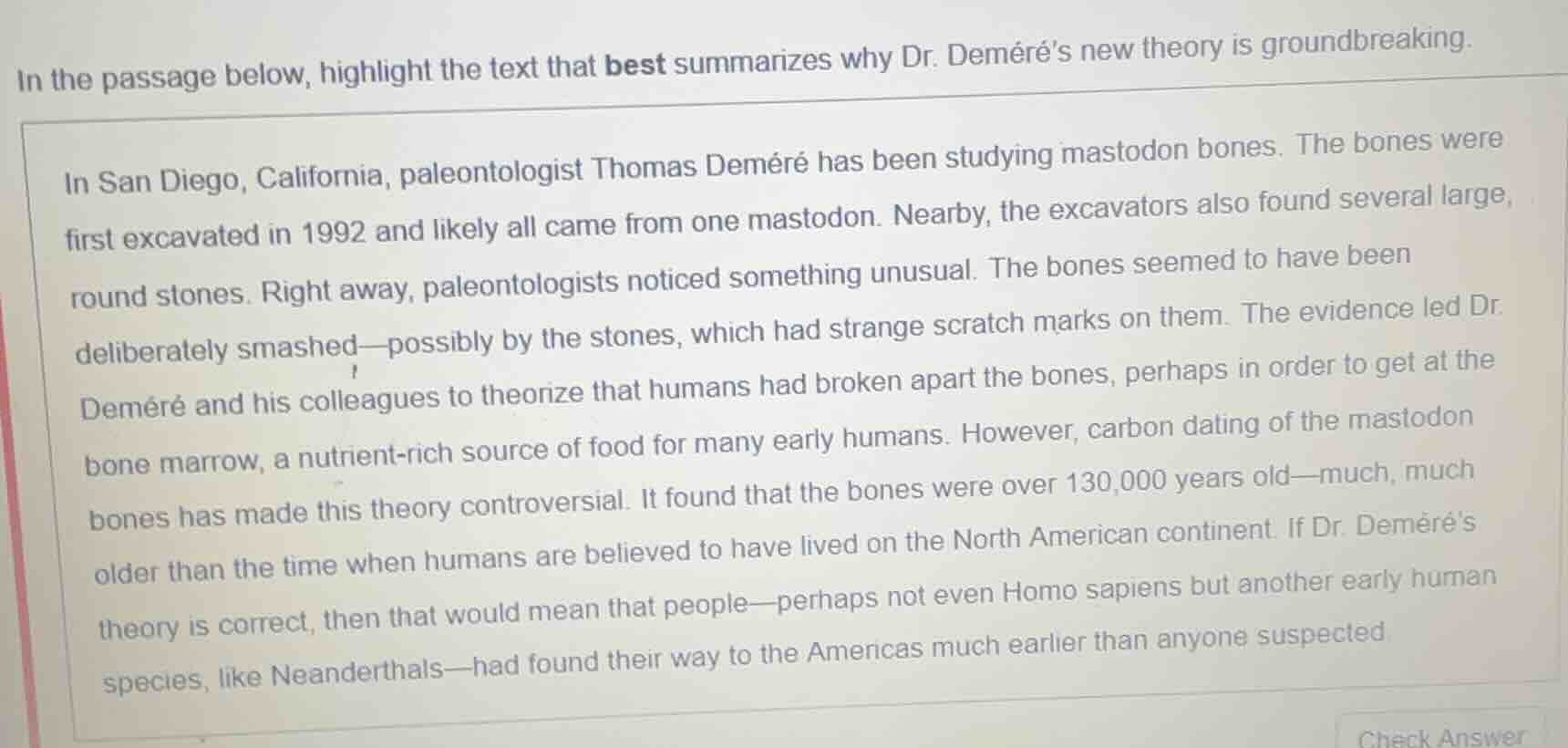
in the passage below, highlight the text that best summarizes why dr. deméré’s new theory is groundbreaking.
in san diego, california, paleontologist thomas deméré has been studying mastodon bones. the bones were first excavated in 1992 and likely all came from one mastodon. nearby, the excavators also found several large, round stones. right away, paleontologists noticed something unusual. the bones seemed to have been deliberately smashed—possibly by the stones, which had strange scratch marks on them. the evidence led dr. deméré and his colleagues to theorize that humans had broken apart the bones, perhaps in order to get at the bone marrow, a nutrient - rich source of food for many early humans. however, carbon dating of the mastodon bones has made this theory controversial. it found that the bones were over 130,000 years old—much, much older than the time when humans are believed to have lived on the north american continent. if dr. deméré’s theory is correct, then that would mean that people—perhaps not even homo sapiens but another early human species, like neanderthals—had found their way to the americas much earlier than anyone suspected
To find the text summarizing why Dr. Deméré’s theory is groundbreaking, we look for the part that shows its significance. The key is the implication about human arrival in the Americas. The relevant sentence is: "If Dr. Deméré’s theory is correct, then that would mean that people—perhaps not even Homo sapiens but another early human species, like Neanderthals—had found their way to the Americas much earlier than anyone suspected" as it explains the groundbreaking nature (rewriting human arrival timeline in Americas).

Snap & solve any problem in the app
Get step-by-step solutions on Sovi AI
Photo-based solutions with guided steps
Explore more problems and detailed explanations
If Dr. Deméré’s theory is correct, then that would mean that people—perhaps not even Homo sapiens but another early human species, like Neanderthals—had found their way to the Americas much earlier than anyone suspected