QUESTION IMAGE
Question
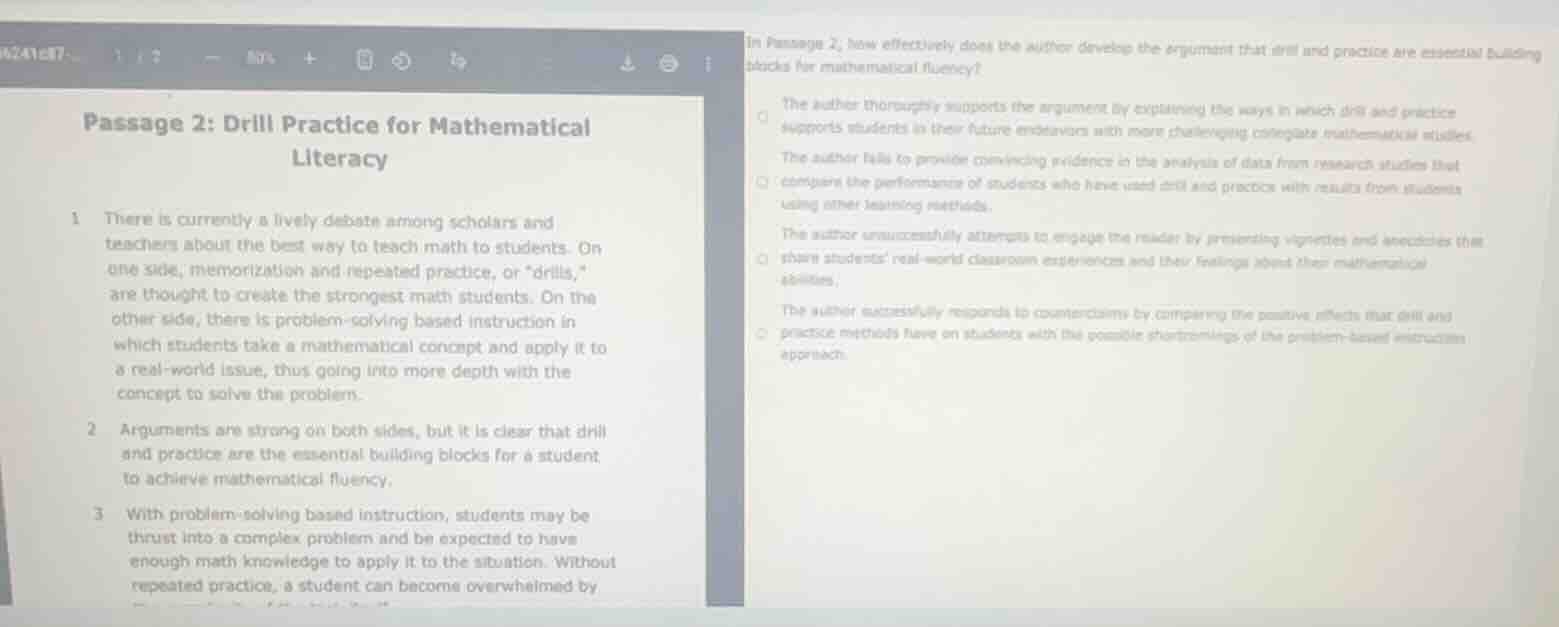
passage 2: drill practice for mathematical literacy
1 there is currently a lively debate among scholars and teachers about the best way to teach math to students. on one side, memorization and repeated practice, or \drills,\ are thought to create the strongest math students. on the other side, there is problem-solving based instruction in which students take a mathematical concept and apply it to a real-world issue, thus going into more depth with the concept to solve the problem.
2 arguments are strong on both sides, but it is clear that drill and practice are the essential building blocks for a student to achieve mathematical fluency.
3 with problem-solving based instruction, students may be thrust into a complex problem and be expected to have enough math knowledge to apply it to the situation. without repeated practice, a student can become overwhelmed by
in passage 2, how effectively does the author develop the argument that drill and practice are essential building blocks for mathematical fluency?
the author thoroughly supports the argument by explaining the ways in which drill and practice supports students in their future endeavors with more challenging collegiate mathematical studies.
the author fails to provide convincing evidence in the analysis of data from research studies that compare the performance of students who have used drill and practice with results from students using other learning methods.
the author unsuccessfully attempts to engage the reader by presenting vignettes and anecdotes that share students real-world classroom experiences and their feelings about their mathematical abilities.
the author successfully responds to counterclaims by comparing the positive effects that drill and practice methods have on students with the possible shortcomings of the problem-based instruction approach.
The passage states there is a debate between drill practice and problem-based math instruction, then argues drill/practice are essential building blocks. It does this by pointing out a key shortcoming of problem-based instruction: students may be overwhelmed without foundational repeated practice, which frames drill/practice as a necessary counter to that flaw. This matches the option about addressing counterclaims by comparing positive drill effects to problem-based shortcomings. The other options are incorrect: no mention of collegiate studies, research data, or vignettes/anecdotes.

Snap & solve any problem in the app
Get step-by-step solutions on Sovi AI
Photo-based solutions with guided steps
Explore more problems and detailed explanations
The author successfully responds to counterclaims by comparing the positive effects that drill and practice methods have on students with the possible shortcomings of the problem-based instruction approach.