QUESTION IMAGE
Question
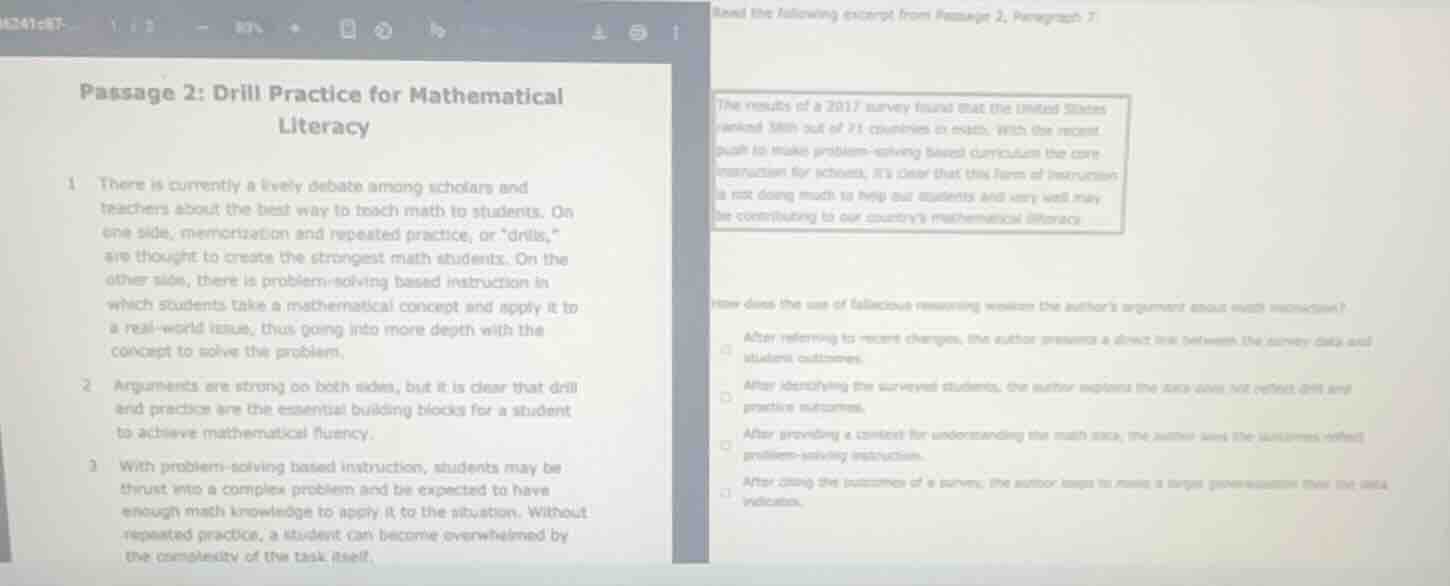
passage 2: drill practice for mathematical literacy
1 there is currently a lively debate among scholars and teachers about the best way to teach math to students. on one side, memorization and repeated practice, or \drills,\ are thought to create the strongest math students. on the other side, there is problem-solving based instruction in which students take a mathematical concept and apply it to a real-world issue, thus going into more depth with the concept to solve the problem.
2 arguments are strong on both sides, but it is clear that drill and practice are the essential building blocks for a student to achieve mathematical fluency.
3 with problem-solving based instruction, students may be thrust into a complex problem and be expected to have enough math knowledge to apply it to the situation. without repeated practice, a student can become overwhelmed by the complexity of the task itself.
based the following excerpt from passage 2, paragraph 7
the results of a 2017 survey found that the united states ranked 38th out of 71 countries in math. with the recent push to make problem-solving based curriculum the core instruction for schools, its clear that this form of instruction is not doing much to help our students and very well may be contributing to our countrys mathematical illiteracy.
how does the use of fallacious reasoning weaken the authors argument about math instruction?
- after referring to recent changes, the author presents a direct link between the survey data and student outcomes.
- after identifying the surveyed students, the author explains the data does not reflect drill and practice outcomes.
- after providing a context for understanding the math data, the author uses the outcomes reflect problem-solving instruction.
- after citing the outcomes of a survey, the author leaps to make a large generalization that the data validates.
The author uses survey data showing U.S. math ranking, then incorrectly links poor student outcomes directly to problem-solving instruction without valid evidence of causation. This is a false causal leap, a type of fallacious reasoning, that weakens the argument as the connection is not proven.

Snap & solve any problem in the app
Get step-by-step solutions on Sovi AI
Photo-based solutions with guided steps
Explore more problems and detailed explanations
After citing the outcomes of a survey, the author leaps to make a large generalization that lacks validation.