QUESTION IMAGE
Question
passage 1
the farmer and the peasant
there once lived a well - to - do farmer and opposite his house lived a poor peasant, and the peasant thought if he carried on his cultivation just as the farmer, he might get more food. so every day he visited the farmer’s house and heard what work he would do the next day. he imitated the farmer exactly: he plowed and sowed and transplanted when the farmer did and the result was good, for that year he got a fine crop. so he resolved to continue to copy the farmer.
the selfish farmer suspected what the peasant was doing and did not like it, so he resolved to teach the peasant to mind his own business. in january they both planted sugar cane, and when the crop was half grown the peasant heard the farmer give orders to put the leveler over the crop and break it down. this was only a pretense, but the peasant went away and crushed his sugar cane crop. it turned out that each root of the peasant’s sugar cane then sent up a number of shoots and in the end he had a much heavier crop than the farmer. the farmer continued with his tricks and soon the peasant was sowing roasted pulse. yet the few seeds of the peasant’s which germinated produced such fine plants that when he came to thresh, he had more grain than the farmer. so in a few years, the peasant became the richer man.
2
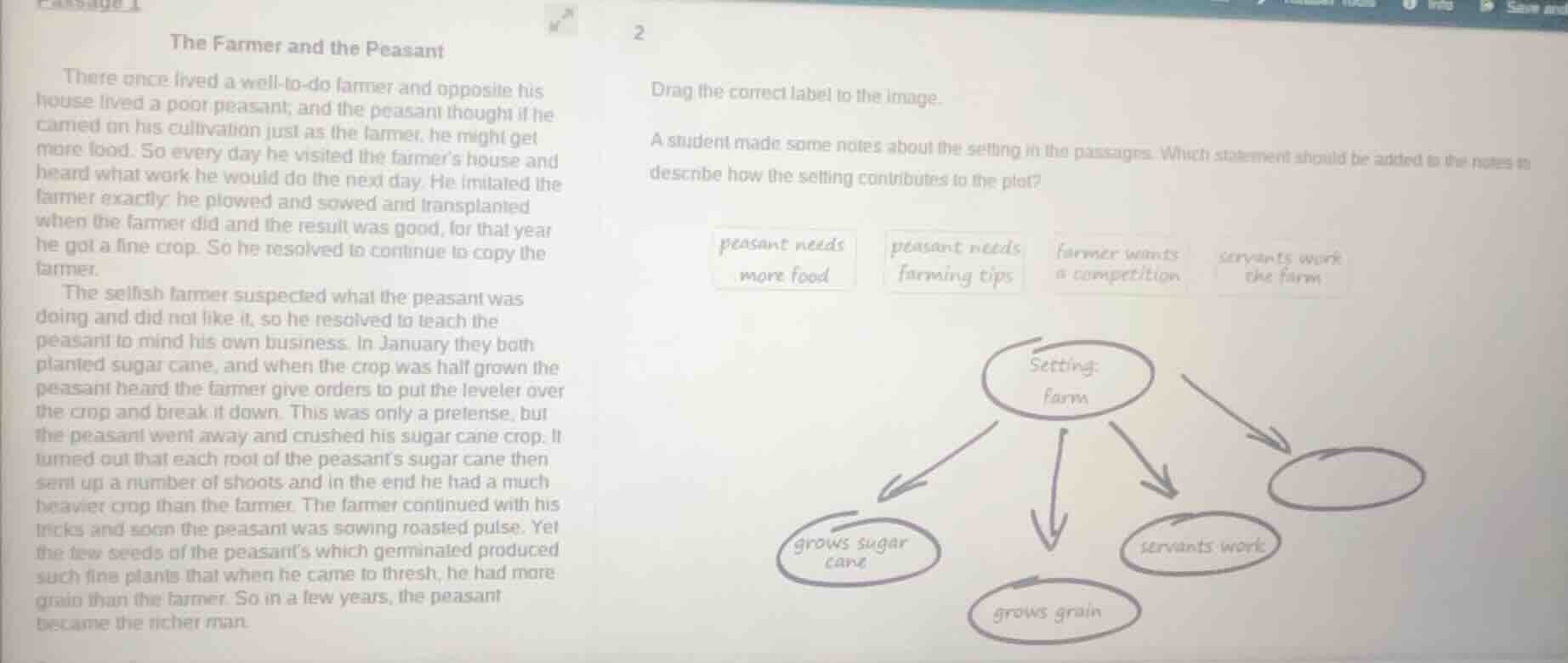
drag the correct label to the image.
a student made some notes about the setting in the passage. which statement should be added to the notes to describe how the setting contributes to the plot?
peasant needs more food peasant needs farming tips farmer wants a competition servants work the farm
(there is a diagram with “setting: farm” in an oval, and arrows pointing to “grows sugar cane”, “grows grain”, “servants work” and another empty oval.)
For the "Drag the correct label to the image" part:
Looking at the context, the peasant's main motivation is getting more food as he thought imitating the farmer's cultivation would help. Among the options, "peasant needs more food" relates to the setting (farm) and the plot's development (his actions to get more food). The other options: "peasant needs farming tips" is not the main need (he imitates actions, not seeks tips), "farmer wants a competition" is not supported (farmer is selfish, not wanting competition but to stop the peasant), "servants work the farm" – the passage focuses on the farmer and peasant, not servants. So the correct label for the empty circle (connected to "Setting: farm") related to the peasant's need is "peasant needs more food".
For the "Which statement should be added..." part:
The setting is a farm. The plot involves the peasant imitating the farmer's farming (growing sugar cane, grain) to get more food. A statement like "The farm setting provides the environment where the peasant can imitate the farmer’s cultivation methods (like growing sugar cane and grain) to try to obtain more food, and the farm activities (e.g., plowing, sowing) drive the actions that lead to the peasant eventually becoming richer" would work. But based on the labels, to connect setting (farm) to the plot's driver, the key is the peasant's need for more food driving his actions on the farm. So the statement could be: "The farm setting allows the peasant to observe and imitate the farmer’s farming practices, and his desire for more food (stemming from the farm - based livelihood) motivates his actions that advance the plot (leading to his increased crop yields and wealth)."
Final Answers:
- Drag the correct label: peasant needs more food
- Statement to add: A suitable statement is "The farm setting enables the peasant to mimic the farmer’s agricultural activities, and his need for more food (arising from the farm - based context) propels the plot as his imitative actions lead to greater crop production and his eventual prosperity." (Or a more concise version focusing on how the farm setting (where farming happens) contributes to the plot by providing the context for the peasant's actions to get more food through imitating the farmer's cultivation.)

Snap & solve any problem in the app
Get step-by-step solutions on Sovi AI
Photo-based solutions with guided steps
Explore more problems and detailed explanations
For the "Drag the correct label to the image" part:
Looking at the context, the peasant's main motivation is getting more food as he thought imitating the farmer's cultivation would help. Among the options, "peasant needs more food" relates to the setting (farm) and the plot's development (his actions to get more food). The other options: "peasant needs farming tips" is not the main need (he imitates actions, not seeks tips), "farmer wants a competition" is not supported (farmer is selfish, not wanting competition but to stop the peasant), "servants work the farm" – the passage focuses on the farmer and peasant, not servants. So the correct label for the empty circle (connected to "Setting: farm") related to the peasant's need is "peasant needs more food".
For the "Which statement should be added..." part:
The setting is a farm. The plot involves the peasant imitating the farmer's farming (growing sugar cane, grain) to get more food. A statement like "The farm setting provides the environment where the peasant can imitate the farmer’s cultivation methods (like growing sugar cane and grain) to try to obtain more food, and the farm activities (e.g., plowing, sowing) drive the actions that lead to the peasant eventually becoming richer" would work. But based on the labels, to connect setting (farm) to the plot's driver, the key is the peasant's need for more food driving his actions on the farm. So the statement could be: "The farm setting allows the peasant to observe and imitate the farmer’s farming practices, and his desire for more food (stemming from the farm - based livelihood) motivates his actions that advance the plot (leading to his increased crop yields and wealth)."
Final Answers:
- Drag the correct label: peasant needs more food
- Statement to add: A suitable statement is "The farm setting enables the peasant to mimic the farmer’s agricultural activities, and his need for more food (arising from the farm - based context) propels the plot as his imitative actions lead to greater crop production and his eventual prosperity." (Or a more concise version focusing on how the farm setting (where farming happens) contributes to the plot by providing the context for the peasant's actions to get more food through imitating the farmer's cultivation.)