QUESTION IMAGE
Question
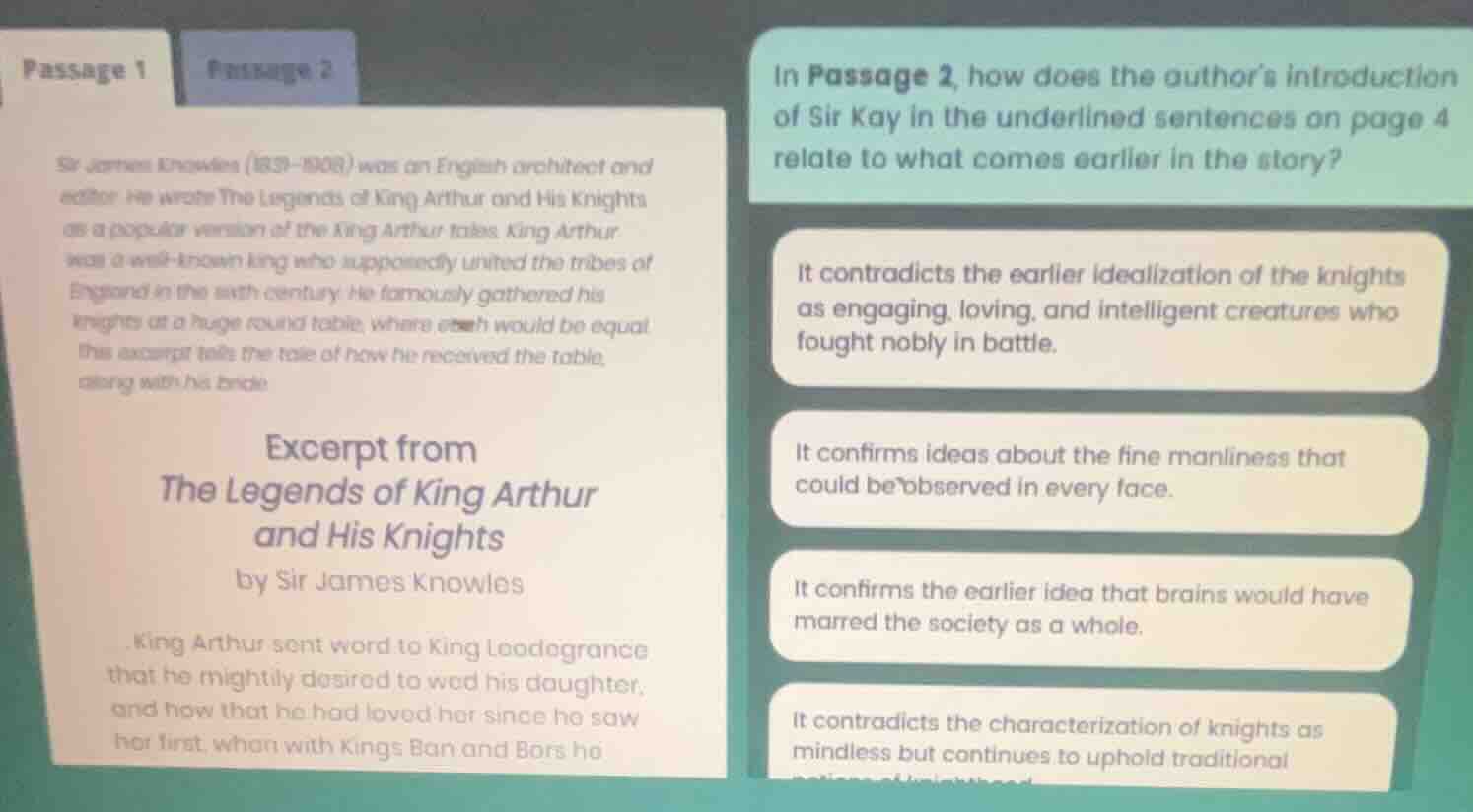
passage 1 passage 2 sir james knowles (1839 - 1908) was an english architect and editor. he wrote the legends of king arthur and his knights as a popular version of the king arthur tales. king arthur was a well - known king who supposedly united the tribes of england in the sixth century. he famously gathered his knights at a huge round table, where each would be equal. this excerpt tells the tale of how he received the table, along with his bride. excerpt from the legends of king arthur and his knights by sir james knowles king arthur sent word to king leodogrance that he mightily desired to wed his daughter, and how that he had loved her since he saw her first, when with kings ban and bors he in passage 2, how does the author’s introduction of sir kay in the underlined sentences on page 4 relate to what comes earlier in the story? it contradicts the earlier idealization of the knights as engaging, loving, and intelligent creatures who fought nobly in battle. it confirms ideas about the fine manliness that could be observed in every face. it confirms the earlier idea that brains would have marred the society as a whole. it contradicts the characterization of knights as mindless but continues to uphold traditional
To solve this, we analyze the relationship between Sir Kay's introduction and earlier parts. The first option says it contradicts the earlier idealization of knights as engaging, loving, intelligent, and noble in battle. If Sir Kay's portrayal is different (e.g., less ideal), this makes sense. The other options either confirm positive views (which would not be a contradiction) or have illogical confirmations (like "brains marring society" which is unclear). So the first option is correct as it shows a contrast between the idealized knights and Sir Kay's possible different depiction.

Snap & solve any problem in the app
Get step-by-step solutions on Sovi AI
Photo-based solutions with guided steps
Explore more problems and detailed explanations
It contradicts the earlier idealization of the knights as engaging, loving, and intelligent creatures who fought nobly in battle.