QUESTION IMAGE
Question
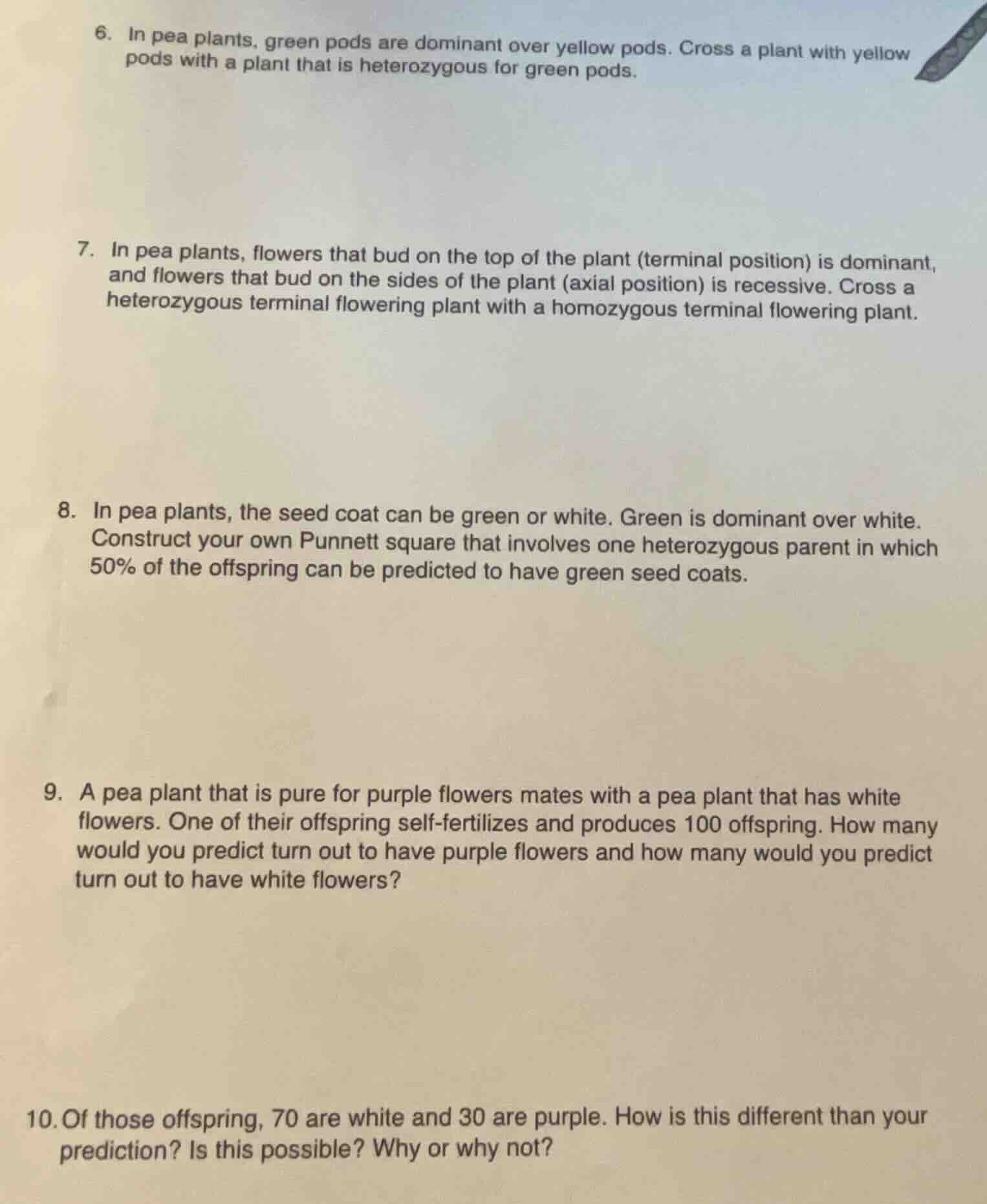
- in pea plants, green pods are dominant over yellow pods. cross a plant with yellow pods with a plant that is heterozygous for green pods.
- in pea plants, flowers that bud on the top of the plant (terminal position) is dominant, and flowers that bud on the sides of the plant (axial position) is recessive. cross a heterozygous terminal flowering plant with a homozygous terminal flowering plant.
- in pea plants, the seed coat can be green or white. green is dominant over white. construct your own punnett square that involves one heterozygous parent in which 50% of the offspring can be predicted to have green seed coats.
- a pea plant that is pure for purple flowers mates with a pea plant that has white flowers. one of their offspring self - fertilizes and produces 100 offspring. how many would you predict turn out to have purple flowers and how many would you predict turn out to have white flowers?
- of those offspring, 70 are white and 30 are purple. how is this different than your prediction? is this possible? why or why not?
Step1: Define alleles for Q6
Let $G$ = dominant green pod, $g$ = recessive yellow pod.
Yellow plant: $gg$; Heterozygous green plant: $Gg$
Step2: Set up Punnett Square for Q6
| $G$ | $g$ | |
|---|---|---|
| $g$ | $Gg$ | $gg$ |
Genotype ratio: $\frac{1}{2}Gg$, $\frac{1}{2}gg$; Phenotype ratio: 1 green : 1 yellow
Step3: Define alleles for Q7
Let $T$ = dominant terminal flower, $t$ = recessive axial flower.
Heterozygous terminal: $Tt$; Homozygous terminal: $TT$
Step4: Set up Punnett Square for Q7
| $T$ | $t$ | |
|---|---|---|
| $T$ | $TT$ | $Tt$ |
Genotype ratio: $\frac{1}{2}TT$, $\frac{1}{2}Tt$; Phenotype ratio: 100% terminal flowers
Step5: Design cross for Q8
Let $S$ = dominant green seed coat, $s$ = recessive white seed coat.
Heterozygous parent: $Ss$; To get 50% green offspring, cross with homozygous recessive $ss$
Punnett Square:
| $S$ | $s$ | |
|---|---|---|
| $s$ | $Ss$ | $ss$ |
Phenotype ratio: 50% green ($Ss$), 50% white ($ss$)
Step6: First cross for Q9
Let $P$ = dominant purple flower, $p$ = recessive white flower.
Pure purple: $PP$; White flower: $pp$
First cross offspring: all $Pp$ (purple)
Step7: Self-fertilize $Pp$ for Q9
Punnett Square for $Pp \times Pp$:
| $P$ | $p$ | |
|---|---|---|
| $p$ | $Pp$ | $pp$ |
Phenotype ratio: $\frac{3}{4}$ purple, $\frac{1}{4}$ white. For 100 offspring:
Purple count: $100 \times \frac{3}{4} = 75$; White count: $100 \times \frac{1}{4} = 25$
Step8: Analyze Q10 deviation
Prediction: 75 purple, 25 white; Observed: 30 purple, 70 white. Observed has far more white flowers. This is possible because Punnett square ratios are statistical probabilities, not fixed outcomes. Random fertilization can cause real-world offspring counts to deviate from predicted ratios, especially with small sample sizes.

Snap & solve any problem in the app
Get step-by-step solutions on Sovi AI
Photo-based solutions with guided steps
Explore more problems and detailed explanations
- Genotype ratio: 1 $Gg$ : 1 $gg$; Phenotype ratio: 1 green pod plant : 1 yellow pod plant
- Genotype ratio: 1 $TT$ : 1 $Tt$; Phenotype ratio: 100% terminal flowering plants
- Cross a heterozygous green seed coat plant ($Ss$) with a homozygous white seed coat plant ($ss$). Punnett square yields 50% green ($Ss$) and 50% white ($ss$) offspring.
- 75 purple-flowered offspring, 25 white-flowered offspring
- The observed count has far fewer purple flowers and far more white flowers than the predicted 75 purple/25 white. This is possible because Punnett square ratios are only statistical expectations, not guaranteed results. Random chance in fertilization can lead to deviations from predicted ratios, especially with a relatively small sample size of 100 offspring.