QUESTION IMAGE
Question
pedigree analysis
introduction: a pedigree is a diagram that shows how organisms are related and also traces the occurrence of a particular trait or characteristic for several generations. the genetic makeup of individuals in the pedigree might be determined if one understands heredity and probability.
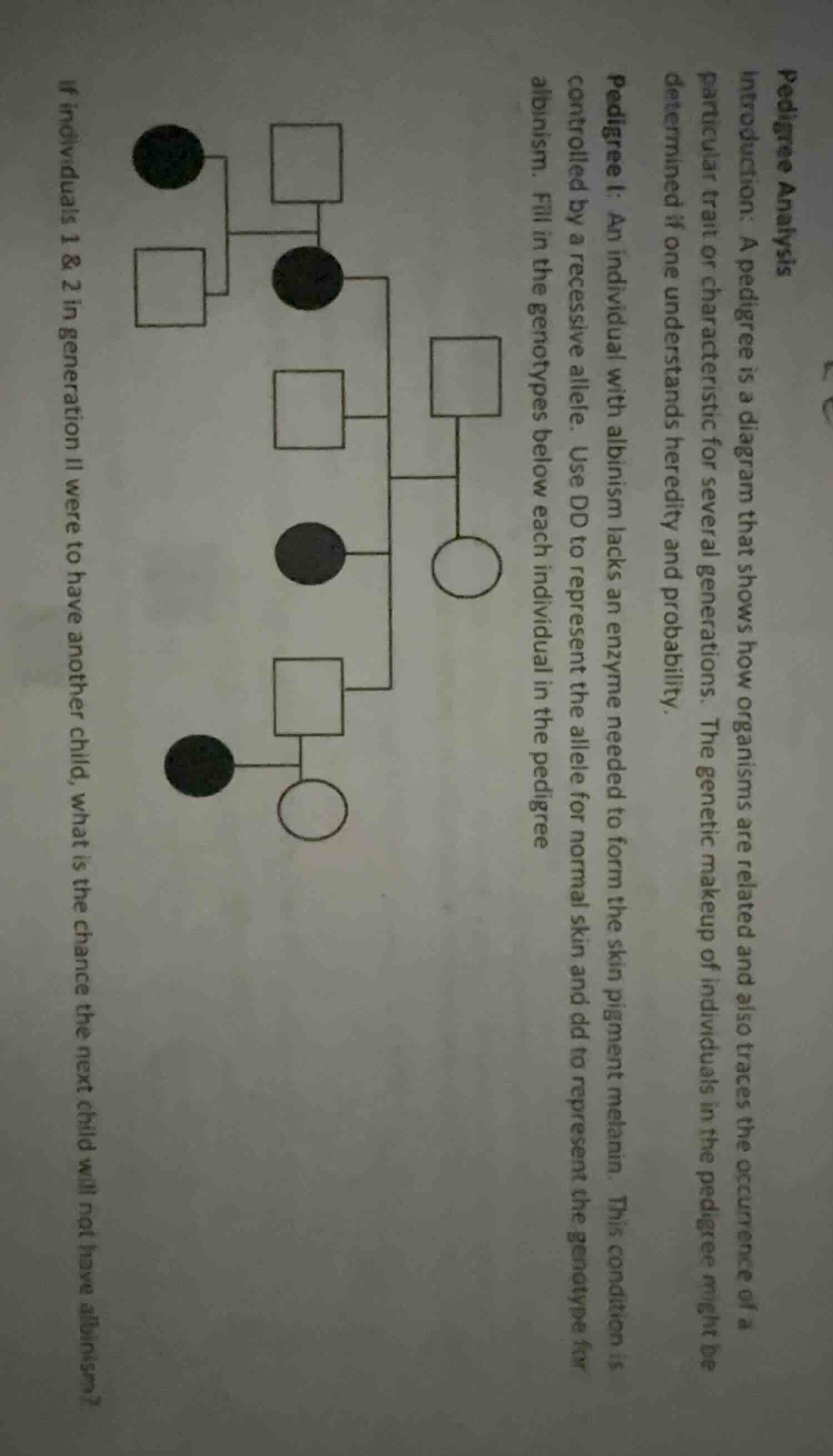
pedigree i: an individual with albinism lacks an enzyme needed to form the skin pigment melanin. this condition is controlled by a recessive allele. use dd to represent the allele for normal skin and dd to represent the genotype for albinism. fill in the genotypes below each individual in the pedigree
if individuals 1 & 2 in generation ii were to have another child, what is the chance the next child will not have albinism?
Step1: Identify parent genotypes
Albinism is recessive ($dd$). The affected child (filled circle) has $dd$, so both parents (Generation II, 1 & 2: empty square, empty circle) must be carriers: $Dd$.
Step2: Set up Punnett square
Cross $Dd \times Dd$:
Step3: Calculate non-albino probability
Non-albino genotypes: $DD, Dd$. There are 3 out of 4 possible genotypes.
Probability = $\frac{3}{4}$

Snap & solve any problem in the app
Get step-by-step solutions on Sovi AI
Photo-based solutions with guided steps
Explore more problems and detailed explanations
The chance the next child will not have albinism is $\frac{3}{4}$ (or 75%).
---
Genotypes for all pedigree individuals:
- Generation I:
- Filled circle: $dd$
- Empty square (spouse of filled circle): $Dd$ (since they have an affected child)
- Empty square (spouse of top filled circle): $Dd$
- Top filled circle: $dd$
- Generation II:
- Empty square (spouse of filled circle): $Dd$
- Filled circle: $dd$
- Empty square (spouse of empty circle): $Dd$
- Empty circle: $Dd$
- Generation III:
- Filled circle: $dd$
- Empty square: $Dd$
- Empty circle: $Dd$