QUESTION IMAGE
Question
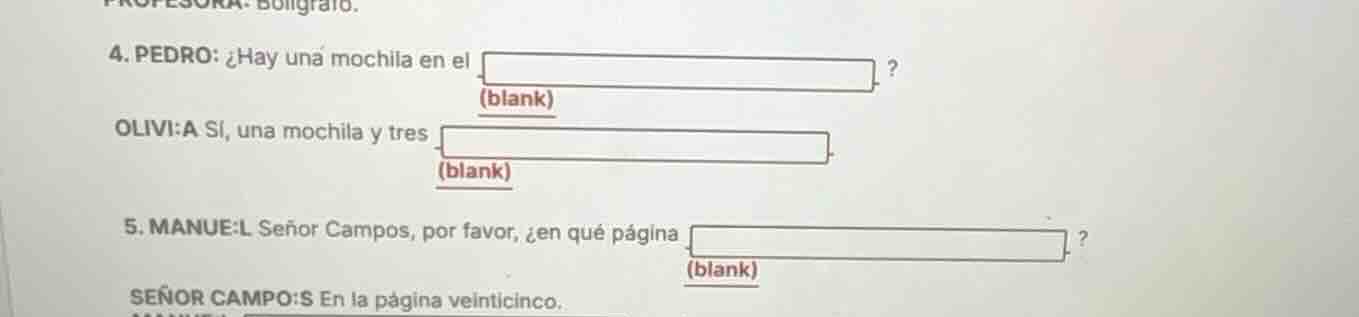
- pedro: ¿hay una mochila en el (blank) ?
olivi:a sí, una mochila y tres (blank) .
- manue:l señor campos, por favor, ¿en qué página (blank) ?
señor campo:s en la página veinticinco.
To solve this fill - in - the - blank exercise in Spanish, we analyze the context of each sentence:
Sentence 4 (Pedro's question)
- The first blank: We need a place - related noun. A common place where a backpack could be is “estante” (shelf) or “escritorio” (desk). Let's assume a common classroom setting, “estante” is a good fit. The sentence structure is “¿Hay una mochila en el [place]?”, so “estante” works here.
- The second blank: After “tres” (three), we need a plural noun. “libros” (books) is a common item that can be in a place with a backpack. So the second blank can be “libros”.
Sentence 5 (Manuel's question)
- The blank: Manuel is asking about a page related to an action, likely “está el ejercicio” (is the exercise) or a similar structure. A common question is “¿en qué página está el texto?” (on what page is the text?) or “¿en qué página está la lección?” (on what page is the lesson?). Let's go with “está el texto” as a common example.
Filled - in Sentences:
- PEDRO: ¿Hay una mochila en el $\boldsymbol{estante}$?
OLIVIA: Sí, una mochila y tres $\boldsymbol{libros}$.
- MANUEL: Señor Campos, por favor, ¿en qué página $\boldsymbol{está el texto}$?
SEÑOR CAMPOS: En la página veinticinco.
(Note: These are sample answers. Other appropriate Spanish nouns/phrases can also be used based on the context of the textbook or lesson, such as “escritorio” for the first blank in sentence 4, “cuadernos” for the second blank, or “está la lección” for the blank in sentence 5.)

Snap & solve any problem in the app
Get step-by-step solutions on Sovi AI
Photo-based solutions with guided steps
Explore more problems and detailed explanations
To solve this fill - in - the - blank exercise in Spanish, we analyze the context of each sentence:
Sentence 4 (Pedro's question)
- The first blank: We need a place - related noun. A common place where a backpack could be is “estante” (shelf) or “escritorio” (desk). Let's assume a common classroom setting, “estante” is a good fit. The sentence structure is “¿Hay una mochila en el [place]?”, so “estante” works here.
- The second blank: After “tres” (three), we need a plural noun. “libros” (books) is a common item that can be in a place with a backpack. So the second blank can be “libros”.
Sentence 5 (Manuel's question)
- The blank: Manuel is asking about a page related to an action, likely “está el ejercicio” (is the exercise) or a similar structure. A common question is “¿en qué página está el texto?” (on what page is the text?) or “¿en qué página está la lección?” (on what page is the lesson?). Let's go with “está el texto” as a common example.
Filled - in Sentences:
- PEDRO: ¿Hay una mochila en el $\boldsymbol{estante}$?
OLIVIA: Sí, una mochila y tres $\boldsymbol{libros}$.
- MANUEL: Señor Campos, por favor, ¿en qué página $\boldsymbol{está el texto}$?
SEÑOR CAMPOS: En la página veinticinco.
(Note: These are sample answers. Other appropriate Spanish nouns/phrases can also be used based on the context of the textbook or lesson, such as “escritorio” for the first blank in sentence 4, “cuadernos” for the second blank, or “está la lección” for the blank in sentence 5.)