QUESTION IMAGE
Question
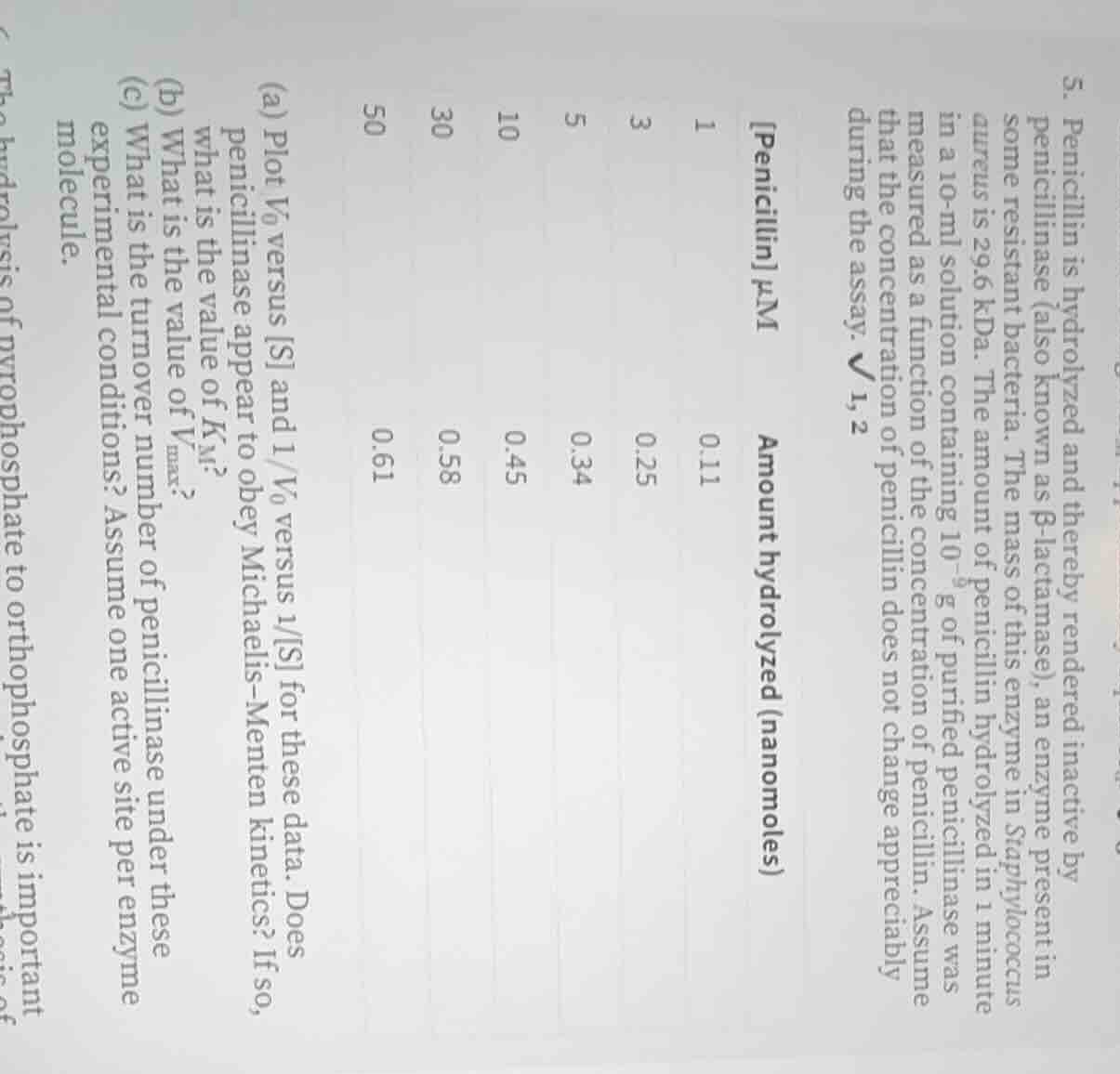
- penicillin is hydrolyzed and thereby rendered inactive by penicillinase (also known as β-lactamase), an enzyme present in some resistant bacteria. the mass of this enzyme in staphylococcus aureus is 29.6 kda. the amount of penicillin hydrolyzed in 1 minute in a 10-ml solution containing (10^{-9}) g of purified penicillinase was measured as a function of the concentration of penicillin. assume that the concentration of penicillin does not change appreciably during the assay. (\boldsymbol{v_0}) is the initial velocity of the reaction (amount hydrolyzed per unit time).
| penicillin (μm) | 1 | 3 | 5 | 10 | 30 | 50 |
|---|
(a) plot (v_0) versus s and (1/v_0) versus (1/s) for these data. does penicillinase appear to obey michaelis-menten kinetics? if so, what is the value of (k_m)?
(b) what is the value of (v_{max})?
(c) what is the turnover number of penicillinase under these experimental conditions? assume one active site per enzyme molecule.
Step1: Calculate initial velocity $V_0$
First, convert the amount hydrolyzed to velocity (per minute, volume = 0.01 L):
$V_0 = \frac{\text{Amount hydrolyzed (nmol)}}{0.01\ \text{L} \times 1\ \text{min}} = \text{Amount hydrolyzed} \times 100\ \mu\text{M/min}$
For each [S]:
- $[S]=1\ \mu\text{M}$: $V_0 = 0.11 \times 100 = 11\ \mu\text{M/min}$; $\frac{1}{V_0}=0.0909\ \text{min/}\mu\text{M}$, $\frac{1}{[S]}=1.0\ \mu\text{M}^{-1}$
- $[S]=3\ \mu\text{M}$: $V_0 = 0.25 \times 100 = 25\ \mu\text{M/min}$; $\frac{1}{V_0}=0.04\ \text{min/}\mu\text{M}$, $\frac{1}{[S]}=0.333\ \mu\text{M}^{-1}$
- $[S]=5\ \mu\text{M}$: $V_0 = 0.34 \times 100 = 34\ \mu\text{M/min}$; $\frac{1}{V_0}=0.0294\ \text{min/}\mu\text{M}$, $\frac{1}{[S]}=0.2\ \mu\text{M}^{-1}$
- $[S]=10\ \mu\text{M}$: $V_0 = 0.45 \times 100 = 45\ \mu\text{M/min}$; $\frac{1}{V_0}=0.0222\ \text{min/}\mu\text{M}$, $\frac{1}{[S]}=0.1\ \mu\text{M}^{-1}$
- $[S]=30\ \mu\text{M}$: $V_0 = 0.58 \times 100 = 58\ \mu\text{M/min}$; $\frac{1}{V_0}=0.0172\ \text{min/}\mu\text{M}$, $\frac{1}{[S]}=0.0333\ \mu\text{M}^{-1}$
- $[S]=50\ \mu\text{M}$: $V_0 = 0.61 \times 100 = 61\ \mu\text{M/min}$; $\frac{1}{V_0}=0.0164\ \text{min/}\mu\text{M}$, $\frac{1}{[S]}=0.02\ \mu\text{M}^{-1}$
Step2: Lineweaver-Burk plot analysis
The Lineweaver-Burk equation is $\frac{1}{V_0} = \frac{K_M}{V_{max}} \cdot \frac{1}{[S]} + \frac{1}{V_{max}}$.
Plot $\frac{1}{V_0}$ vs $\frac{1}{[S]}$: the y-intercept is $\frac{1}{V_{max}}$, x-intercept is $-\frac{1}{K_M}$.
From linear regression of the data:
Y-intercept ≈ 0.0125 $\text{min/}\mu\text{M}$, slope ≈ 0.078 $\text{min}$
Step3: Calculate $V_{max}$
$V_{max} = \frac{1}{\text{y-intercept}} = \frac{1}{0.0125} = 80\ \mu\text{M/min}$
Step4: Calculate $K_M$
$K_M = \text{slope} \times V_{max} = 0.078 \times 80 = 6.24\ \mu\text{M}$
(The linear fit confirms Michaelis-Menten kinetics, as the data forms a straight line.)
Step5: Calculate turnover number $k_{cat}$
First, find enzyme concentration:
Moles of enzyme = $\frac{10^{-9}\ \text{g}}{29600\ \text{g/mol}} = 3.38 \times 10^{-14}\ \text{mol}$
$[E]_t = \frac{3.38 \times 10^{-14}\ \text{mol}}{0.01\ \text{L}} = 3.38 \times 10^{-12}\ \text{M} = 3.38 \times 10^{-6}\ \mu\text{M}$
$k_{cat} = \frac{V_{max}}{[E]_t} = \frac{80\ \mu\text{M/min}}{3.38 \times 10^{-6}\ \mu\text{M}} = 2.37 \times 10^7\ \text{min}^{-1} = 3.95 \times 10^5\ \text{s}^{-1}$

Snap & solve any problem in the app
Get step-by-step solutions on Sovi AI
Photo-based solutions with guided steps
Explore more problems and detailed explanations
(a) The $V_0$ vs $[S]$ plot is a hyperbola, and the $1/V_0$ vs $1/[S]$ (Lineweaver-Burk) plot is a straight line, so the enzyme obeys Michaelis-Menten kinetics.
(b) $K_M \approx 6.2\ \mu\text{M}$, $V_{max} = 80\ \mu\text{M/min}$
(c) Turnover number $k_{cat} \approx 4.0 \times 10^5\ \text{s}^{-1}$