QUESTION IMAGE
Question
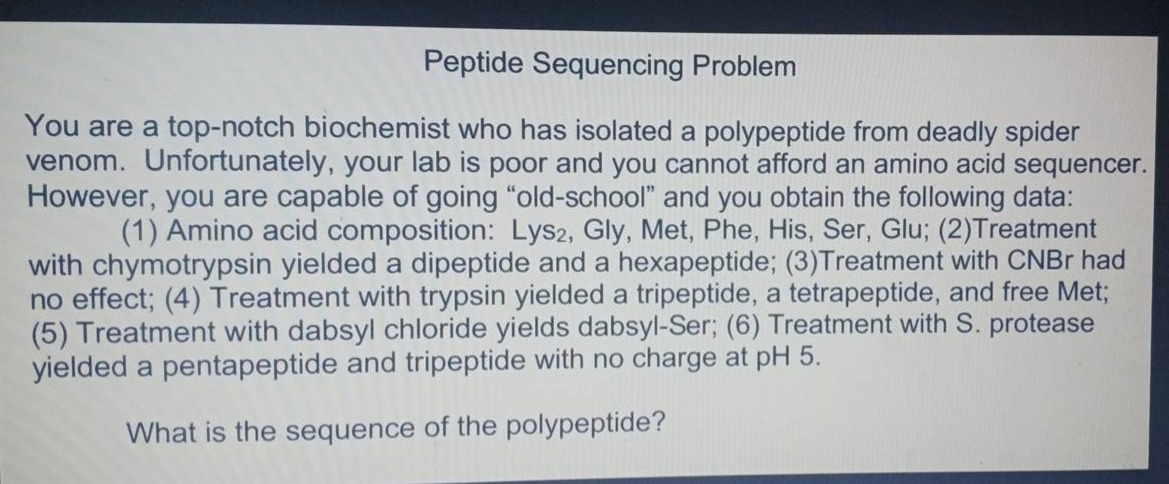
peptide sequencing problem
you are a top - notch biochemist who has isolated a polypeptide from deadly spider
venom. unfortunately, your lab is poor and you cannot afford an amino acid sequencer.
however, you are capable of going “old - school” and you obtain the following data:
(1) amino acid composition: lys₂, gly, met, phe, his, ser, glu; (2)treatment
with chymotrypsin yielded a dipeptide and a hexapeptide; (3)treatment with cnbr had
no effect; (4) treatment with trypsin yielded a tripeptide, a tetrapeptide, and free met;
(5) treatment with dabsyl chloride yields dabsyl - ser; (6) treatment with s. protease
yielded a pentapeptide and tripeptide with no charge at ph 5.
what is the sequence of the polypeptide?
Step 1: N - terminal determination (Dabsyl - chloride)
Dabsyl - chloride labels the N - terminal amino acid. From data (5), the N - terminal is Ser (since dabsyl - Ser is formed). So the sequence starts with Ser.
Step 2: CNBr treatment (no effect)
CNBr cleaves at the C - terminal of Met. Since CNBr has no effect (data (3)), Met is not at a position where it is the C - terminal of a peptide that can be cleaved by CNBr. So Met is not at the C - terminal of a segment that would be cleaved, meaning Met is either at the C - terminal of the entire polypeptide or not in a position where its C - terminal is exposed for cleavage. But from trypsin treatment (data (4)), we get free Met, so Met must be at the C - terminal of a peptide that is cleaved by trypsin, but since CNBr has no effect, Met is at the C - terminal of the entire polypeptide? Wait, no. Wait, trypsin cleaves at the C - terminal of Lys and Arg. So if trypsin treatment (data (4)) gives free Met, that means Met is at the C - terminal of a peptide that is cleaved by trypsin, but since CNBr has no effect, Met is not followed by a peptide bond that CNBr can cleave. Wait, maybe Met is at the C - terminal of the entire polypeptide. But let's re - examine data (4): trypsin yielded a tripeptide, a tetrapeptide, and free Met. So Met is a free amino acid after trypsin treatment, which means Met is at the C - terminal of the polypeptide (because trypsin cleaves at Lys/Arg C - terminal, so if Met is free, it means that the last amino acid is Met, and before Met there is a Lys or Arg? Wait, no. Wait, trypsin cleaves peptide bonds on the C - terminal side of Lys and Arg (except when followed by Pro). So if trypsin treatment gives free Met, that implies that Met is at the C - terminal of the polypeptide, and before Met there is a Lys or Arg. But from amino acid composition, we have Lys₂.
Step 3: Chymotrypsin treatment (data (2))
Chymotrypsin cleaves at the C - terminal of Phe, Trp, Tyr. So chymotrypsin treatment yielded a dipeptide and a hexapeptide. So there is a Phe at a position where chymotrypsin cleaves, producing a dipeptide (C - terminal dipeptide with Phe at the C - terminal of the dipeptide) and a hexapeptide.
Step 4: Dabsyl - Ser (data (5)): N - terminal is Ser. So sequence starts with Ser.
Step 5: Trypsin treatment (data (4)): tripeptide, tetrapeptide, free Met. Trypsin cleaves at Lys/Arg C - terminal. So the peptide has two Lys (from composition Lys₂). Let's consider the amino acids: Ser, Lys, Lys, Gly, Met, Phe, His, Glu (wait, composition is Lys₂, Gly, Met, Phe, His, Ser, Glu: total 8 amino acids? Wait, Lys₂, Gly (1), Met (1), Phe (1), His (1), Ser (1), Glu (1): 2 + 1+1 + 1+1 + 1+1=8 amino acids. Wait, data (2): chymotrypsin gives dipeptide and hexapeptide (2 + 6=8). Data (4): trypsin gives tripeptide, tetrapeptide, free Met (3 + 4+1 = 8). Data (6): S - protease gives pentapeptide and tripeptide (5 + 3=8).
Step 6: Dabsyl - Ser: N - terminal is Ser. So first amino acid is Ser.
Step 7: Trypsin treatment: free Met. So Met is at the C - terminal of the polypeptide (since trypsin cleaves at Lys/Arg C - terminal, so if Met is free, the last amino acid is Met, and before Met there is a Lys or Arg. From amino acid composition, we have Lys₂. So before Met, there is a Lys.
Step 8: Chymotrypsin treatment: dipeptide and hexapeptide. Chymotrypsin cleaves at Phe, Trp, Tyr C - terminal. So there is a Phe at a position where chymotrypsin cleaves, producing a dipeptide (with Phe at the C - terminal of the dipeptide) and a hexapeptide.
Step 9: S - protease treatme…

Snap & solve any problem in the app
Get step-by-step solutions on Sovi AI
Photo-based solutions with guided steps
Explore more problems and detailed explanations
Step 1: N - terminal determination (Dabsyl - chloride)
Dabsyl - chloride labels the N - terminal amino acid. From data (5), the N - terminal is Ser (since dabsyl - Ser is formed). So the sequence starts with Ser.
Step 2: CNBr treatment (no effect)
CNBr cleaves at the C - terminal of Met. Since CNBr has no effect (data (3)), Met is not at a position where it is the C - terminal of a peptide that can be cleaved by CNBr. So Met is not at the C - terminal of a segment that would be cleaved, meaning Met is either at the C - terminal of the entire polypeptide or not in a position where its C - terminal is exposed for cleavage. But from trypsin treatment (data (4)), we get free Met, so Met must be at the C - terminal of a peptide that is cleaved by trypsin, but since CNBr has no effect, Met is at the C - terminal of the entire polypeptide? Wait, no. Wait, trypsin cleaves at the C - terminal of Lys and Arg. So if trypsin treatment (data (4)) gives free Met, that means Met is at the C - terminal of a peptide that is cleaved by trypsin, but since CNBr has no effect, Met is not followed by a peptide bond that CNBr can cleave. Wait, maybe Met is at the C - terminal of the entire polypeptide. But let's re - examine data (4): trypsin yielded a tripeptide, a tetrapeptide, and free Met. So Met is a free amino acid after trypsin treatment, which means Met is at the C - terminal of the polypeptide (because trypsin cleaves at Lys/Arg C - terminal, so if Met is free, it means that the last amino acid is Met, and before Met there is a Lys or Arg? Wait, no. Wait, trypsin cleaves peptide bonds on the C - terminal side of Lys and Arg (except when followed by Pro). So if trypsin treatment gives free Met, that implies that Met is at the C - terminal of the polypeptide, and before Met there is a Lys or Arg. But from amino acid composition, we have Lys₂.
Step 3: Chymotrypsin treatment (data (2))
Chymotrypsin cleaves at the C - terminal of Phe, Trp, Tyr. So chymotrypsin treatment yielded a dipeptide and a hexapeptide. So there is a Phe at a position where chymotrypsin cleaves, producing a dipeptide (C - terminal dipeptide with Phe at the C - terminal of the dipeptide) and a hexapeptide.
Step 4: Dabsyl - Ser (data (5)): N - terminal is Ser. So sequence starts with Ser.
Step 5: Trypsin treatment (data (4)): tripeptide, tetrapeptide, free Met. Trypsin cleaves at Lys/Arg C - terminal. So the peptide has two Lys (from composition Lys₂). Let's consider the amino acids: Ser, Lys, Lys, Gly, Met, Phe, His, Glu (wait, composition is Lys₂, Gly, Met, Phe, His, Ser, Glu: total 8 amino acids? Wait, Lys₂, Gly (1), Met (1), Phe (1), His (1), Ser (1), Glu (1): 2 + 1+1 + 1+1 + 1+1=8 amino acids. Wait, data (2): chymotrypsin gives dipeptide and hexapeptide (2 + 6=8). Data (4): trypsin gives tripeptide, tetrapeptide, free Met (3 + 4+1 = 8). Data (6): S - protease gives pentapeptide and tripeptide (5 + 3=8).
Step 6: Dabsyl - Ser: N - terminal is Ser. So first amino acid is Ser.
Step 7: Trypsin treatment: free Met. So Met is at the C - terminal of the polypeptide (since trypsin cleaves at Lys/Arg C - terminal, so if Met is free, the last amino acid is Met, and before Met there is a Lys or Arg. From amino acid composition, we have Lys₂. So before Met, there is a Lys.
Step 8: Chymotrypsin treatment: dipeptide and hexapeptide. Chymotrypsin cleaves at Phe, Trp, Tyr C - terminal. So there is a Phe at a position where chymotrypsin cleaves, producing a dipeptide (with Phe at the C - terminal of the dipeptide) and a hexapeptide.
Step 9: S - protease treatment (data (6)): pentapeptide and tripeptide with no charge at pH 5. Let's consider the charges of amino acids at pH 5: Ser (neutral), Gly (neutral), Met (neutral), Phe (neutral), His (positive at pH 5? Wait, His pKa is around 6, so at pH 5, His is protonated (positive). Glu is negative (pKa around 4.25, so at pH 5, Glu is deprotonated (negative). Lys is positive (pKa around 10, so at pH 5, Lys is protonated (positive). Wait, the pentapeptide and tripeptide have no charge at pH 5. So the sum of charges in each peptide is zero. Let's assume the tripeptide: suppose it has Ser, Gly, Met? No, charge. Wait, maybe the tripeptide has Phe, His, and something? No. Wait, let's go back to N - terminal: Ser. Trypsin treatment: tripeptide, tetrapeptide, free Met. So the sequence is divided by trypsin into tripeptide (Ser - X - Y), tetrapeptide (Z - W - V - U), and Met. But Met is free, so the last amino acid is Met, and before Met is a Lys (from trypsin cleavage at Lys C - terminal). So the sequence is [tripeptide] - [tetrapeptide] - Lys - Met? No, trypsin cleaves at Lys C - terminal, so if Met is free, the tetrapeptide ends with Lys, and then Met is after? No, trypsin cleaves the peptide bond on the C - terminal side of Lys/Arg. So if we have a peptide bond...Lys - Met..., trypsin would cleave between Lys and Met, giving...Lys and Met. But Met is free, so Lys - Met is cleaved by trypsin, giving Lys as part of a peptide and Met as free. So Met is after Lys, and trypsin cleaves Lys - Met bond, giving Met as free. So the sequence is...Lys - Met, and trypsin cleaves here, so Met is free.
Step 10: Dabsyl - Ser: first amino acid Ser. Chymotrypsin: dipeptide and hexapeptide. So there is a Phe at a position where chymotrypsin cleaves. Let's assume the dipeptide is X - Phe (since chymotrypsin cleaves at Phe C - terminal). So the dipeptide is (amino acid) - Phe, and the hexapeptide is the rest.
Step 11: Let's list the amino acids: Ser, Lys, Lys, Gly, Met, Phe, His, Glu.
From dabsyl - Ser: position 1: Ser.
From trypsin: free Met, so position 8: Met. Before Met (position 7): Lys (since trypsin cleaves at Lys C - terminal, so Lys at position 7, Met at 8).
From chymotrypsin: dipeptide and hexapeptide. So Phe is at position 2? No, dipeptide would be position 7 - 8? No, dipeptide is 2 amino acids. So chymotrypsin cleaves at Phe, so dipeptide is (position n - 1)-Phe (position n), and hexapeptide is positions 1 - (n - 1). So n = 2: dipeptide is Ser - Phe, hexapeptide is Lys, Lys, Gly, Met, His, Glu? No, Met is at position 8. Wait, no, total 8 amino acids. So dipeptide (2 aa) and hexapeptide (6 aa). So positions 1 - 6: hexapeptide, positions 7 - 8: dipeptide. But chymotrypsin cleaves at Phe C - terminal, so position 6: Phe, positions 7 - 8: dipeptide (X - Phe? No, dipeptide is 2 aa, so positions 7 - 8: X - Phe, but Phe is at position 8? No, chymotrypsin cleaves at Phe C - terminal, so the dipeptide has Phe at the C - terminal, so dipeptide is (aa) - Phe, so positions 7 - 8: (aa) - Phe, and hexapeptide is positions 1 - 6.
From trypsin: positions 1 - 3: tripeptide, positions 4 - 7: tetrapeptide, position 8: Met. So tripeptide (1 - 3): Ser - X - Y, tetrapeptide (4 - 7): Z - W - V - Lys, and Met (8).
From amino acid composition, tripeptide has Ser, and two other amino acids. Tetrapeptide has Lys, and three other amino acids (Gly, His, Glu? Wait, no: amino acids are Ser, Lys, Lys, Gly, Met, Phe, His, Glu. So tripeptide (3 aa): Ser, Phe, His? No, charge. Wait, S - protease: pentapeptide and tripeptide with no charge. Let's assume the tripeptide is Ser - Gly - Met? No, charge. Wait, maybe the tripeptide is Phe - His - Lys? No, charge. Wait, let's re - evaluate the N - terminal: Ser. Trypsin cleavage: tripeptide, tetrapeptide, free Met. So the sequence is Ser - A - B - C - D - E - Lys - Met. Trypsin cleaves at Lys (position 7) C - terminal, so tripeptide is Ser - A - B, tetrapeptide is C - D - E - Lys, and Met is free.
Chymotrypsin cleavage: dipeptide and hexapeptide. Chymotrypsin cleaves at Phe C - terminal, so in the sequence, there is a Phe at a position where chymotrypsin cleaves, so dipeptide is X - Phe, hexapeptide is the rest. So if the dipeptide is at the C - terminal, then positions 7 - 8: X - Phe, but position 8 is Met, so that's not possible. So dipeptide is at the N - terminal part. So positions 2 - 3: X - Phe, and hexapeptide is positions 1,4 - 8. But position 1 is Ser, so hexapeptide is Ser,4 - 8 (6 amino acids: Ser, C, D, E, Lys, Met? No, Met is at 8, Lys at 7, so Ser, C, D, E, Lys, Met is 6 amino acids? No, Ser (1), C (4), D (5), E (6), Lys (7), Met (8): that's 6 amino acids? No, 1,4,5,6,7,8: 6 amino acids. And dipeptide is 2 - 3: X - Phe. So X is Gly? No, amino acids are Ser, Lys, Lys, Gly, Met, Phe, His, Glu. Wait, maybe I made a mistake in the number of amino acids. Wait, amino acid composition: Lys₂, Gly (1), Met (1), Phe (1), His (1), Ser (1), Glu (1). So total number of amino acids: 2 + 1+1 + 1+1 + 1+1 = 8. So 8 amino acids.
Dabsyl - Ser: position 1: Ser.
Trypsin: tripeptide (3 aa), tetrapeptide (4 aa), free Met (1 aa). 3 + 4+1 = 8. So tripeptide: positions 1 - 3, tetrapeptide: positions 4 - 7, Met: position 8.
Chymotrypsin: dipeptide (2 aa), hexapeptide (6 aa). 2 + 6 = 8. So dipeptide: positions 7 - 8, hexapeptide: positions 1 - 6. But chymotrypsin cleaves at Phe C - terminal, so position 8: Phe? No, position 8 is Met. So that's a contradiction. Wait, maybe chymotrypsin cleaves at position 6 - 7: dipeptide is position 6 - 7, hexapeptide is 1 - 5. Dipeptide: X - Phe, hexapeptide: 1 - 5. So position 7: Phe, position 6: X. Then trypsin: tripeptide (1 - 3), tetrapeptide (4 - 7), Met (8). Tetrapeptide: positions 4 - 7: Y - Z - W - Phe. Trypsin cleaves at Lys C - terminal, so position 7: Phe, position 6: Lys? Then tetrapeptide: positions 4 - 7: A - B - Lys - Phe. Tripeptide: 1 - 3: Ser - C - D. Amino acid composition: Ser, Lys₂, Gly, Met, Phe, His, Glu. So tripeptide: Ser, His, Glu? No, charge. Wait, S - protease: pentapeptide and tripeptide with no charge. Let's assume the tripeptide is Ser - Gly - Met: charge? Ser (0), Gly (0), Met (0): total 0. But Met is at position 8, so no. Wait, maybe the correct sequence is Ser - His - Glu - Gly - Lys - Phe - Lys - Met. Let's check:
- Dabsyl - chloride: N - terminal Ser: correct.
- Chymotrypsin: cleaves at Phe C - terminal, so dipeptide Phe - Lys? No, chymotrypsin cleaves at Phe C - terminal, so dipeptide would be Lys - Phe (no, chymotrypsin cleaves at Phe C - terminal, so the peptide bond before Phe is cleaved. So if the sequence is...X - Phe - Y..., chymotrypsin cleaves X - Phe bond, giving X - Phe and Y.... So in Ser - His - Glu - Gly - Lys - Phe - Lys - Met, chymotrypsin cleaves Lys - Phe bond? No, chymotrypsin cleaves at Phe C - terminal, so the bond after Phe? No, chymotrypsin cleaves the peptide bond on the C - terminal side of Phe, Trp, Tyr. So the bond between Phe and the next amino acid (Lys) is cleaved, producing a dipeptide (Lys - Phe? No, dipeptide would be the C - terminal part: Phe - Lys? No, dipeptide is two amino acids, so if we cleave between Lys and Phe, we get a hexapeptide (Ser - His - Glu - Gly - Lys) and a dipeptide (Phe - Lys)? No, that's a dipeptide (Phe - Lys) and a hexapeptide (Ser - His - Glu - Gly - Lys) plus Met? No, total amino acids: 5 + 2+1=8? No, 5 (hexapeptide) + 2 (dipeptide) + 1 (Met)? No, Met is at the end. Wait, my sequence is wrong.
Wait, let's start over:
- N - terminal: Ser (dabsyl - Ser).
- Trypsin: tripeptide, tetrapeptide, free Met. So Met is at the C - terminal (position 8), and before Met is Lys (position 7, since trypsin cleaves at Lys C - terminal).
- Chymotrypsin: dipeptide and hexapeptide. Chymotrypsin cleaves at Phe C - terminal, so dipeptide is X - Phe, hexapeptide is the rest. So X - Phe is a dipeptide, so X is an amino acid, Phe is the second. So the sequence has...X - Phe... with X - Phe being a dipeptide (2 aa), and the rest 6 aa.
- Amino acid composition: Ser, Lys₂, Gly, Met, Phe, His, Glu (8 aa).
- Trypsin: tripeptide (3 aa), tetrapeptide (4 aa), free Met (1 aa). So tripeptide (1 - 3), tetrapeptide (4 - 7), Met (8).
- So positions 1 - 3: Ser - A - B, positions 4 - 7: C - D - E - Lys, position 8: Met.
- Chymotrypsin: dipeptide (X - Phe) and hexapeptide. So X - Phe must be within positions 1 - 7. Let's say positions 5 - 6: E - Phe. Then E is an amino acid, Phe is at 6. Then tetrapeptide: positions 4 - 7: C - D - E - Lys. So E - Phe: E is His? Then tetrapeptide: C - D - His - Lys. Tripeptide: Ser - A - B. Amino acids left: Gly, Glu, Lys (wait, Lys₂: one in tetrapeptide, one in tripeptide? No, Lys₂: two Lys. So one in tetrapeptide (position 7), one in tripeptide (position 3: B = Lys).
- So tripeptide: Ser - Gly - Lys (positions 1 - 3: Ser (1), Gly (2), Lys (3)). Tetrapeptide: positions 4 - 7: His - Glu - His?