QUESTION IMAGE
Question
peptide sequencing problem
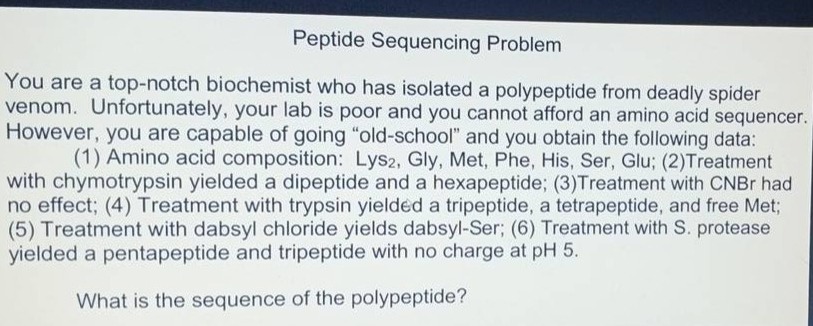
you are a top - notch biochemist who has isolated a polypeptide from deadly spider venom. unfortunately, your lab is poor and you cannot afford an amino acid sequencer. however, you are capable of going “old - school” and you obtain the following data: (1) amino acid composition: lys₂, gly, met, phe, his, ser, glu; (2)treatment with chymotrypsin yielded a dipeptide and a hexapeptide; (3)treatment with cnbr had no effect; (4) treatment with trypsin yielded a tripeptide, a tetrapeptide, and free met; (5) treatment with dabsyl chloride yields dabsyl - ser; (6) treatment with s. protease yielded a pentapeptide and tripeptide with no charge at ph 5.
what is the sequence of the polypeptide?
Step 1: N - terminal determination (Dabsyl - Ser)
Dabsyl - chloride labels the N - terminal amino acid. So the N - terminal is Ser. So the sequence starts with Ser.
Step 2: CNBr effect (no effect)
CNBr cleaves at Met (specifically at the C - terminal of Met, i.e., Met - X where X is not Pro). Since CNBr has no effect, there is no Met in a position where it would be cleaved by CNBr. But we know Met is in the peptide (from amino acid composition: Met is present). Wait, the amino acid composition is Lys₂, Gly, Met, Phe, His, Ser, Glu. Wait, let's recount: Lys (2), Gly (1), Met (1), Phe (1), His (1), Ser (1), Glu (1). Total amino acids: 2 + 1+1 + 1+1 + 1+1=8? Wait, no: Lys₂ (2), Gly (1), Met (1), Phe (1), His (1), Ser (1), Glu (1). So 2 + 1+1+1+1+1+1 = 8? Wait, maybe I miscounted. Wait, Lys₂ (2), Gly (1), Met (1), Phe (1), His (1), Ser (1), Glu (1). So 2+1 = 3, +1 (Met)=4, +1 (Phe)=5, +1 (His)=6, +1 (Ser)=7, +1 (Glu)=8. So 8 amino acids? Wait, but let's check the treatments:
Chymotrypsin: cleaves at aromatic amino acids (Phe, Trp, Tyr) on the carboxyl side. So chymotrypsin treatment gives a dipeptide and a hexapeptide. So the dipeptide must have an aromatic amino acid at the C - terminal (since chymotrypsin cleaves after aromatic). So possible dipeptide: X - Phe (since Phe is aromatic).
Trypsin: cleaves at Lys and Arg (carboxyl side, unless next is Pro). Trypsin treatment gives a tripeptide, a tetrapeptide, and free Met. So Met is free, meaning that Met is at the C - terminal of a trypsin - cleaved fragment? Wait, no: trypsin cleaves at Lys/Arg. So if Met is free, that means that Met is at the C - terminal of a fragment, and the bond before Met is cleaved by trypsin? Wait, no, trypsin cleaves after Lys/Arg. So if Met is free, that implies that there is a Lys or Arg before Met, and trypsin cleaves between Lys/Arg and Met. Wait, but Met is not Lys or Arg. Wait, maybe Met is at the end? Wait, no, the amino acid composition has Met. Wait, let's re - evaluate:
Amino acid composition: Lys (2), Gly, Met, Phe, His, Ser, Glu. So 8 amino acids? Wait, Ser (1), Lys (2), Gly (1), Met (1), Phe (1), His (1), Glu (1). So 1+2 + 1+1+1+1+1=8.
Dabsyl - Ser: N - terminal is Ser. So sequence starts with Ser.
S. protease: yields a pentapeptide and tripeptide with no charge at pH 5. Let's consider the charges: Glu is acidic (negative at pH 5), Lys is basic (positive at pH 5), His: at pH 5, His has a pKa around 6, so at pH 5, His is mostly protonated (positive). So to have no charge, the fragments must have equal positive and negative charges, or neutral amino acids.
Let's start with N - terminal: Ser.
From trypsin: tripeptide, tetrapeptide, free Met. So Met is free, so Met is at the C - terminal of a trypsin - cleaved fragment? Wait, no, trypsin cleaves after Lys/Arg. So if Met is free, that means that there is a Lys/Arg before Met, and trypsin cleaves between Lys/Arg and Met. So Met is at the end of a fragment, and the fragment before is cleaved by trypsin (after Lys/Arg) to release Met. So Met is at the C - terminal of a fragment, and the bond before Met is between Lys/Arg and Met.
From chymotrypsin: dipeptide (X - Phe) and hexapeptide. So dipeptide: X - Phe, hexapeptide: the rest.
Let's list the amino acids: Ser, Lys (2), Gly, Met, Phe, His, Glu.
N - terminal: Ser.
Let's consider the trypsin fragments: tripeptide, tetrapeptide, free Met. So the total length: 3 + 4+1 = 8, which matches. So the fragments are: tripeptide (a), tetrapeptide (b), and Met (c). So a + b + c = 8.
Chymotrypsin: dipeptide (d) and hexapeptide (e). d + e = 8, so d = 2,…

Snap & solve any problem in the app
Get step-by-step solutions on Sovi AI
Photo-based solutions with guided steps
Explore more problems and detailed explanations
Step 1: N - terminal determination (Dabsyl - Ser)
Dabsyl - chloride labels the N - terminal amino acid. So the N - terminal is Ser. So the sequence starts with Ser.
Step 2: CNBr effect (no effect)
CNBr cleaves at Met (specifically at the C - terminal of Met, i.e., Met - X where X is not Pro). Since CNBr has no effect, there is no Met in a position where it would be cleaved by CNBr. But we know Met is in the peptide (from amino acid composition: Met is present). Wait, the amino acid composition is Lys₂, Gly, Met, Phe, His, Ser, Glu. Wait, let's recount: Lys (2), Gly (1), Met (1), Phe (1), His (1), Ser (1), Glu (1). Total amino acids: 2 + 1+1 + 1+1 + 1+1=8? Wait, no: Lys₂ (2), Gly (1), Met (1), Phe (1), His (1), Ser (1), Glu (1). So 2 + 1+1+1+1+1+1 = 8? Wait, maybe I miscounted. Wait, Lys₂ (2), Gly (1), Met (1), Phe (1), His (1), Ser (1), Glu (1). So 2+1 = 3, +1 (Met)=4, +1 (Phe)=5, +1 (His)=6, +1 (Ser)=7, +1 (Glu)=8. So 8 amino acids? Wait, but let's check the treatments:
Chymotrypsin: cleaves at aromatic amino acids (Phe, Trp, Tyr) on the carboxyl side. So chymotrypsin treatment gives a dipeptide and a hexapeptide. So the dipeptide must have an aromatic amino acid at the C - terminal (since chymotrypsin cleaves after aromatic). So possible dipeptide: X - Phe (since Phe is aromatic).
Trypsin: cleaves at Lys and Arg (carboxyl side, unless next is Pro). Trypsin treatment gives a tripeptide, a tetrapeptide, and free Met. So Met is free, meaning that Met is at the C - terminal of a trypsin - cleaved fragment? Wait, no: trypsin cleaves at Lys/Arg. So if Met is free, that means that Met is at the C - terminal of a fragment, and the bond before Met is cleaved by trypsin? Wait, no, trypsin cleaves after Lys/Arg. So if Met is free, that implies that there is a Lys or Arg before Met, and trypsin cleaves between Lys/Arg and Met. Wait, but Met is not Lys or Arg. Wait, maybe Met is at the end? Wait, no, the amino acid composition has Met. Wait, let's re - evaluate:
Amino acid composition: Lys (2), Gly, Met, Phe, His, Ser, Glu. So 8 amino acids? Wait, Ser (1), Lys (2), Gly (1), Met (1), Phe (1), His (1), Glu (1). So 1+2 + 1+1+1+1+1=8.
Dabsyl - Ser: N - terminal is Ser. So sequence starts with Ser.
S. protease: yields a pentapeptide and tripeptide with no charge at pH 5. Let's consider the charges: Glu is acidic (negative at pH 5), Lys is basic (positive at pH 5), His: at pH 5, His has a pKa around 6, so at pH 5, His is mostly protonated (positive). So to have no charge, the fragments must have equal positive and negative charges, or neutral amino acids.
Let's start with N - terminal: Ser.
From trypsin: tripeptide, tetrapeptide, free Met. So Met is free, so Met is at the C - terminal of a trypsin - cleaved fragment? Wait, no, trypsin cleaves after Lys/Arg. So if Met is free, that means that there is a Lys/Arg before Met, and trypsin cleaves between Lys/Arg and Met. So Met is at the end of a fragment, and the fragment before is cleaved by trypsin (after Lys/Arg) to release Met. So Met is at the C - terminal of a fragment, and the bond before Met is between Lys/Arg and Met.
From chymotrypsin: dipeptide (X - Phe) and hexapeptide. So dipeptide: X - Phe, hexapeptide: the rest.
Let's list the amino acids: Ser, Lys (2), Gly, Met, Phe, His, Glu.
N - terminal: Ser.
Let's consider the trypsin fragments: tripeptide, tetrapeptide, free Met. So the total length: 3 + 4+1 = 8, which matches. So the fragments are: tripeptide (a), tetrapeptide (b), and Met (c). So a + b + c = 8.
Chymotrypsin: dipeptide (d) and hexapeptide (e). d + e = 8, so d = 2, e = 6.
Dabsyl - Ser: N - terminal is Ser, so Ser is in the first position.
Let's assume the sequence is Ser - X - X - X - X - X - X - Met? No, because trypsin gives free Met, so Met is at the end? Wait, no, trypsin cleaves after Lys/Arg. So if Met is free, then the last amino acid is Met, and before Met is a Lys/Arg, which is cleaved by trypsin. So sequence ends with Lys/Arg - Met? But Met is free, so Lys/Arg - Met, and trypsin cleaves between Lys/Arg and Met, releasing Met. So Met is at the C - terminal? Wait, no, if Met is free, that means Met is not part of a longer peptide, so Met is the last amino acid. So sequence ends with Met.
Wait, but amino acid composition has Met, so Met is in the sequence, and trypsin releases free Met, so Met is at the C - terminal, and before Met is a Lys (since Lys is basic, trypsin cleaves after Lys). So Lys - Met, and trypsin cleaves between Lys and Met, releasing Met. So Met is at position 8, and position 7 is Lys.
Now, N - terminal: Ser (position 1).
From chymotrypsin: dipeptide (X - Phe) and hexapeptide. So Phe is at position 2 or 7? No, position 7 is Lys (from above). So Phe is at position 2: Ser - Phe - X - X - X - X - X - Met? No, dipeptide is 2 amino acids, so X - Phe, so positions 1 - 2: Ser - Phe? But dabsyl - Ser is position 1, so position 1 is Ser, position 2 is Phe: dipeptide Ser - Phe, and hexapeptide is positions 3 - 8.
Now, hexapeptide: positions 3 - 8: X - X - X - X - X - Met (position 8 is Met, position 7 is Lys, so position 7: Lys, position 8: Met. So hexapeptide is positions 3 - 8: X - X - X - X - Lys - Met.
Trypsin treatment: tripeptide, tetrapeptide, free Met. So the hexapeptide (positions 3 - 8: 6 amino acids) and dipeptide (positions 1 - 2: 2 amino acids). Trypsin cleaves the hexapeptide? Wait, no, the total peptide is 8 amino acids: dipeptide (2) + hexapeptide (6) = 8. Trypsin treatment: tripeptide (3) + tetrapeptide (4) + free Met (1) = 8. So the dipeptide (2) and hexapeptide (6) must be split by trypsin into tripeptide (3), tetrapeptide (4), and free Met (1). So dipeptide (2) + part of hexapeptide (1) = tripeptide, and the rest of hexapeptide (5) = tetrapeptide? No, 2 + 6 = 8; 3+4 + 1=8. So 2 (dipeptide) + 1 (from hexapeptide) = 3 (tripeptide), and 5 (from hexapeptide) = 4? No, 5≠4. Wait, maybe my initial assumption is wrong.
Alternative approach:
Amino acids: Ser, Lys (2), Gly, Met, Phe, His, Glu.
N - terminal: Ser (Dabsyl - Ser).
Trypsin: cleaves after Lys/Arg. So fragments: tripeptide (a), tetrapeptide (b), free Met (c). So a has length 3, b has length 4, c has length 1 (Met). So a + b + c = 8.
Chymotrypsin: cleaves after Phe, Trp, Tyr. So fragments: dipeptide (d: X - Phe) and hexapeptide (e: 6 amino acids). d + e = 8.
S. protease: pentapeptide and tripeptide, no charge at pH 5. Let's consider the charges:
Glu (E): - 1 at pH 5.
Lys (K): + 1 at pH 5.
His (H): + 1 at pH 5 (since pKa ~ 6, at pH 5, protonated).
Gly (G): 0.
Met (M): 0.
Phe (F): 0.
Ser (S): 0.
So to have no charge, the number of positive charges (Lys, His) must equal negative charges (Glu).
Let's build the sequence:
N - terminal: Ser (S).
From chymotrypsin: dipeptide is X - Phe (F). So S - F? Or another X - F. But N - terminal is S, so dipeptide could be S - F (positions 1 - 2), then hexapeptide is positions 3 - 8.
Hexapeptide: positions 3 - 8 (6 amino acids): contains Lys (2), Gly (G), Met (M), His (H), Glu (E).
Trypsin: tripeptide, tetrapeptide, free Met. So Met is free, so M is at position 8, and before M is a Lys (K), so position 7: K, position 8: M (since trypsin cleaves after K, releasing M).
So hexapeptide: positions 3 - 8: X - X - X - X - K - M.
Now, the hexapeptide (positions 3 - 8) has 6 amino acids: positions 3,4,5,6,7,8 (K at 7, M at 8). So positions 3 - 6: X - X - X - X (4 amino acids), which are G, H, E, and one K (since total Lys is 2: one at position 7, one in positions 3 - 6).
Trypsin fragments: tripeptide (3 amino acids), tetrapeptide (4 amino acids), free M (1). So the dipeptide (S - F, 2 amino acids) + 1 amino acid from hexapeptide (position 3) = tripeptide (3 amino acids: S - F - X), and the remaining hexapeptide (positions 4 - 8: 5 amino acids? No, 6 - 1 = 5, but tetrapeptide is 4. Wait, this is confusing. Let's try another way.
Total amino acids: S, K, K, G, M, F, H, E (8 amino acids).
N - terminal: S.
Trypsin: cleaves after K. So possible cleavage sites: after K1 and K2.
Trypsin gives tripeptide, tetrapeptide, free M. So the fragments are:
- Tripeptide: S - X - X (since N - terminal is S)
- Tetrapeptide: X - X - X - X
- Free M: M
So the sequence is Tripeptide - Tetrapeptide - M? No, because M is free, so the sequence is Tripeptide - Tetrapeptide - M, with a cleavage between Tetrapeptide and M (by trypsin, so Tetrapeptide ends with K, and M is after K). So Tetrapeptide: X - X - X - K, then M.
Tripeptide: S - X - X (length 3), Tetrapeptide: X - X - X - K (length 4), M (length 1). Total: 3 + 4+1 = 8.
Chymotrypsin: cleaves after F. Chymotrypsin gives dipeptide (X - F) and hexapeptide. So dipeptide is X - F, hexapeptide is the rest.
Dipeptide length 2: X - F. So X is S? So S - F (dipeptide), then hexapeptide is positions 3 - 8 (6 amino acids: K, K, G, H, E, M? No, M is free. Wait, M is at the end, so hexapeptide is positions 3 - 7 (5 amino acids) + M? No, M is free.
Wait, let's use the S. protease information: pentapeptide and tripeptide, no charge at pH 5.
Pentapeptide and tripeptide: 5 + 3 = 8.
No charge at pH 5: so in pentapeptide and tripeptide, the number of positive charges (K, H) equals negative charges (E).
Let's assume the tripeptide is S - F - X (from chymotrypsin dipeptide S - F, then +1 amino acid). The pentapeptide is the rest: K, K, G, H, E, M? No, 5 amino acids. Wait, total amino acids: 8, so tripeptide (3) + pentapeptide (5) = 8.
Tripeptide: S - F - K (since K is positive, and F is aromatic, chymotrypsin cleaves after F, so S - F is dipeptide, then K is next, making tripeptide S - F - K (3 amino acids).
Pentapeptide: G, H, E, K, M? No, M is free. Wait, M is free, so pentapeptide is G, H, E, K, and one more? No, 5 amino acids: G, H, E, K, and X? Wait, total amino acids: S, F, K (tripeptide), then G, H, E, K, M (pentapeptide? No, 3 + 5 = 8, but M is free. Wait, M is free, so pentapeptide is 5, tripeptide is 3, and M is 1: 5 + 3+1 = 9, which is wrong. I must have made a mistake in the number of amino acids. Wait, amino acid composition: Lys₂ (2), Gly (1), Met (1), Phe (1), His (1), Ser (1), Glu (1). So 2 + 1+1+1+1+1+1 = 8. So 8 amino acids. So trypsin: tripeptide (3) + tetrapeptide (4) + free M (1) = 8. Correct. Chymotrypsin: dipeptide (2) + hexapeptide (6) = 8. Correct. S. protease: pentapeptide (5) + tripeptide (3) = 8. Correct.
Let's list all amino acids with their single - letter codes: S (Ser), K (Lys), K (Lys), G (Gly), M (Met), F (Phe), H (His), E (Glu).
N - terminal: S (Dabsyl - Ser).
Chymotrypsin cleaves after F, so dipeptide is X - F. So X is S (N - terminal), so dipeptide: S - F (positions 1 - 2). Hexapeptide: positions 3 - 8 (K, K, G, M, H, E? No, M is free. Wait, M is free, so M is at position 8, and hexapeptide is positions 3 - 7 (5 amino acids? No, hexapeptide is 6. I'm stuck. Let's use the S. protease information: no charge at pH 5. So the pentapeptide and tripeptide have equal positive and negative charges.
Glu (E) is - 1, Lys (K) is + 1, His (H) is + 1 (at pH 5). So for no charge: number of E = number of (K + H).
Let's consider the tripeptide and pentapeptide:
Case 1: Tripeptide has 1 E, pentapeptide has 1 (K + H). But total E is 1, total K is 2, total H is 1.
Case 2: Tripeptide has 0 E, pentapeptide has 1 E and 1 (K + H). But 1 E and 1 (K + H) gives 0 charge ( - 1+1 = 0). Wait, 1 E (-1) and 1 (K or H) (+1) gives 0. Or 1 E and 2 (K/H) (+2) gives +1, which is charged. So better: 1 E and 1 (K + H) (total +1 - 1 = 0).
Total E: 1, so pentapeptide has 1 E, tripeptide has 0 E.
Total K: 2, H: 1. So pentapeptide has 1 E, and (K + H) = 1 (so 1 K or 1 H). Tripeptide has 0 E, and (K + H) = 2 (since total K + H =